Korean Reading Practice: Elementary
Elementary Korean reading means short connected passages a step above beginner, built from common words and past-tense sentences. Read for the gist, then reread for the connectors that show the order of events.
Level: TOPIK 2. Elementary reading is one step past the beginner self-introduction. The sentences are still short, but now they connect: things happen in order, in the past, and the connectors tell you what came first.
By the end of this page you can…
…read a short account of someone’s weekend, follow the order of events, and answer questions about it.
How to read an elementary text
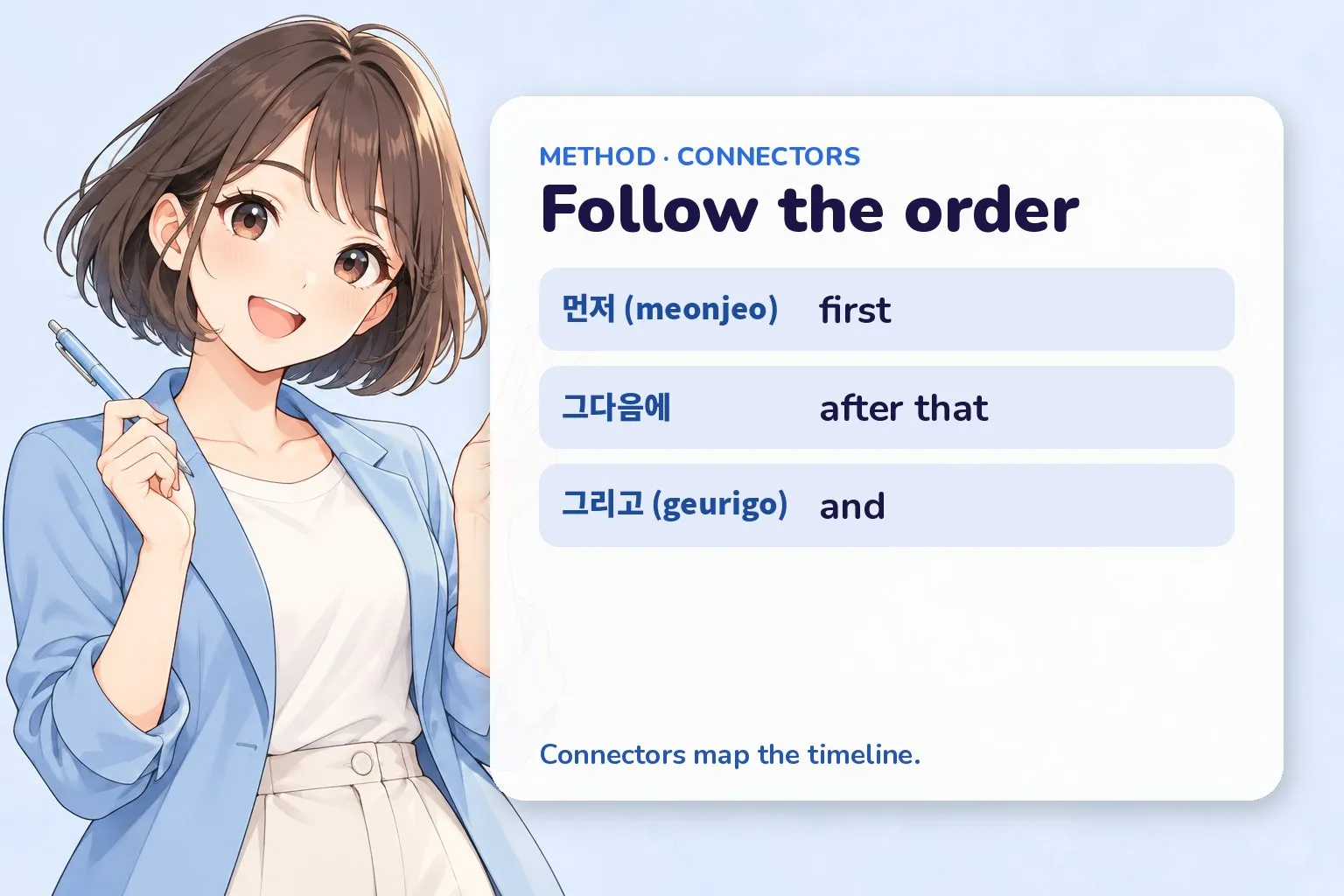
Keep the same three habits as at beginner level, with one addition: track the connectors. Words like 먼저 (meonjeo, “first”), 그다음에 (geudaeume, “after that”) and 그리고 (geurigo, “and”) carry the timeline, so spotting them tells you the sequence even before you know every word.
The graded text
Read this short account of a weekend one line at a time. Each line shows the Korean, its romanisation, and the English.
- 지난 토요일에 친구하고 서울에 갔어요.Jinan toyoire chinguhago Seoure gasseoyo.Last Saturday I went to Seoul with a friend.past tense + 하고 for 'with'
- 아침 일찍 지하철을 탔어요.Achim iljjik jihacheoreul tasseoyo.We took the subway early in the morning.
- 먼저 오래된 궁을 봤어요.Meonjeo oraedoen gungeul bwasseoyo.First we saw an old palace.먼저 = 'first'
- 그다음에 공원에서 김밥을 먹었어요.Geudaeume gongwoneseo gimbabeul meogeosseoyo.After that we ate gimbap in the park.그다음에 = 'after that'
- 날씨가 좋아서 정말 기분이 좋았어요.Nalssiga joaseo jeongmal gibuni joasseoyo.The weather was nice, so we felt really good.-아서 = 'because/so'
- 그리고 선물을 샀어요.Geurigo seonmureul sasseoyo.And we bought gifts.그리고 = 'and'
- 친구는 작은 인형을 샀어요.Chinguneun jageun inhyeongeul sasseoyo.My friend bought a small doll.
- 저는 예쁜 엽서를 골랐어요.Jeoneun yeppeun yeopseoreul gollasseoyo.I chose a pretty postcard.
- 저녁에 조금 피곤했지만 즐거웠어요.Jeonyeoge jogeum pigonhaetjiman jeulgeowosseoyo.In the evening I was a bit tired, but it was enjoyable.-지만 = 'but'
- 다음에 또 서울에 가고 싶어요.Daeume tto Seoure gago sipeoyo.I want to go to Seoul again next time.
Key vocabulary
These are some of the most common elementary words in the text.
| Word | Romanisation | English |
|---|---|---|
| 토요일 | toyoil | Saturday |
| 지하철 | jihacheol | subway |
| 궁 | gung | palace |
| 공원 | gongwon | park |
| 김밥 | gimbap | gimbap (rice roll) |
| 날씨 | nalssi | weather |
| 선물 | seonmul | gift |
| 엽서 | yeopseo | postcard |
| 저녁 | jeonyeok | evening |
| 피곤했어요 | pigonhaesseoyo | was tired |
Check you understood
- Where did the writer go, and with whom? (To Seoul, with a friend.)
- What did they do first? (Saw an old palace.)
- What did they eat, and where? (Gimbap, in the park.)
- What did each person buy? (The friend a small doll; the writer a postcard.)
- How did the writer feel in the evening? (A bit tired, but it was enjoyable.)
Extension: read a little more every day
Once this passage feels easy, change the goal rather than the text at first: read it aloud for smooth rhythm, then cover the English and translate each line yourself, then retell the weekend from memory in your own short sentences. When you are ready for new material, choose TOPIK 2 graded readers or simple diary-style posts, and keep each session short.
Practice
Elementary reading practice
Try each one, then press Check. No sign-up, nothing is sent anywhere — it all runs in your browser.
Hint: starts with m
Show answer
meonjeo — 먼저 (meonjeo) means 'first' and marks the first event.
3 Match each word with its meaning.
- 궁 (gung)
- 공원 (gongwon)
- 선물 (seonmul)
- 엽서 (yeopseo)
Show answer
- 궁 (gung) → palace
- 공원 (gongwon) → park
- 선물 (seonmul) → gift
- 엽서 (yeopseo) → postcard
These are common elementary words from the text.
Quick recap before you practise.
Quiz
Elementary reading quiz
7 questions · pick an answer and you'll see straight away if it's right.
-
Show answer
reread a short passage with a new goal each pass — Short connected texts, reread with a purpose, build elementary reading best.
-
Show answer
a friend — 친구하고 서울에 갔어요 (chinguhago Seoure gasseoyo) = 'went to Seoul with a friend'.
-
Show answer
after that — 그다음에 (geudaeume) means 'after that'.
-
Show answer
saw an old palace — 먼저 오래된 궁을 봤어요 (meonjeo oraedoen gungeul bwasseoyo) = 'first we saw an old palace'.
-
Show answer
gift — 선물 (seonmul) means gift.
-
Show answer
a postcard — 예쁜 엽서를 골랐어요 (yeppeun yeopseoreul gollasseoyo) = 'chose a pretty postcard'.
-
Show answer
they reveal the order of events — 먼저 (meonjeo), 그다음에 (geudaeume), 그리고 (geurigo) map the timeline, so the story makes sense early.
Next
- Build the grammar behind the sentences in the Korean grammar section
- Warm up with the beginner text first: Korean Reading Practice: Beginner
- New here? Start with Start Learning Korean Here
All Korean practice topics
Vocabulary, pronunciation, phrases, practice and exam help, ordered by level. Pick a topic and go straight to it. New lessons go live every day, so topics marked Coming soon fill in over the next weeks.
Practice
TOPIK 1 3 topics · 1 ready
- 01 Korean Reading Practice: Beginner
- 02 Hangul Reading Fluency Practice Coming soon
- 03 Batchim Pronunciation Drills Coming soon
TOPIK 2 3 topics · 2 ready
- 04 How to Practise Korean Listening
- 05 Korean Reading Practice: Elementary You are here
- 06 Korean Particles Review Set Coming soon
TOPIK 3 5 topics · 2 ready
- 07 Shadowing to Improve Korean Speaking
- 08 Korean Reading Practice: Intermediate
- 09 How to Practise Korean Writing Coming soon
- 10 Korean Honorifics Practice Set Coming soon
- 11 Korean Speech Levels Practice Coming soon