Korean Reading Practice: Upper-Intermediate
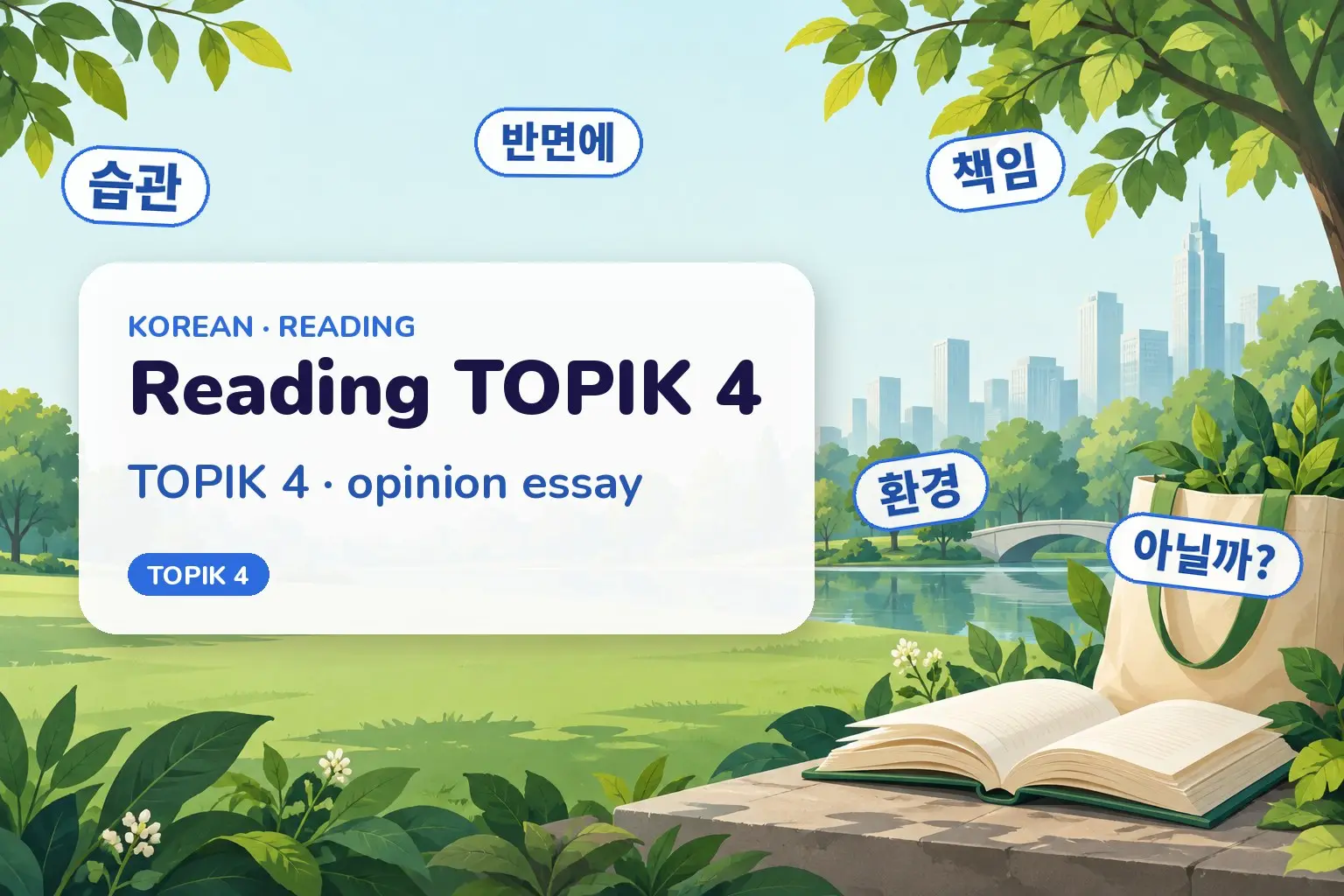
Upper-intermediate Korean reading (TOPIK 4) means short opinion essays that weigh two sides. The new skill is following the argument through connectors like 반면에 (banmyeone, 'on the other hand') and hedged endings like 아닐까? (anilkka?, 'isn't it?').
Level: TOPIK 4. Upper-intermediate reading is a real step up from intermediate: the text is now a short opinion essay, and the writer weighs one side against another. The skill is to follow the argument, not just the events.
By the end of this page you can…
…read a short TOPIK 4 opinion essay about cutting single-use products, follow how the writer balances individual and collective responsibility, and answer questions about the writer’s position.
How to read an upper-intermediate text
At this level, meaning hangs on connectors and hedged endings. Learn the signposts and a dense paragraph opens up: 그러나 (geureona, “but”) and 반면에 (banmyeone, “on the other hand”) pivot to the opposite side, 그렇다고 해서 (geureotago haeseo, “that said”) blocks a hasty conclusion, and the ending 것은 아니다 (geoseun anida) means “it is not that…”. Writers also soften claims with 아닐까? (anilkka?, “isn’t it?”) and mark cause with 때문이다 (ttaemunida, “that is because”). Keep reading to the end of each sentence, because the Korean verb — and the writer’s real point — comes last.
The graded text
Read this short essay one line at a time. Each line shows the Korean, its romanisation, and the English.
- 요즘 환경 문제에 관심을 가지는 사람이 많아지고 있다.Yojeum hwangyeong munjee gwansimeul gajineun sarami manajigo itda.These days, more and more people are taking an interest in environmental problems.
- 특히 일회용품 사용을 줄이자는 목소리가 커지고 있다.Teukhi ilhoeyongpum sayong-eul jurijaneun moksoriga keojigo itda.In particular, the call to reduce the use of single-use products is growing louder.
- 과거에는 편리함이 가장 중요하다고 여겨졌다.Gwageoeneun pyeollihami gajang jungyohadago yeogyeojyeotda.In the past, convenience was considered the most important thing.여겨졌다 = passive, 'was considered'
- 그러나 환경을 생각하면 편리함만 추구할 수는 없다.Geureona hwangyeong-eul saenggakamyeon pyeollihamman chuguhal suneun eopda.But if we think of the environment, we cannot pursue convenience alone.그러나 = 'but'
- 예를 들어, 장바구니를 사용하면 비닐봉지를 줄일 수 있다.Yereul deureo, jangbagunireul sayonghamyeon binilbongjireul juril su itda.For example, if you use a shopping basket, you can cut down on plastic bags.
- 반면에, 모든 책임을 개인에게만 맡기는 것은 문제가 있다.Banmyeone, modeun chaegimeul gaeinegeman matgineun geoseun munjega itda.On the other hand, leaving all the responsibility to individuals alone is a problem.반면에 = 'on the other hand'
- 기업과 정부의 노력도 반드시 필요하기 때문이다.Gieopgwa jeongbu-ui noryeokdo bandeusi piryohagi ttaemunida.That is because the efforts of companies and the government are also essential.기 때문이다 = 'that is because'
- 그렇다고 해서 개인이 할 일이 없는 것은 아니다.Geureotago haeseo gaeini hal iri eomneun geoseun anida.That said, it is not that individuals have nothing to do.것은 아니다 = 'it is not that…'
- 작은 습관이 모이면 큰 변화를 만들 수 있다.Jageun seupgwani moimyeon keun byeonhwareul mandeul su itda.When small habits add up, they can create big change.
- 결국 중요한 것은 함께 실천하려는 태도가 아닐까?Gyeolguk jungyohan geoseun hamkke silcheonharyeoneun taedoga anilkka?In the end, what matters is surely the attitude of acting together, isn't it?아닐까? = a softened claim
- 앞으로 더 많은 사람들이 동참하기를 기대한다.Apeuro deo maneun saramdeuri dongchamhagireul gidaehanda.I hope that more people will take part from now on.
Key vocabulary
These are some of the most useful upper-intermediate words in the essay.
| Word | Reading | English |
|---|---|---|
| 환경 | hwangyeong | environment |
| 일회용품 | ilhoeyongpum | single-use product |
| 편리함 | pyeolliham | convenience |
| 추구하다 | chuguhada | to pursue |
| 비닐봉지 | binilbongji | plastic bag |
| 책임 | chaegim | responsibility |
| 노력 | noryeok | effort |
| 습관 | seupgwan | habit |
| 실천 | silcheon | practice, putting into action |
| 동참 | dongcham | taking part |
Check you understood
- What are more people taking an interest in? (Environmental problems, 환경 문제 (hwangyeong munje).)
- What was considered most important in the past? (Convenience, 편리함 (pyeolliham).)
- What everyday example does the writer give? (Using a shopping basket to cut plastic bags.)
- Does the writer blame only individuals? (No — companies and government 노력 (noryeok), “effort”, is essential too.)
- What does the writer say matters in the end? (The attitude of acting together, 함께 (hamkke).)
Extension: read a little more every day
Once this essay feels easy, change the goal rather than the text at first: read it aloud for smooth rhythm, then cover the English and translate each line, then summarise the writer’s argument in one sentence of your own. When you are ready for new material, choose TOPIK 4 graded readers, newspaper opinion columns (사설 (saseol), “editorials”) or essay blogs, and keep each session short. If you want to warm up on something gentler first, revisit the intermediate reading passage.
Practice
Upper-intermediate reading practice
Try each one, then press Check. No sign-up, nothing is sent anywhere — it all runs in your browser.
Hint: ban-myeon-e
Show answer
banmyeone — 반면에 (banmyeone) = 'on the other hand'.
3 Match each word with its meaning.
- 환경 (hwangyeong)
- 책임 (chaegim)
- 습관 (seupgwan)
- 동참 (dongcham)
Show answer
- 환경 (hwangyeong) → environment
- 책임 (chaegim) → responsibility
- 습관 (seupgwan) → habit
- 동참 (dongcham) → taking part
These are common TOPIK 4 nouns from the essay.
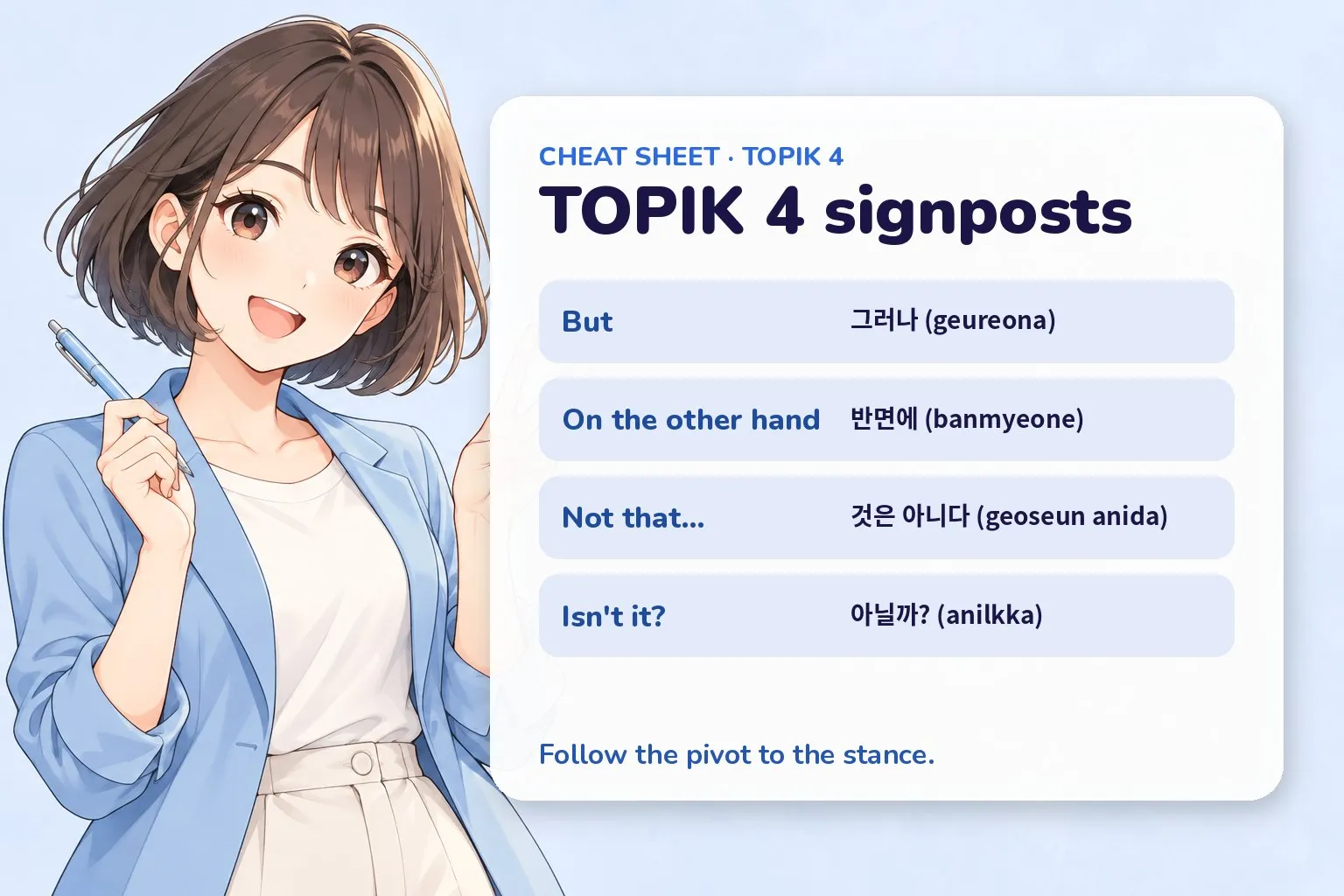
Quick recap before you practise.
Quiz
Upper-intermediate reading quiz
7 questions · pick an answer and you'll see straight away if it's right.
-
Show answer
reread a short essay with a new goal each pass — Reread a short argument with a purpose each pass: gist, grammar, then the writer's stance.
-
Show answer
environmental problems — 환경 문제에 관심을 가지는 사람이 많아지고 있다 (hwangyeong munjee gwansimeul gajineun sarami manajigo itda).
-
Show answer
but — 그러나 (geureona) = 'but', a pivot to a contrasting idea.
-
Show answer
using a shopping basket to cut plastic bags — 장바구니를 사용하면 비닐봉지를 줄일 수 있다 (jangbagunireul sayonghamyeon binilbongjireul juril su itda).
-
Show answer
companies and the government — 기업과 정부의 노력도 반드시 필요하기 때문이다 (gieopgwa jeongbu-ui noryeokdo bandeusi piryohagi ttaemunida).
-
Show answer
the attitude of acting together — 함께 실천하려는 태도 (hamkke silcheonharyeoneun taedo) = 'the attitude of acting together'.
-
Show answer
they show the writer's stance and how the sides relate — Connectors like 반면에 (banmyeone) and endings like 아닐까? (anilkka?) carry the argument.
Next
- Build the grammar behind the sentences in the Korean grammar section
- Warm up with the intermediate text first: Korean Reading Practice: Intermediate
- New here? Start with Start Learning Korean Here
All Korean practice topics
Vocabulary, pronunciation, phrases, practice and exam help, ordered by level. Pick a topic and go straight to it. New lessons go live every day, so topics marked Coming soon fill in over the next weeks.
Practice
TOPIK 1 3 topics · 1 ready
- 01 Korean Reading Practice: Beginner
- 02 Hangul Reading Fluency Practice Coming soon
- 03 Batchim Pronunciation Drills Coming soon
TOPIK 2 3 topics · 2 ready
- 04 How to Practise Korean Listening
- 05 Korean Reading Practice: Elementary
- 06 Korean Particles Review Set Coming soon
TOPIK 3 5 topics · 2 ready
- 07 Shadowing to Improve Korean Speaking
- 08 Korean Reading Practice: Intermediate
- 09 How to Practise Korean Writing Coming soon
- 10 Korean Honorifics Practice Set Coming soon
- 11 Korean Speech Levels Practice Coming soon
TOPIK 4 1 topics · 1 ready
- 12 Korean Reading Practice: Upper-Intermediate You are here