Indonesian Reading Practice: Elementary
This page gives you two short, original Indonesian texts at elementary level, with the new words glossed and comprehension questions. Read each text first for the general idea, then again slowly, and check the word list only when you are stuck.
Level: Elementary. At this level the texts get a little longer and talk about different times — yesterday, now, and later. Below are two short passages written for elementary learners, with the new words explained and questions to check what you understood.
By the end of this page you can…
…read two short elementary Indonesian texts, follow the time words, work out the new words, and answer comprehension questions.
How to use this page
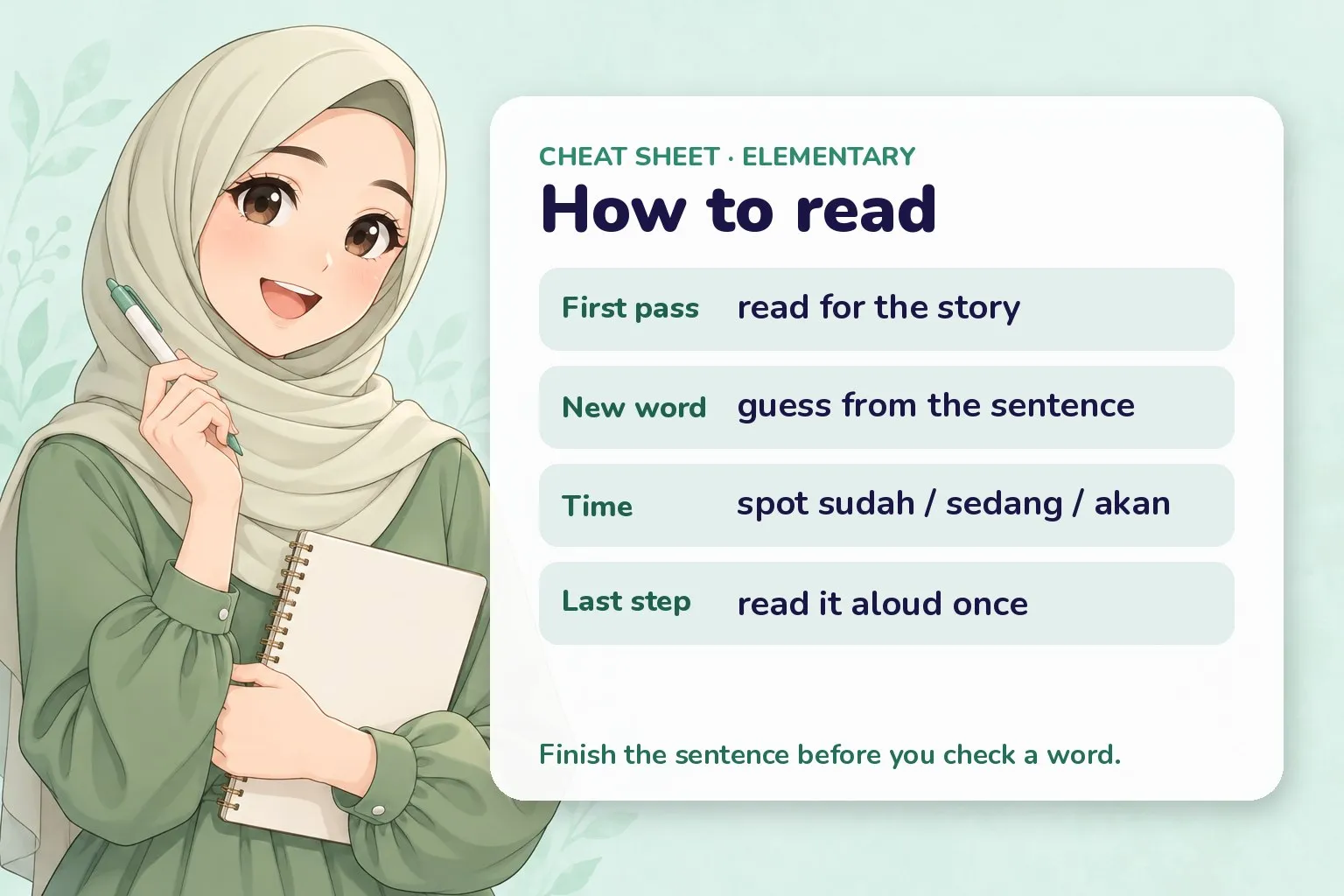
- Read once for the gist. Do not stop at every word. What happens? Who is in it?
- Read again, slowly. Guess new words from the sentence around them.
- Check the word list under each text — only for the words you could not guess.
- Read it aloud once, or play the audio sentences, so you hear the words too.
- Answer the questions at the bottom without looking back, then check.
Reading 1: Akhir pekan Dewi
Akhir pekan lalu Dewi pergi ke Bandung. Dia mengunjungi temannya, Sari. Hari Sabtu pagi mereka sarapan bersama, lalu pergi ke pusat kota.
Cuaca tidak bagus. Hujan turun, jadi mereka masuk ke sebuah museum. Di sana mereka melihat banyak lukisan yang indah. Setelah itu mereka makan es krim, walaupun udara dingin.
Hari Minggu Dewi sudah pulang ke rumah naik kereta. Dia agak lelah, tetapi sangat senang. “Lain kali saya akan tinggal lebih lama,” katanya.
New words (Reading 1)
| Word | Meaning | Example from the text |
|---|---|---|
| akhir pekan lalu | last weekend | Akhir pekan lalu Dewi pergi ke Bandung. |
| mengunjungi | to visit (base: kunjung) | Dia mengunjungi temannya. |
| lalu | then, next | …lalu pergi ke pusat kota. |
| hujan turun | it rained (rain fell) | Hujan turun. |
| jadi | so, therefore | Jadi mereka masuk ke museum. |
| setelah itu | after that | Setelah itu mereka makan es krim. |
| lain kali | next time | Lain kali saya akan tinggal lebih lama. |
Reading 2: Pesan untuk seorang teman
Halo Budi,
apa kabar? Saya baik-baik saja. Saya sudah menemukan apartemen baru, karena apartemen lama saya terlalu kecil. Yang baru lebih besar dan punya balkon.
Minggu lalu saya membawa banyak kardus. Itu melelahkan! Adik saya membantu saya, jadi lebih cepat. Malam hari kami memesan pizza.
Apakah kamu mau mengunjungi saya? Kamu bisa datang akhir pekan ini. Kita bisa memasak bersama dan menonton film. Tolong balas pesan saya, ya!
Salam, Andi
New words (Reading 2)
| Word | Meaning | Example from the text |
|---|---|---|
| menemukan | to find (base: temu) | Saya sudah menemukan apartemen baru. |
| karena | because | …karena apartemen lama terlalu kecil. |
| membawa | to carry / bring (base: bawa) | Saya membawa banyak kardus. |
| melelahkan | tiring, exhausting | Itu melelahkan! |
| membantu | to help (base: bantu) | Adik saya membantu saya. |
| memesan | to order (base: pesan) | Kami memesan pizza. |
| balas | to reply | Tolong balas pesan saya. |
How to say it
Indonesian spelling is consistent — one sound per letter — but watch these:
- c is always “ch”: cuaca (“weather”) ≈ “chu-AH-cha”.
- ng is one soft sound as in “singer”: mengunjungi keeps a smooth ng.
- e can be a light “uh” (pekan ≈ “PUH-kan”) or a clear “e” (es krim); listen for both.
- Stress is light, usually on the second-to-last syllable; nothing is drawn out.
Example sentences
Listen to key sentences from the texts, then read them aloud.
- Akhir pekan lalu Dewi pergi ke Bandung.Last weekend Dewi went to Bandung.lalu = last/past time word
- Dia mengunjungi temannya, Sari.She visited her friend, Sari.
- Hujan turun, jadi mereka masuk ke museum.It rained, so they went into a museum.
- Setelah itu mereka makan es krim.After that they ate ice cream.
- Saya sudah menemukan apartemen baru.I have found a new apartment.sudah = already
- Apartemen lama saya terlalu kecil.My old apartment is too small.
- Adik saya membantu saya.My younger sibling helped me.
- Apakah kamu mau mengunjungi saya?Do you want to visit me?
- Kita bisa memasak bersama.We can cook together.
Quick recap before you answer the questions.
Comprehension practice
Reading comprehension practice
Try each one, then press Check. No sign-up, nothing is sent anywhere — it all runs in your browser.
Hint: to go home
Show answer
pulang — On Sunday Dewi went home by train: pulang.
Hint: a round Italian dish
Show answer
pizza — In the evening they ordered pizza.
5 Match each meN- verb to its base word.
- mengunjungi
- menemukan
- membawa
- membantu
Show answer
- mengunjungi → kunjung
- menemukan → temu
- membawa → bawa
- membantu → bantu
Each verb is built on a base word that carries the meaning.
6 Put Dewi's weekend in order.
Show answer
pergi ke Bandung mengunjungi Sari masuk ke museum pulang ke rumah — To Bandung, visit Sari, the museum, then home on Sunday.
Quiz
Elementary Indonesian reading quiz
8 questions · pick an answer and you'll see straight away if it's right.
-
Show answer
temannya, Sari — She visited her friend Sari.
-
Show answer
es krim — After the museum they ate ice cream, even though it was cold.
-
Show answer
tidak bagus, hujan turun — The weather was not good; it rained.
-
Show answer
balkon — The new apartment is bigger and has a balcony.
-
Show answer
adiknya — His younger sibling helped him, so it went faster.
-
Show answer
so / therefore — jadi links a cause to a result: so, therefore.
-
Show answer
sudah terjadi — sudah = already; it marks something that has happened.
-
Show answer
membaca sekali untuk idenya — Read for the gist first; check only the words you cannot guess.
Next
- Build the grammar: Indonesian Personal Pronouns
- Review sentences: Sentences Without ‘To Be’
- Practise hearing it: How to Practise Indonesian Listening
All Indonesian practice topics
Vocabulary, pronunciation, phrases, practice and exam help, ordered by level. Pick a topic and go straight to it. New lessons go live every day, so topics marked Coming soon fill in over the next weeks.
Practice
Beginner 1 topics · 1 ready
Elementary 2 topics · 2 ready
- 02 How to Practise Indonesian Listening
- 03 Indonesian Reading Practice: Elementary You are here
Intermediate 5 topics · 2 ready
- 04 Shadowing to Improve Indonesian Speaking
- 05 Indonesian Reading Practice: Intermediate
- 06 How to Practise Indonesian Writing Coming soon
- 07 Indonesian me- Verb Practice Coming soon
- 08 Indonesian di-/ter- Passive Practice Coming soon