Indonesian Reading Practice: Upper-Intermediate
This page gives you two original Indonesian texts at upper-intermediate level — an opinion piece and a personal email — each with the harder words glossed and comprehension questions. Read first for the main argument, then again slowly, checking the word list only when a sentence will not click.
Level: Upper-Intermediate. At this level Indonesian texts argue a point, weigh two sides and use prefixed verbs freely. Below are two original passages — an opinion piece and a personal email — with the harder words explained and questions to check what you understood.
By the end of this page you can…
…read two upper-intermediate Indonesian texts that argue both sides of an issue, recognise me-/di- verbs and conditionals, work out new words from context, and answer comprehension questions.
How to use this page
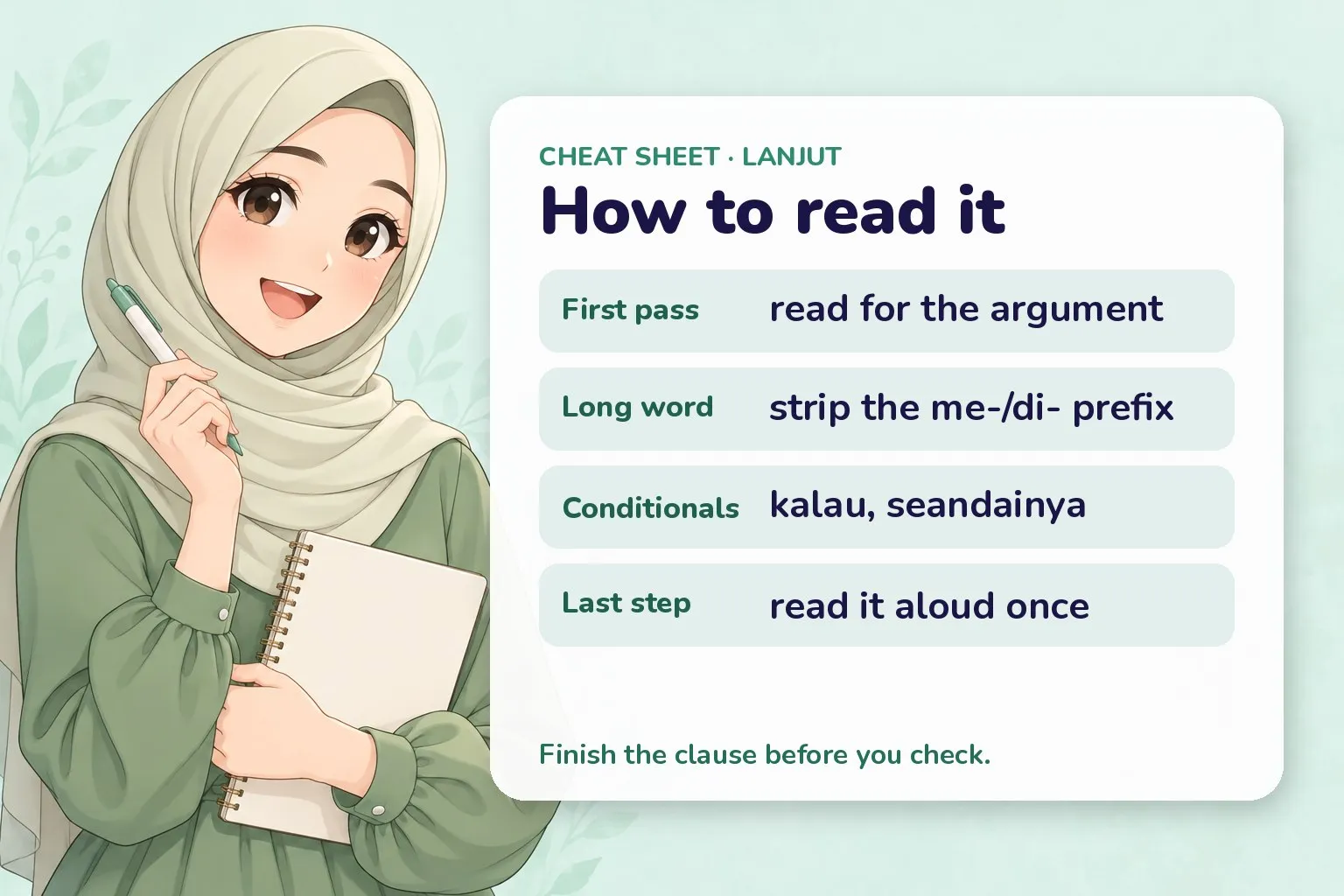
- Read once for the argument. What is the issue, and what does the writer think about it?
- Read again, slowly. Follow the signposts (di satu sisi … di sisi lain, namun, karena itu) to see how the argument is built.
- Check the word list under each text — only for words you could not guess.
- Read it aloud once, or play the audio sentences, so you hear the rhythm too.
- Answer the questions at the bottom without looking back, then check.
Reading 1: Media sosial: untung atau rugi?
Media sosial sudah menjadi bagian penting dalam kehidupan sehari-hari. Banyak orang menggunakannya untuk tetap berhubungan dengan teman, mencari informasi, atau menjual barang. Namun, tidak sedikit pula yang merasa bahwa media sosial justru membuat mereka lebih cemas.
Di satu sisi, platform ini memudahkan kita berkomunikasi tanpa batas jarak. Seorang pedagang kecil kini bisa memasarkan produknya ke seluruh Indonesia hanya melalui telepon genggam. Di sisi lain, banyak pengguna membandingkan hidup mereka dengan kehidupan orang lain yang terlihat sempurna di layar, padahal belum tentu sesuai dengan kenyataan.
Menurut saya, masalahnya bukan pada teknologinya, melainkan pada cara kita menggunakannya. Jika kita bisa membatasi waktu dan memilih informasi dengan bijak, media sosial akan tetap bermanfaat. Yang penting, kita tidak melupakan hubungan di dunia nyata.
New words (Reading 1)
| Word | Meaning | Example from the text |
|---|---|---|
| menggunakan | to use | Banyak orang menggunakannya. |
| cemas | anxious | …membuat mereka lebih cemas. |
| memasarkan | to market, sell | …bisa memasarkan produknya. |
| membandingkan | to compare | …membandingkan hidup mereka. |
| padahal | whereas, even though | …padahal belum tentu benar. |
| membatasi | to limit | …jika kita bisa membatasi waktu. |
| bermanfaat | useful, beneficial | Media sosial akan tetap bermanfaat. |
Reading 2: Sebuah email tentang pindah ke kota
Halo Rina,
Aku mau cerita tentang pengalamanku pindah ke Jakarta bulan lalu. Awalnya aku ragu karena biaya hidup di sini jauh lebih mahal daripada di kampung. Namun, peluang kerja memang lebih banyak, jadi aku memutuskan untuk mencobanya.
Hal yang paling melelahkan adalah perjalanan ke kantor. Kalau aku berangkat terlalu siang, jalanan pasti macet dan aku bisa terjebak berjam-jam. Karena itu, sekarang aku selalu naik kereta komuter yang lebih cepat dan murah. Seandainya aku tahu soal ini sejak awal, aku pasti tidak akan membeli motor.
Meskipun kota ini melelahkan, aku mulai menikmatinya. Banyak hal baru yang bisa kupelajari di sini. Kapan-kapan kamu harus berkunjung, ya!
Salam, Dewi
New words (Reading 2)
| Word | Meaning | Example from the text |
|---|---|---|
| ragu | hesitant, unsure | Awalnya aku ragu. |
| peluang | opportunity | Peluang kerja lebih banyak. |
| melelahkan | tiring | Perjalanan ke kantor melelahkan. |
| macet | jammed (traffic) | Jalanan pasti macet. |
| terjebak | stuck, trapped | Aku bisa terjebak berjam-jam. |
| seandainya | if (only), supposing | Seandainya aku tahu sejak awal… |
| menikmati | to enjoy | Aku mulai menikmatinya. |
How to say it
Indonesian spelling is consistent — one sound per letter. A few points at this level:
- c is always “ch”: cemas ≈ “CHE-mas”, macet ≈ “MA-chet”.
- ng is one soft sound as in “singer”: menggunakan ≈ “meng-goo-NA-kan”; ngg adds a hard “g” after it.
- e can be a schwa (“uh”) or a full “e”: peluang ≈ “puh-LOO-ang”, meskipun ≈ “mes-kee-POON”.
- Stress is light, usually on the second-to-last syllable; nothing is drawn out.
Example sentences
Listen to key sentences from the texts, then read them aloud.
- Media sosial sudah menjadi bagian penting dalam kehidupan sehari-hari.Social media has become an important part of daily life.
- Banyak orang menggunakannya untuk tetap berhubungan dengan teman.Many people use it to stay in touch with friends.meng- verb
- Di satu sisi, platform ini memudahkan kita berkomunikasi.On one hand, this platform makes it easier for us to communicate.
- Di sisi lain, banyak pengguna membandingkan hidup mereka dengan orang lain.On the other hand, many users compare their lives with other people's.
- Menurut saya, masalahnya bukan pada teknologinya.In my opinion, the problem is not the technology itself.bukan negates a noun
- Awalnya aku ragu karena biaya hidup lebih mahal.At first I hesitated because the cost of living was higher.
- Kalau aku berangkat terlalu siang, jalanan pasti macet.If I leave too late, the roads are sure to be jammed.kalau = if
- Seandainya aku tahu sejak awal, aku tidak akan membeli motor.If I had known from the start, I wouldn't have bought a motorbike.unreal past
- Meskipun kota ini melelahkan, aku mulai menikmatinya.Even though this city is tiring, I'm starting to enjoy it.
Quick recap before you answer the questions.
Comprehension practice
Reading comprehension practice
Try each one, then press Check. No sign-up, nothing is sent anywhere — it all runs in your browser.
Hint: root: mudah (easy)
Show answer
memudahkan — memudahkan = to make easier (me- + mudah + -kan).
Hint: traffic word
Show answer
macet — Jalanan pasti macet — the roads are sure to be jammed.
5 Match each connector to its meaning.
- namun
- padahal
- karena itu
- meskipun
Show answer
- namun → however
- padahal → whereas
- karena itu → therefore
- meskipun → even though
These connectors carry the logic of an upper-intermediate text.
6 Put Dewi's story in order.
Show answer
awalnya ragu soal biaya pindah ke Jakarta naik kereta komuter mulai menikmati kota — She hesitated over cost, moved, switched to the train, then grew to enjoy the city.
Quiz
Upper-intermediate Indonesian reading quiz
8 questions · pick an answer and you'll see straight away if it's right.
-
Show answer
media sosial — The first text discusses social media.
-
Show answer
memudahkan komunikasi tanpa batas jarak — It makes communication easier regardless of distance.
-
Show answer
orang membandingkan diri dengan hidup orang lain yang terlihat sempurna — Users compare themselves with others' seemingly perfect lives.
-
Show answer
biaya hidup lebih mahal — The cost of living in Jakarta is higher than in her hometown.
-
Show answer
dia tidak tahu sejak awal (pengandaian) — seandainya marks an unreal past: she did not know at the time.
-
Show answer
useful / beneficial — bermanfaat = useful, beneficial (root: manfaat).
-
Show answer
membaca sekali untuk memahami argumen — Read once for the argument first; look up only blocking words.
-
Show answer
pelaku / yang melakukan — me- marks the active doer; di- would mark the passive.
Next
- Build the grammar: Negation: tidak vs bukan
- Easier first: Indonesian Reading Practice: Intermediate (B1)
- New here? Start with Start Learning Indonesian Here
All Indonesian practice topics
Vocabulary, pronunciation, phrases, practice and exam help, ordered by level. Pick a topic and go straight to it. New lessons go live every day, so topics marked Coming soon fill in over the next weeks.
Practice
Beginner 1 topics · 1 ready
Elementary 2 topics · 2 ready
Intermediate 5 topics · 2 ready
- 04 Shadowing to Improve Indonesian Speaking
- 05 Indonesian Reading Practice: Intermediate
- 06 How to Practise Indonesian Writing Coming soon
- 07 Indonesian me- Verb Practice Coming soon
- 08 Indonesian di-/ter- Passive Practice Coming soon
Upper-Intermediate 1 topics · 1 ready
- 09 Indonesian Reading Practice: Upper-Intermediate You are here