Indonesian Reading Practice: Beginner
This page gives you two short, original Indonesian texts at beginner level, with the new words glossed and comprehension questions. Read each text first for the general idea, then again slowly, and check the word list only when you are stuck.
Level: Beginner. Reading is one of the gentlest ways to grow your Indonesian, because you set the speed. Below are two short texts written for beginners, with the new words explained and questions to check what you understood.
By the end of this page you can…
…read two short beginner Indonesian texts, work out the new words, and answer simple comprehension questions.
How to use this page
- Read once for the gist. Do not stop at every word. What is the text about? Who is in it?
- Read again, slowly. Try to guess any new words from the sentence around them.
- Check the word list under each text — but only for the words you could not guess.
- Read it aloud once, or play the audio sentences, so you hear the words too.
- Answer the questions at the bottom without looking back, then check.
Reading 1: Hari Ani
Ani adalah mahasiswa. Dia tinggal di rumah kecil dengan adiknya. Setiap pagi dia bangun jam tujuh. Dia mandi dan makan pagi. Dia minum teh dengan susu. Dia suka teh.
Ani pergi ke kampus naik bus. Kelas mulai jam sembilan. Jam satu dia makan siang dengan teman-temannya. Pada sore hari dia belajar di rumah.
Pada malam hari Ani menonton televisi atau membaca buku. Jam sebelas dia tidur. Dia lelah, tetapi dia senang.
New words (Reading 1)
| Word | Meaning | Example from the text |
|---|---|---|
| mahasiswa | a university student | Ani adalah mahasiswa. |
| tinggal | to live, to stay | Dia tinggal di rumah kecil. |
| bangun | to wake up | Setiap pagi dia bangun jam tujuh. |
| makan pagi | breakfast (lit. eat morning) | Dia mandi dan makan pagi. |
| naik bus | by bus (lit. ride bus) | Ani pergi ke kampus naik bus. |
| makan siang | lunch | Jam satu dia makan siang. |
| lelah | tired | Dia lelah, tetapi senang. |
Reading 2: Budi di Akhir Pekan
Budi tidak bekerja pada hari Sabtu dan Minggu. Pada Sabtu pagi dia bermain sepak bola dengan kakaknya di taman. Mereka suka sepak bola. Setelah bermain mereka lapar, jadi mereka makan banyak.
Pada sore hari Budi pergi belanja. Dia membeli roti, telur, buah, dan sayur.
Pada hari Minggu Budi tinggal di rumah. Dia membersihkan rumah dan menelepon ibunya. Pada malam hari dia memasak untuk dua teman. Mereka makan, berbicara, dan tertawa bersama. Akhir pekan yang menyenangkan.
New words (Reading 2)
| Word | Meaning | Example from the text |
|---|---|---|
| akhir pekan | the weekend | Budi di akhir pekan. |
| lapar | hungry | Setelah bermain mereka lapar. |
| belanja | to shop | Budi pergi belanja. |
| sayur | vegetables | Dia membeli buah dan sayur. |
| membersihkan | to clean | Dia membersihkan rumah. |
| menelepon | to call (on the phone) | Dia menelepon ibunya. |
How to say it
Indonesian is read almost exactly as written. A few sounds to get right:
- c is English ch: kecil ≈ “KUH-cheel”.
- ng is the soft sound in “singer”: bangun ≈ “BA-ngoon”.
- e can be a short “uh” (kecil, pergi) or a clear “eh” (teh, meja).
- u is a pure “oo”: bus ≈ “boos”; stress is usually light and even.
Example sentences
Listen to key sentences from the texts, then read them aloud.
- Ani adalah mahasiswa.Ani is a university student.
- Dia bangun jam tujuh.She wakes up at seven o'clock.
- Ani pergi ke kampus naik bus.Ani goes to campus by bus.
- Jam satu dia makan siang.At one o'clock she has lunch.
- Pada malam hari dia membaca buku.In the evening she reads a book.
- Budi bermain sepak bola di taman.Budi plays football in the park.
- Setelah bermain mereka lapar.After playing they are hungry.
- Dia menelepon ibunya.He calls his mother.
- Akhir pekan yang menyenangkan.A pleasant weekend.
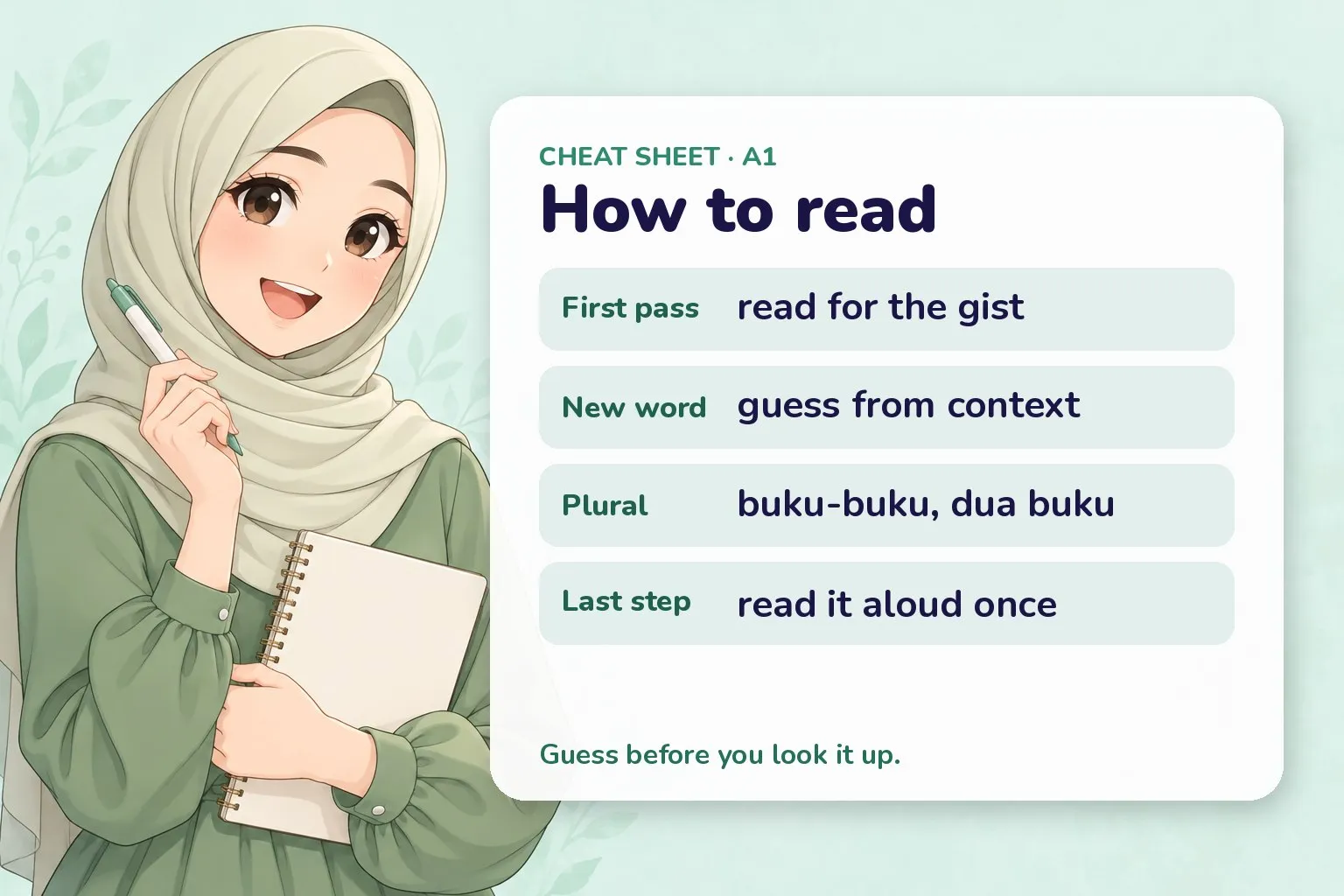
Quick recap before you answer the questions.
Comprehension practice
Reading comprehension practice
Try each one, then press Check. No sign-up, nothing is sent anywhere — it all runs in your browser.
Hint: a white drink
Show answer
susu — The text says she drinks tea with milk (susu).
Hint: does not go out
Show answer
tinggal — On Sunday Budi stays at home: tinggal di rumah.
5 Match each person to what they do.
- Ani pergi ke kampus
- Budi pergi belanja
- Ani membaca buku
- Budi membersihkan rumah
Show answer
- Ani pergi ke kampus → naik bus
- Budi pergi belanja → pada sore hari
- Ani membaca buku → pada malam hari
- Budi membersihkan rumah → pada hari Minggu
Each pair matches a routine from the two texts.
6 Put Ani's day in order.
Show answer
dia bangun dia pergi ke kampus dia makan siang dia tidur — Wake up first, then campus, lunch at one, and sleep at eleven.
Quiz
Beginner Indonesian reading quiz
8 questions · pick an answer and you'll see straight away if it's right.
-
Show answer
di rumah kecil dengan adiknya — The text says she lives in a small house with her younger sibling.
-
Show answer
belajar di rumah — In the afternoon she studies at home; TV is in the evening.
-
Show answer
pada hari Sabtu dan Minggu — Budi does not work at the weekend — Saturday and Sunday.
-
Show answer
mereka lapar setelah bermain — After playing football they are hungry, so they eat a lot.
-
Show answer
roti, telur, buah, dan sayur — He buys bread, eggs, fruit and vegetables.
-
Show answer
banyak teman (plural by doubling) — teman-teman is the reduplicated plural: friends.
-
Show answer
membaca sekali untuk idenya — Read for the gist first; check only the words you cannot guess.
-
Show answer
tired / needing rest — Ani is lelah (tired), but she is happy (senang).
Next
- Practise hearing it: How to Practise Indonesian Listening
- Build the grammar: Indonesian Plurals and Reduplication
- New here? Start with Start Learning Indonesian Here
All Indonesian practice topics
Vocabulary, pronunciation, phrases, practice and exam help, ordered by level. Pick a topic and go straight to it. New lessons go live every day, so topics marked Coming soon fill in over the next weeks.
Practice
Beginner 1 topics · 1 ready
- 01 Indonesian Reading Practice: Beginner You are here
Elementary 2 topics · 2 ready
Intermediate 5 topics · 2 ready
- 04 Shadowing to Improve Indonesian Speaking
- 05 Indonesian Reading Practice: Intermediate
- 06 How to Practise Indonesian Writing Coming soon
- 07 Indonesian me- Verb Practice Coming soon
- 08 Indonesian di-/ter- Passive Practice Coming soon