How to Practise Indonesian Listening
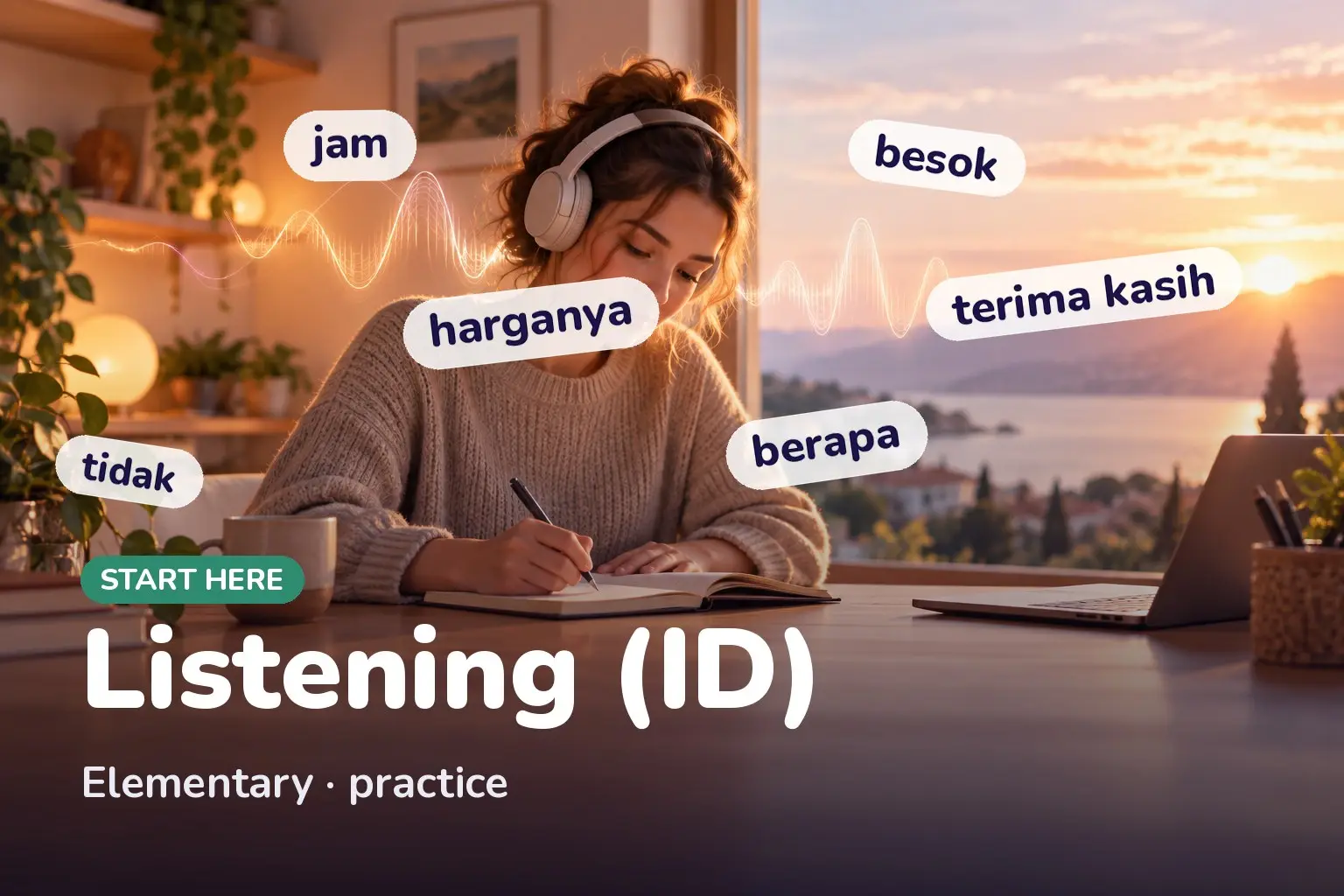
To practise Indonesian listening, pick audio at or just below your level and play the same short clip several times: first for the gist, then for detail, then with the transcript. Mix top-down guessing from context with bottom-up decoding of the actual sounds.
Level: Elementary. Listening is the skill most learners neglect and then panic about in a real conversation. The fix is not more hours of hard audio — it is the right audio, repeated the right way. This page gives you a routine you can run on any short Indonesian clip.
By the end of this page you can…
…choose listening material at your level, run a repeatable listening routine, handle the sounds and contractions that make spoken Indonesian hard to catch, and find free audio to practise with.
What listening practice is
Listening practice is not background noise while you cook. It is active: you choose a short clip, set yourself a question, and listen with full attention to answer it. Two processes work together.
- Top-down listening uses what you already know — the topic, the situation, the words you expect — to predict and fill gaps. At a market you know a number is probably a price.
- Bottom-up listening decodes the actual sounds and words as they arrive, without guessing. This is what catches the detail top-down skips: the exact time, the negative tidak, the right name.
Good listeners switch between the two. Beginners lean too hard on one: all guessing (you miss tidak and reverse the meaning) or all decoding (you freeze on one unknown word and lose the sentence).
Graded listening: pick the right level
The material should be comprehensible: you follow most of it and stretch for the rest. Audio far above your level teaches you only that Indonesian is fast. Choose clips where you catch perhaps 70–90% unaided, then work on the gaps.
A listening routine, step by step
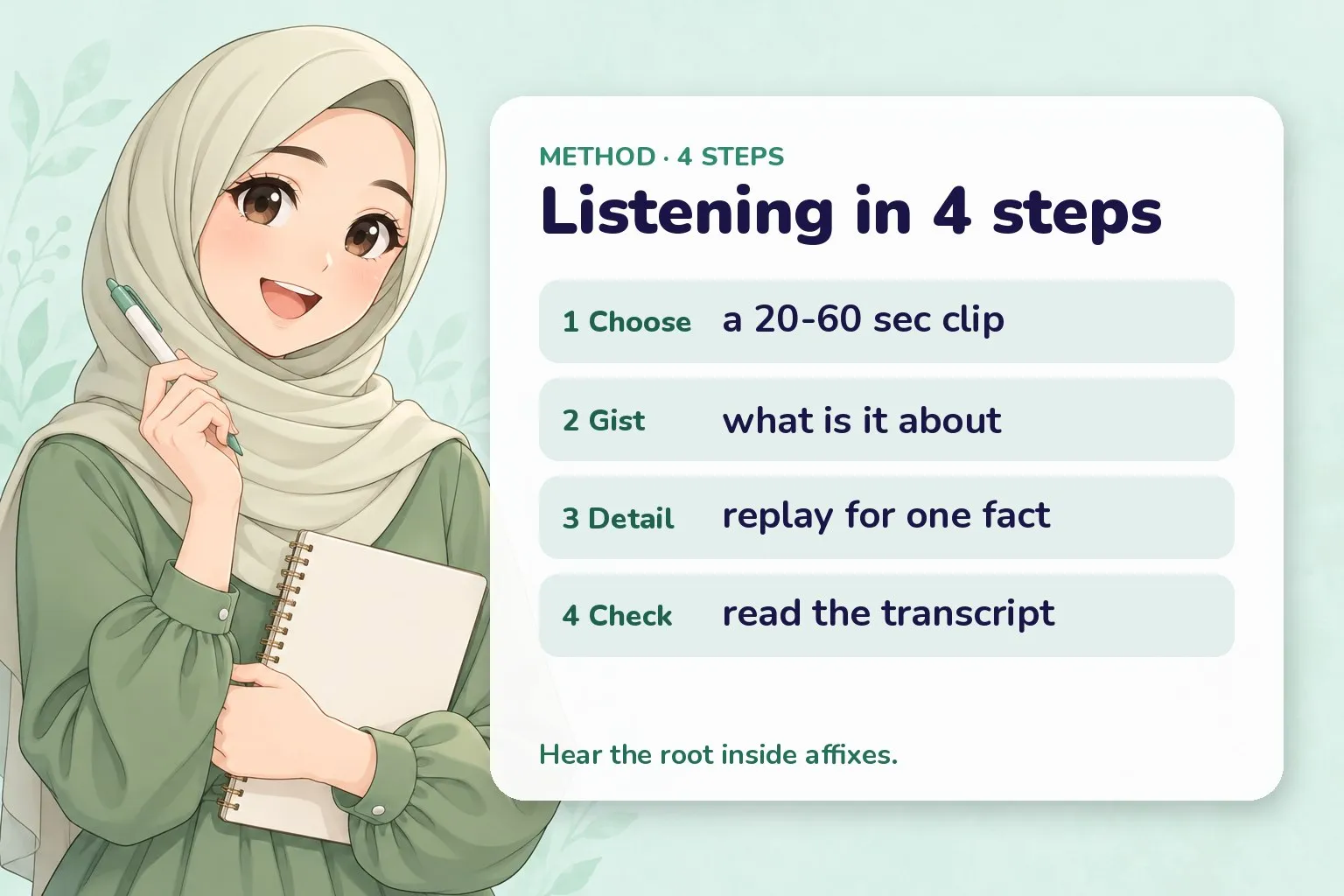
- Pick a short clip, 20–60 seconds. A news headline, a dialogue, or the audio on this site is plenty.
- Listen once for the gist. What is it about? Who is speaking? Do not read anything yet.
- Listen again for one detail. Set a question first: a number, a time, a name, a yes/no. Replay only the part you need.
- Do a mini-dictation. Play a sentence, pause, and write what you heard. Gaps show you exactly which sounds you are missing.
- Open the transcript. Compare it with what you wrote. Mark the words you heard wrong, not just the ones you did not know.
- Listen one last time while reading, then once more with the text hidden. The second hearing should feel noticeably clearer.
What makes Indonesian hard to hear
- Affixes hide the root. Prefixes and suffixes reshape a word: membaca (to read) is built on baca, mengambil on ambil. Learn to strip the affix and hear the root.
- Speech contracts. Everyday talk shortens words: tidak → nggak / gak, sudah → udah, saja → aja, bagaimana → gimana. The spoken form is not the written one.
- Plurals by repetition. buku-buku (books) doubles the word; in fast speech the repeat can slip past you.
- The schwa e. The letter e is usually a soft “uh” (empat, beli) but sometimes a clear “e” (enak); it is not marked, so you learn it by ear.
How to say it
Hearing these sounds clearly is what you are training; it helps to be able to produce them too:
- c is always “ch”: cari ≈ “CHAH-ree”, cucu ≈ “CHOO-choo”.
- ng and ny. ng is one sound as in “sing” (dengan); ny is like the ni in “onion” (nyanyi, -nya).
- Final -k. A soft catch in the throat, not a hard k: tidak ≈ “TEE-daʔ”, anak ≈ “AH-naʔ”.
- r. Lightly rolled or tapped: rumah, beras — not the English r.
Example sentences
Play each line, then replay it with your eyes off the text and write what you hear:
- Jam berapa sekarang?What time is it now?listen for the time
- Sekarang jam sembilan.It is nine o'clock now.the number
- Berapa harganya?How much is it?harga + -nya
- Harganya dua puluh ribu rupiah.It is twenty thousand rupiah.price
- Maaf, saya tidak mengerti.Sorry, I don't understand.listen for tidak
- Bisa diulang?Can you repeat?
- Di mana stasiunnya?Where is the station?
- Kereta berangkat jam tujuh.The train leaves at seven.
- Tolong bicara lebih pelan.Please speak more slowly.
- Kita bertemu besok.We meet tomorrow.listen for the day
- Dia sudah pergi.He/She has already gone.sudah is often said udah
- Nama saya Andi.My name is Andi.
Quick recap before you practise.
Where to find audio
- Graded material: BIPA (Indonesian for foreign speakers) lessons are built for learners, so the audio is paced for your level.
- Level targets: the UKBI proficiency test describes listening levels you can aim your practice at.
- This site’s audio: every example above plays through your browser’s built-in voice — use it for mini-dictation.
- High-frequency words first: the FrequencyWords lists tell you which words to expect most, so learning them makes any clip easier to decode.
Practice
Listening-strategy practice
Try each one, then press Check. No sign-up, nothing is sent anywhere — it all runs in your browser.
Hint: write exactly what you hear
Show answer
dictation — Dictation shows you precisely which sounds you are missing.
4 Put the listening routine in order.
Show answer
pick a short clip listen for the gist listen for one detail check the transcript — Choose, gist, detail, then confirm with the transcript.
5 Match each spoken form to its full written word.
- nggak
- udah
- aja
- gimana
Show answer
- nggak → tidak (not)
- udah → sudah (already)
- aja → saja (just)
- gimana → bagaimana (how)
Everyday speech contracts these common words.
Quiz
Indonesian listening quiz
8 questions · pick an answer and you'll see straight away if it's right.
-
Show answer
audio you can mostly follow, with a little stretch — You learn most from audio you largely understand.
-
Show answer
using context and expectations to predict — Top-down uses what you already know to fill gaps.
-
Show answer
decoding the actual sounds and words — Bottom-up catches the exact detail that guessing skips.
-
Show answer
each pass you catch a little more — Repetition on one clip is where the gains come from.
-
Show answer
baca — Strip the prefix me(m)- and you hear the root baca.
-
Show answer
nggak — Everyday Indonesian contracts tidak to nggak or gak.
-
Show answer
get the gist and note the gaps — Gist first; detail and exact words come on later passes.
-
Show answer
many clips on the same topic — Staying on one topic recycles the same vocabulary until it sticks.
Next
- Build the words you will hear in the Indonesian grammar section
- New here? Start with Start Learning Indonesian Here
All Indonesian practice topics
Vocabulary, pronunciation, phrases, practice and exam help, ordered by level. Pick a topic and go straight to it. New lessons go live every day, so topics marked Coming soon fill in over the next weeks.
Practice
Beginner 1 topics · 1 ready
Elementary 2 topics · 2 ready
- 02 How to Practise Indonesian Listening You are here
- 03 Indonesian Reading Practice: Elementary
Intermediate 5 topics · 2 ready
- 04 Shadowing to Improve Indonesian Speaking
- 05 Indonesian Reading Practice: Intermediate
- 06 How to Practise Indonesian Writing Coming soon
- 07 Indonesian me- Verb Practice Coming soon
- 08 Indonesian di-/ter- Passive Practice Coming soon