How to Practise German Writing
To practise German writing, write a little every day and build up in stages: correct single sentences first, then join them into short paragraphs, then get feedback and rewrite. Keep a personal error list and check every noun is capitalised and every verb sits in position 2.
On this page11 sections · tap to jump
- 01By the end of this page you can…
- 02Why write at all
- 03Stage 1 — correct single sentences
- 04Stage 2 — join sentences into paragraphs
- 05Stage 3 — the feedback loop
- 06What to write, by level
- 07Model answers — use them well
- 08Example sentences to build from
- 09The errors to hunt in your own drafts
- 10Practice
- 11Quiz
Level: B1. Writing is where German grammar stops being abstract: you cannot hide a missing case ending or a stray verb in writing the way you can in fast speech. The good news is that writing is the easiest skill to practise alone, because you can check and fix every word.
By the end of this page you can…
…run a daily German writing routine, move from single sentences to paragraphs, set up a feedback loop that actually improves your drafts, and target the mistakes German learners make most.
Why write at all
Writing forces slow, deliberate choices. You decide the case, pick the article, place the verb — and you can see the result and fix it. That makes writing the best testing ground for grammar you are learning elsewhere. A rule you can use correctly in writing, with time to think, is one step from using it in speech.
Stage 1 — correct single sentences
Start below paragraph level. Write five to ten short sentences a day about something real: what you did, what you will do, what is on your desk. Keep them simple and check each one against a rule you know.
- Is the conjugated verb in position 2? (Heute gehe ich ins Kino, not Heute ich gehe….)
- Is every noun capitalised? (der Tisch, die Katze, das Haus.)
- Does the article match the case? (Ich sehe den Mann, accusative.)
Stage 2 — join sentences into paragraphs
Once single sentences come out clean, link them. This is where connectors do the work and where German word order gets interesting:
- Coordinating connectors (und, aber, oder, denn) keep normal order: Ich bleibe zu Hause, denn es regnet.
- Subordinating connectors (weil, dass, wenn, obwohl) send the verb to the end: Ich bleibe zu Hause, weil es regnet.
Write a five-sentence paragraph with at least one weil or dass clause, then check that the verb landed at the end of it.
Stage 3 — the feedback loop
A draft nobody corrects teaches you little. Build a loop:
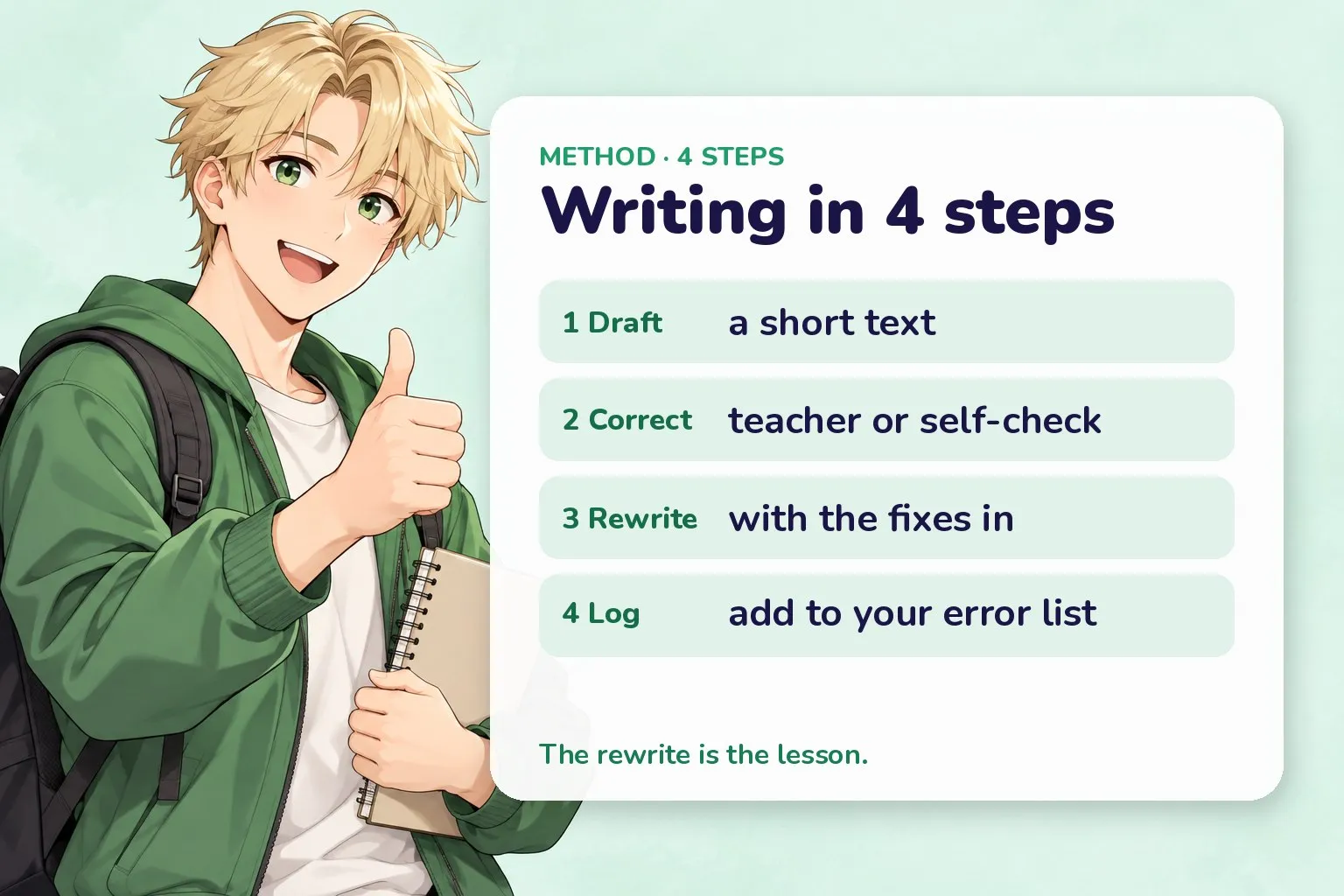
- Draft a short text (a paragraph, an email, a diary entry).
- Get it corrected — a teacher, a language partner, or a careful self-check against your grammar pages.
- Rewrite the whole text with the corrections. This step is the one most learners skip and the one that matters most.
- Log the error in a personal list: the wrong version, the right version, one word on why.
What to write, by level
- A1–A2: a shopping list with articles, a daily diary in the present tense, a short self-introduction, a postcard.
- B1: a 120–150 word email (a complaint, a request, an invitation), an opinion paragraph with weil reasons, a summary of something you read.
- B2 and up: a structured argument with einerseits … andererseits, a formal letter, a report that keeps tenses consistent.
The Goethe-Institut’s course and exam materials are built around these CEFR writing targets, so you can match a task to your level.
Model answers — use them well
A model answer is not for copying; it is for comparing. Write your own version first, then read the model and ask: what did it do that I did not? Mark the connectors it used, the word order, the set phrases (Ich schreibe Ihnen, weil…, Mit freundlichen Grüßen). Then rewrite yours borrowing one or two of those moves.
Example sentences to build from
These are clean frames to adapt — change the content words and keep the structure:
- Heute Morgen habe ich einen Kaffee getrunken.This morning I drank a coffee.perfect tense, verb bracket
- Ich bleibe zu Hause, weil es regnet.I'm staying home because it's raining.weil sends the verb to the end
- Am Wochenende möchte ich meine Freunde treffen.At the weekend I'd like to meet my friends.time first, verb second
- Können Sie mir bitte helfen?Could you please help me?polite request frame
- Ich schreibe Ihnen, weil ich eine Frage habe.I'm writing to you because I have a question.email opener
- Einerseits ist es teuer, andererseits ist es praktisch.On one hand it's expensive, on the other it's practical.balanced argument
- Gestern war das Wetter schlecht, aber heute ist es schön.Yesterday the weather was bad, but today it's nice.aber keeps normal order
- Ich hoffe, dass wir uns bald wiedersehen.I hope we see each other again soon.dass clause, verb at the end
- Mit freundlichen GrüßenKind regards (formal letter close)set phrase
- Zuerst ... dann ... zum Schluss ...First ... then ... finally ...sequence connectors for a paragraph
Quick recap before you practise.
The errors to hunt in your own drafts
- Verb not in position 2: Heute ich gehe… → Heute gehe ich…
- Lowercase nouns: der tisch → der Tisch.
- Wrong case after a preposition: mit mein Freund → mit meinem Freund (dative).
- Verb not at the end of a weil/dass clause: …, weil es regnet ist → …, weil es regnet.
- English word order in the middle field (time–manner–place): Ich fahre mit dem Bus morgen → Ich fahre morgen mit dem Bus.
Practice
German writing-routine practice
Try each one, then press Check. No sign-up, nothing is sent anywhere — it all runs in your browser.
Hint: all German nouns are capitalised
Show answer
der Tisch — Every German noun starts with a capital: der Tisch.
4 Build the weil-clause: 'I'm staying home because it's raining.'
Show answer
Ich bleibe zu Hause, weil es regnet — weil sends the verb to the end: …, weil es regnet.
5 Match each writing task to a level.
- daily diary in present tense
- 150-word email with reasons
- structured argument essay
- shopping list with articles
Show answer
- daily diary in present tense → A1-A2
- 150-word email with reasons → B1
- structured argument essay → B2+
- shopping list with articles → A1-A2
Match the task to your CEFR writing level.
Quiz
German writing-practice quiz
8 questions · pick an answer and you'll see straight away if it's right.
-
Show answer
correct single sentences — Build accuracy at sentence level before paragraphs.
-
Show answer
weil — Subordinating weil pushes the verb to the end.
-
Show answer
forgetting to capitalise nouns — Every German noun must be capitalised.
-
Show answer
it applies the correction actively — Rewriting turns a passive correction into active practice.
-
Show answer
compare against your own draft — Compare, borrow a move or two, then rewrite your own.
-
Show answer
meinem (dative) — mit takes the dative: mit meinem Freund.
-
Show answer
time-manner-place — German tends to run time, then manner, then place.
-
Show answer
they build fluency and cut dictionary stops — Reusing known high-frequency words builds accuracy and speed.
Next
- Turn writing into reading practice: German Reading Practice: Intermediate (B1)
- Fix word order first in the German grammar section
- New here? Start with Start Learning German Here
All German practice topics
Vocabulary, pronunciation, phrases, practice and exam help, ordered by level. Pick a topic and go straight to it. New lessons go live every day, so topics marked Coming soon fill in over the next weeks.
Practice
A1 1 topics · 1 ready
A2 2 topics · 2 ready
B1 5 topics · 3 ready
- 04 Shadowing to Improve German Speaking
- 05 German Reading Practice: Intermediate
- 06 How to Practise German Writing You are here
- 07 German Two-Way Prepositions Practice Coming soon
- 08 German Adjective Endings Practice Coming soon