How to Practise French Writing
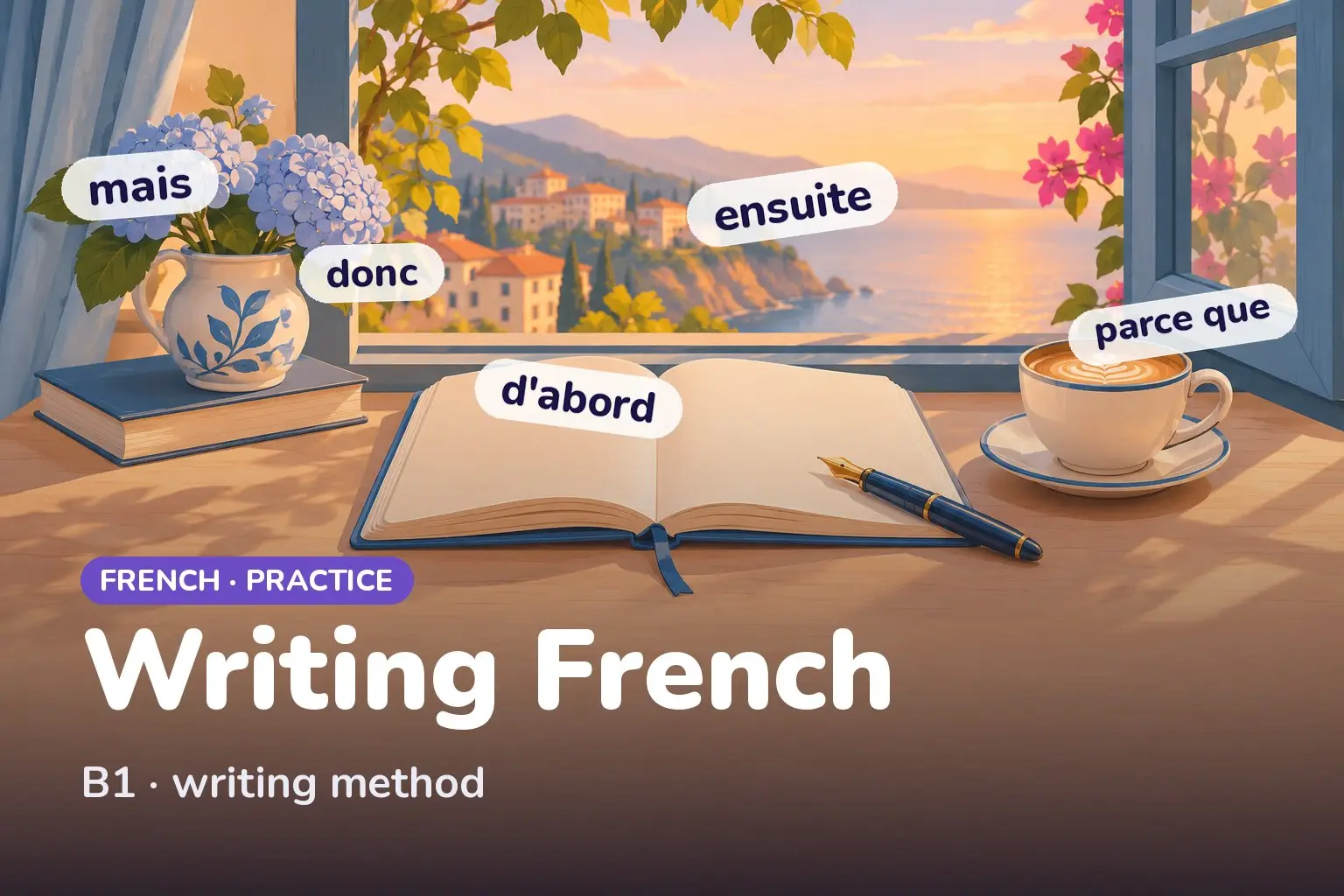
Practise French writing by starting with short, correct sentences, joining them with connectors like d'abord, ensuite and parce que, then checking each piece against a model answer and rewriting it. Watch agreement and silent endings as you go.
Level: B1. French writing is where the grammar you have learned gets tested in slow motion — agreement, verb endings, accents and connectors all have to be right at once. The fix is not to write more, but to write in a loop: short pieces, checked against a model, rewritten. This page gives you that method.
By the end of this page you can…
…run a short French writing session on your own: build from sentences to a structured paragraph, link ideas with the right connectors, and proofread for the errors French writers actually make.
Start with short, correct sentences
Do not begin with a paragraph. Write one sentence you are confident is correct, then another, on a single topic: your weekend, your town, a film you saw. Keep them short and true. The skill you are building first is accuracy, not length.
As you write, two things need constant attention in French: agreement (adjectives and past participles matching gender and number) and accents (é, è, ê change meaning and spelling). These are the errors that cost the most marks and the easiest to fix by habit.
Structure a paragraph with connectors
The jump from sentences to writing is made with connectors (connecteurs logiques), and DELF writing tasks explicitly reward them. A small set covers most needs:
- d’abord — first
- ensuite / puis — then / next
- parce que / car — because
- mais — but
- donc — so / therefore
Open with d’abord, sequence with ensuite, give a reason with parce que, and close with donc. Build the model paragraph below one line at a time.
How to say it
French spelling hides sounds, so read your drafts aloud to hear what you actually wrote. Four traps in this lesson’s words:
- Silent endings: the final consonants of fais, font, d’abord and donc are usually silent — d’abord ≈ “da-BOR”.
- é vs è: é (accent aigu) is a closed “ay” (écrire ≈ “ay-KREER”); è (accent grave) is an open “eh” (règle ≈ “REGL”).
- parce que: runs together as “pars-kuh”, the final e a soft schwa.
- ensuite: nasal en then “sweet” without the final t — “on-SWEET”.
Example sentences
- D'abord, je choisis un sujet simple.First, I choose a simple topic.d'abord opens the sequence
- Ensuite, j'écris trois phrases courtes.Then I write three short sentences.ensuite = next
- J'aime écrire le matin parce que c'est calme.I like writing in the morning because it's quiet.parce que gives a reason
- Je veux écrire, mais je n'ai pas le temps.I want to write, but I don't have time.mais shows contrast
- Je pratique tous les jours, donc je progresse.I practise every day, so I'm improving.donc shows a result
- J'écris une phrase, puis je la relis à voix haute.I write a sentence, then I reread it aloud.
- Mon écriture est lente, mais elle est correcte.My writing is slow, but it's correct.
- Je corrige les accords et les accents en premier.I correct the agreements and accents first.
- Demain, je réécrirai le même texte.Tomorrow I'll rewrite the same text.
Build a feedback loop
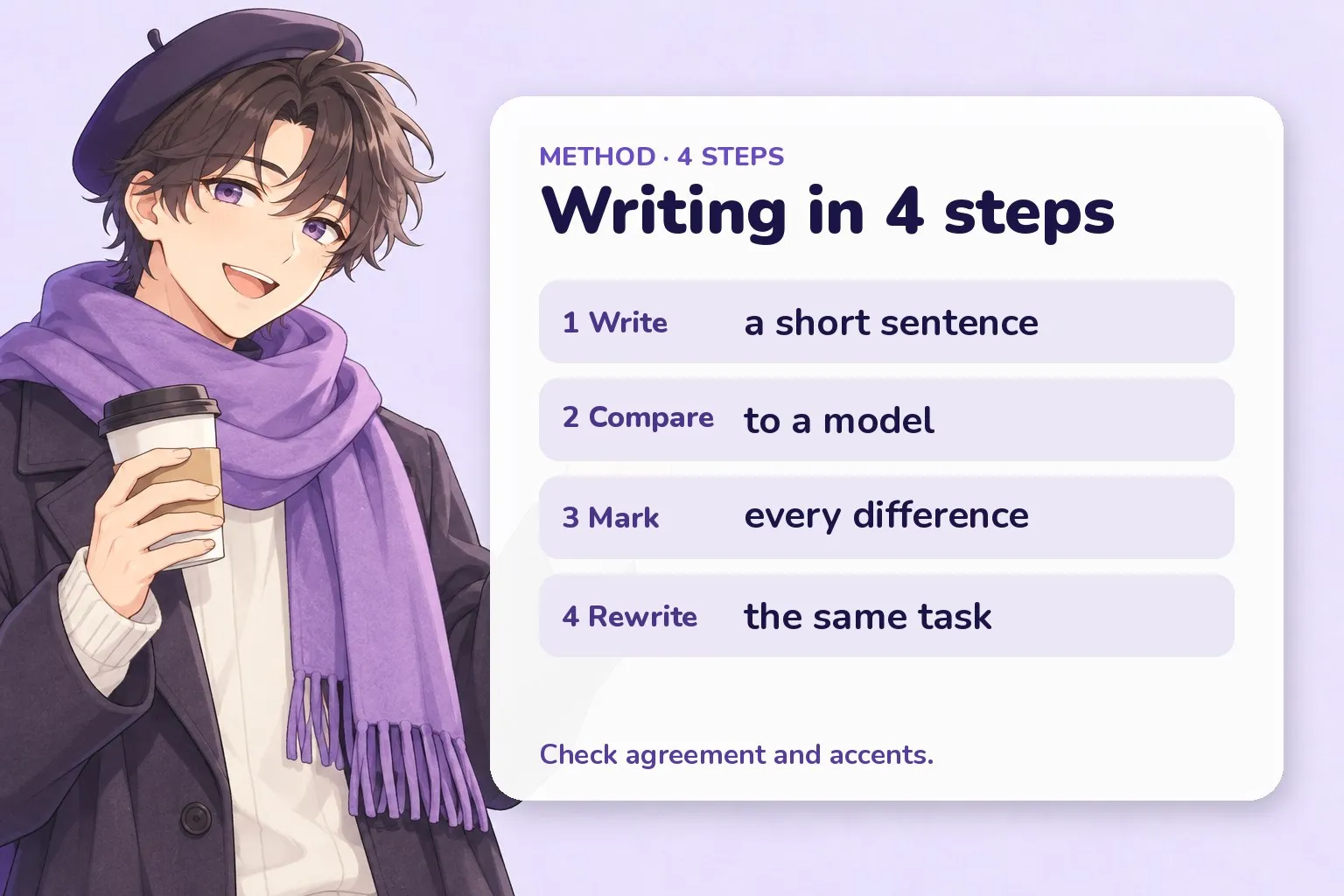
Writing you never check just rehearses your mistakes. After each short piece, run a quick loop:
- Write the sentence or paragraph from the task.
- Compare it to a model — a lesson example, a graded reader, or a corrected version.
- Mark every difference: a missing agreement, a wrong accent, a forgotten connector.
- Rewrite the same task, fixing what you marked.
Write to model answers
A model answer is a short, correct text that does your task — exactly what DELF sample answers provide. Read it, cover it, write your own version, then compare. Our reading practice passages and the examples in each grammar lesson make good models because they are short and verified. Pair writing with shadowing so you can say what you write, and lean on the verb faire and other core verbs you will reuse constantly.
Pick the words you recycle from a frequency list, so your practice centres on the vocabulary you will actually need.
Quick recap before you practise.
Practice
French writing method practice
Try each one, then press Check. No sign-up, nothing is sent anywhere — it all runs in your browser.
Hint: two words, or the single word car
Show answer
parce que — parce que (or car) introduces a reason.
4 Order the connectors as a paragraph would use them.
Show answer
d'abord ensuite donc — Open with d'abord, sequence with ensuite, close with donc.
5 Match each connector to its job.
- d'abord
- ensuite
- mais
- donc
Show answer
- d'abord → first
- ensuite → then
- mais → but
- donc → so / therefore
d'abord first, ensuite then, mais but, donc so.
Quiz
French writing practice quiz
8 questions · pick an answer and you'll see straight away if it's right.
-
Show answer
agreement and accents — Agreement (gender, number, participles) and accents are the high-cost errors.
-
Show answer
connectors — Connectors structure a paragraph and are rewarded in DELF tasks.
-
Show answer
donc — donc means 'so / therefore'.
-
Show answer
to catch words the silent endings hide — French spelling and sound diverge, so reading aloud reveals dropped or wrong words.
-
Show answer
a closed 'ay' — é is a closed 'ay' (écrire); è is the open 'eh' (règle).
-
Show answer
read once per error type (agreement, then accents, then endings) — One pass per error type catches more than one frantic pass for everything.
-
Show answer
a short, correct text that does the same task — DELF sample answers are ideal: short, correct and on-task.
-
Show answer
a frequency list of common words — High-frequency words give the most useful practice.
Next
- Read short model texts in French reading practice
- Say what you write with shadowing practice
- New here? Start with Start Learning French Here
All French practice topics
Vocabulary, pronunciation, phrases, practice and exam help, ordered by level. Pick a topic and go straight to it. New lessons go live every day, so topics marked Coming soon fill in over the next weeks.
Practice
A1 1 topics · 1 ready
A2 3 topics · 2 ready
- 02 How to Practise French Listening
- 03 French Reading Practice: Elementary
- 04 French Verb Conjugation Drills Coming soon
B1 6 topics · 3 ready
- 05 Shadowing to Improve French Speaking
- 06 French Reading Practice: Intermediate
- 07 How to Practise French Writing You are here
- 08 Passe Compose vs Imparfait Practice Coming soon
- 09 French Liaison Practice Coming soon
- 10 French Object Pronoun Practice Coming soon
B2 3 topics · 1 ready
- 11 French Reading Practice: Upper-Intermediate
- 12 French Subjunctive Practice Set Coming soon
- 13 French Past Participle Agreement Practice Coming soon