Spanish Punctuation: Inverted ¿? and ¡!
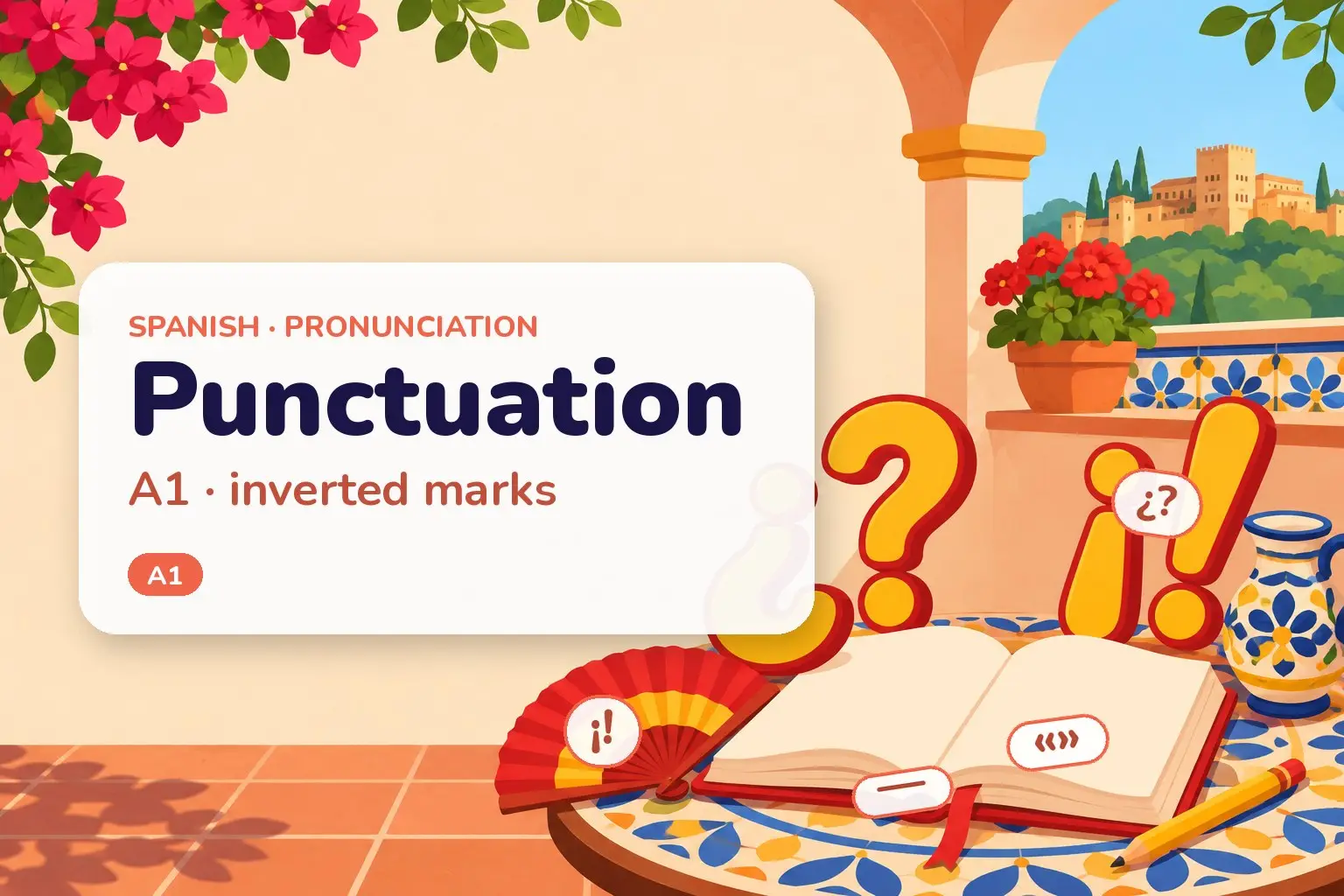
Spanish marks a question or exclamation at both ends: an inverted ¿ or ¡ opens it and a normal ? or ! closes it, as in ¿Cómo estás? and ¡Qué bien! The opening sign goes exactly where the question or exclamation begins, not always at the start of the line.
Level: A1. Spanish uses almost the same punctuation marks as English, with one eye-catching difference: questions and exclamations are marked at both ends. The upside-down signs are not decoration — they tell a reader, before the first word, that a question or a shout is on the way.
By the end of this page you can…
…open and close Spanish questions and exclamations correctly, place the inverted sign where the question really starts, and use the quotation marks and commas the way Spanish does.
The inverted signs
English puts a question mark only at the end. Spanish adds a mirror-image opening sign too:
- Question: ¿ … ? — ¿Cómo estás? (“How are you?”)
- Exclamation: ¡ … ! — ¡Qué bien! (“How great!”)
The opening ¿ and ¡ sit tight against the first word, with no space after them, and the closing ? or ! sits tight against the last word. Both signs are compulsory in standard writing — one at each end.
The opening sign goes where the question starts
This is the rule English speakers miss most. The ¿ or ¡ opens exactly at the point where the question or exclamation begins — which is not always the start of the sentence.
- María, ¿vienes a la fiesta? — “María, are you coming to the party?” (the name is a greeting, not part of the question)
- Si tienes tiempo, ¿me llamas? — “If you have time, will you call me?”
- Qué día tan largo, ¡por fin terminó! — “What a long day, it’s finally over!”
Everything before the opening sign is a statement; the inverted mark shows where the tone turns into a question or a shout.
Quotation marks, commas and dashes
| Mark | Spanish form | Example |
|---|---|---|
| quotation | «…» (angle) or “…” | Dijo: «No lo sé». |
| dialogue dash | — (raya) | —¿Vienes? —preguntó. |
| decimal | comma in much of the world | 3,5 (three point five) |
| thousands | point or thin space | 1.000 or 1 000 |
A few comma habits differ from English:
- No comma before y (“and”) in a simple list: manzanas, peras y uvas (“apples, pears and grapes”).
- Never put a comma between the subject and its verb: write Mi hermano trabaja aquí, not Mi hermano, trabaja aquí.
- Direct address is set off by commas: Hola, Ana, ¿cómo estás?
How to say it
You do not pronounce the punctuation, but it shapes how you read a sentence aloud:
- The ¿ is your cue to raise the pitch. When you see the opening sign, let your voice rise toward the end, just as the ? predicts.
- The ¡ signals extra energy. Read everything between ¡ and ! with a stronger, livelier tone: ¡Qué rico! (“How delicious!”).
- A comma is a short pause, not a drop. Keep the voice up over a comma; let it fall only at the full stop.
Example sentences
Press play to hear the rise of a question and the lift of an exclamation.
- ¿Cómo estás?How are you?question marked at both ends
- ¿Dónde vives?Where do you live?
- ¡Qué bien!How great!exclamation at both ends
- ¡Feliz cumpleaños!Happy birthday!
- María, ¿vienes a la fiesta?María, are you coming to the party?opening ¿ after the name
- Si tienes tiempo, ¿me llamas?If you have time, will you call me?
- ¿Qué quieres comer?What do you want to eat?
- ¡No me digas!You don't say!
- ¿Hablas español o inglés?Do you speak Spanish or English?
- ¡Cuidado!Careful!
- Dijo: «No lo sé».He said: 'I don't know.'angle quotation marks
- Compré manzanas, peras y uvas.I bought apples, pears and grapes.no comma before y
- Mi hermano trabaja aquí.My brother works here.no comma between subject and verb
- Hola, Ana, ¿cómo estás?Hi, Ana, how are you?
- ¿Verdad que sí?Right? / Isn't that so?
Practice
Spanish punctuation practice
Try each one, then press Check. No sign-up, nothing is sent anywhere — it all runs in your browser.
Hint: the inverted question mark
Show answer
¿ — The inverted ¿ opens the question: ¿Cómo estás?
4 Match each mark to its job.
- ¿ ?
- ¡ !
- «»
- —
Show answer
- ¿ ? → question
- ¡ ! → exclamation
- «» → quotation
- — → dialogue dash
Spanish has a dedicated opening sign for questions and exclamations.
Hint: subject and verb
Show answer
false — Never separate the subject from its verb with a comma.
Quiz
Spanish punctuation quiz
10 questions · pick an answer and you'll see straight away if it's right.
-
Show answer
at both the start and the end — ¿ opens it and ? closes it.
-
Show answer
¡ — ¡ is the inverted exclamation mark that opens the phrase.
-
Show answer
where the question begins, after the comma — The sign opens exactly where the question starts, not always at the line start.
-
Show answer
«…» — The angle marks «…» are the traditional Spanish quotes, though the curly pair is common online.
-
Show answer
manzanas, peras y uvas — No comma before y in a simple list.
-
Show answer
Mi hermano trabaja aquí. — No comma separates the subject from its verb.
-
Show answer
a common error; the ¿ is required — Standard Spanish needs the opening ¿.
-
Show answer
a new speaker's words — The raya (—) introduces a character's speech.
-
Show answer
¡Qué bien! — Open with ¡ and close with !: ¡Qué bien!
-
Show answer
3,5 — A comma is the decimal separator: 3,5.
Recap cheat-sheet
| Mark | Use | Example |
|---|---|---|
| ¿ … ? | question, both ends | ¿Cómo estás? |
| ¡ … ! | exclamation, both ends | ¡Qué bien! |
| «…» | quotation | Dijo: «Sí». |
| comma | no comma before y, none subject–verb | peras y uvas |
Next
- Learn where the stress falls and when to add a tilde in Spanish written accents
- Hear the vowel sounds in the Spanish pronunciation overview
- Ask your own questions with the Spanish question words
- New here? Start with Start Learning Spanish Here
All Spanish pronunciation & writing topics
Vocabulary, pronunciation, phrases, practice and exam help, ordered by level. Pick a topic and go straight to it. New lessons go live every day, so topics marked Coming soon fill in over the next weeks.
Pronunciation & writing
A1 5 topics · 5 ready
- 01 Spanish Pronunciation Overview
- 02 The Spanish Alphabet
- 03 Spanish Vowels (5 Pure Sounds)
- 04 Spanish b, v and silent h
- 05 Spanish Punctuation (inverted ? and !) You are here