Spanish Syllables & Word Stress Rules
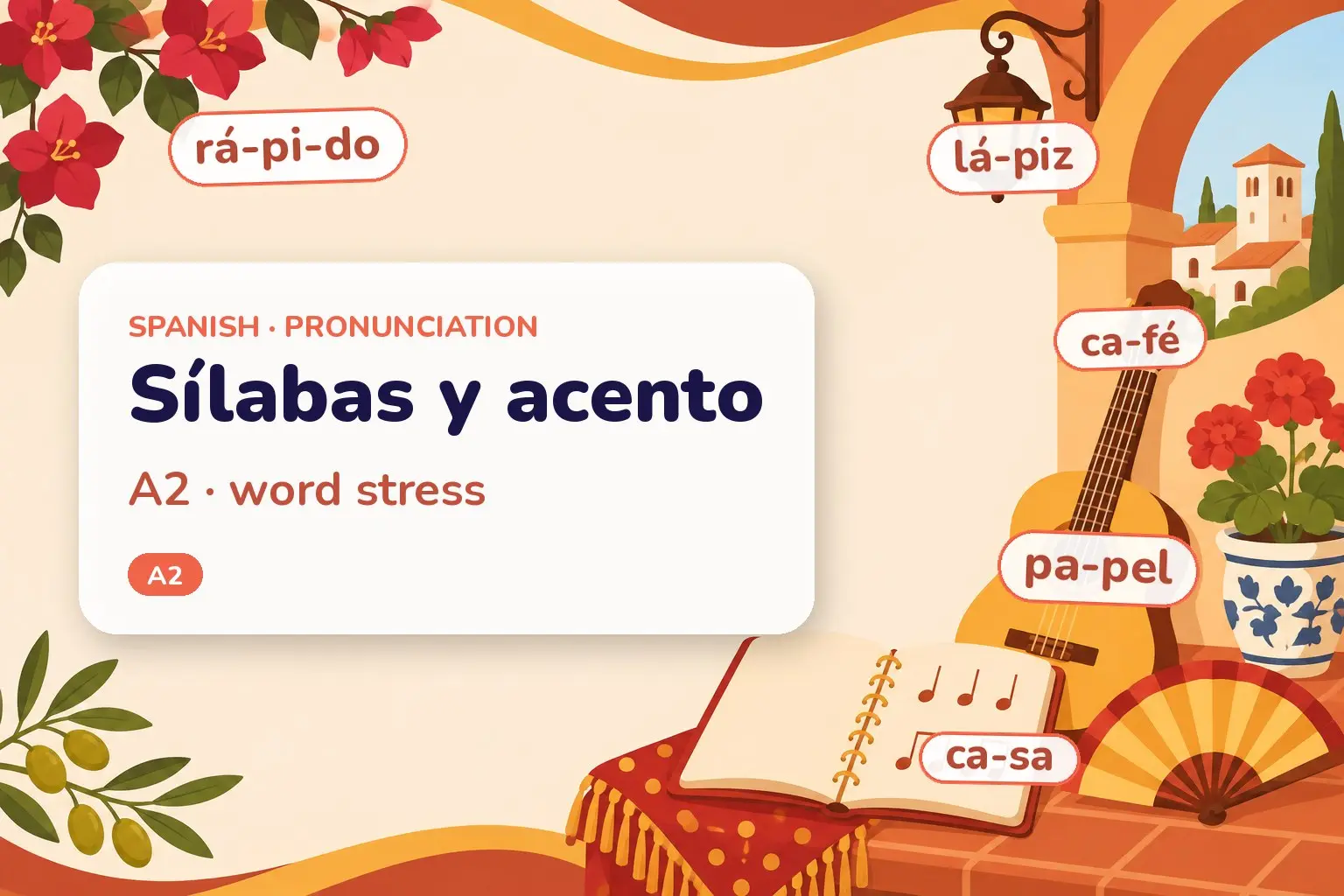
Spanish has two default stress rules. Words ending in a vowel, -n or -s are stressed on the second-to-last syllable (ca-sa, co-men). Words ending in any other consonant are stressed on the last syllable (pa-pel, ciu-dad). A written accent marks every exception.
Level: A2. Stress is where you push your voice in a word, and in Spanish it is not random — two simple rules predict it, and a written accent (the tilde) flags every word that breaks them. Get the rules and you will read unfamiliar Spanish aloud with the stress in the right place, and you will understand what those accent marks are doing.
By the end of this page you can…
…split a Spanish word into syllables, apply the two default stress rules, name a word as aguda, llana or esdrújula, and explain why a tilde appears.
Splitting words into syllables
Spanish prefers each syllable to be a consonant followed by a vowel. A few rules cover almost everything:
- One consonant between two vowels joins the following vowel: ca-sa, me-sa, pe-lo-ta.
- Two consonants between vowels usually split, one each side: car-ta, cuen-to, gus-to.
- But a consonant + l or r stays together, and so do the digraphs ch, ll, rr: ha-blar, li-bro, a-pren-der, co-che, ca-lle, pe-rro.
- Two vowels may share a syllable (a diphthong: bai-le, cui-da) or split into two (a hiatus: te-a-tro, le-er).
Count the syllables before you look for the stress — the rules below point to a syllable, so you need to know which is which.
The two default stress rules
With no accent mark written, the stress falls by the word’s last letter:
- Ends in a vowel, -n or -s → stress the second-to-last syllable. These are llanas (also called graves): ca-sa, za-pa-to, co-men, lu-nes.
- Ends in any other consonant → stress the last syllable. These are agudas: pa-pel, ciu-dad, re-loj, es-pa-ñol.
| Word | Syllables | Ends in | Default stress | Type |
|---|---|---|---|---|
| casa | ca-sa | vowel | ca-sa | llana |
| comen | co-men | -n | co-men | llana |
| lunes | lu-nes | -s | lu-nes | llana |
| papel | pa-pel | -l | pa-pel | aguda |
| ciudad | ciu-dad | -d | ciu-dad | aguda |
| reloj | re-loj | -j | re-loj | aguda |
When the tilde steps in
A tilde (the written accent, as on é) marks any word that does not follow the two rules — it points to the exact syllable to stress:
- café ends in a vowel, so the rule predicts CA-fe; the real stress is on the last syllable, so a tilde is written: ca-fé.
- lápiz ends in -z (a consonant that is not -n or -s), so the rule predicts la-PIZ; the stress is actually on the first syllable: lá-piz.
- inglés ends in -s, so the rule predicts IN-gles; the stress is on the last syllable: in-glés.
Words stressed on the third-to-last syllable are called esdrújulas, and they always carry a tilde — no exceptions: rá-pi-do, mé-di-co, pá-ja-ro, sá-ba-do.
How to say it
A couple of habits make the stress audible:
- Lengthen and lift the stressed syllable. English speakers often keep every syllable even. In Spanish, make the stressed vowel a touch longer and higher: ca-FÉ, MÉ-di-co.
- Keep the other vowels pure. Even unstressed, each vowel stays its clean sound — no English “uh”. The o in mé-di-co is still “oh”, never “medi-kuh”. See the five clear vowels in Spanish vowels.
Read these aloud
Press play, then say each word, pushing the marked syllable.
- casahouseca-sa · llana
- mesatableme-sa · llana
- zapatoshoeza-pa-to · llana
- comenthey eatco-men · llana, ends in -n
- lunesMondaylu-nes · llana, ends in -s
- papelpaperpa-pel · aguda
- ciudadcityciu-dad · aguda
- relojclock / watchre-loj · aguda
- españolSpanishes-pa-ñol · aguda
- cafécoffeeca-fé · tilde: stress the last syllable
- inglésEnglishin-glés · tilde on the last syllable
- lápizpencillá-piz · tilde on the first syllable
- árboltreeár-bol · llana marked by a tilde
- rápidofastrá-pi-do · esdrújula, always a tilde
- médicodoctormé-di-co · esdrújula
- sábadoSaturdaysá-ba-do · esdrújula
Practice
Spanish syllables and stress practice
Try each one, then press Check. No sign-up, nothing is sent anywhere — it all runs in your browser.
Hint: the most common type
Show answer
llana — Second-to-last stress = llana (also called grave).
4 Match each word to its type.
- casa
- papel
- rápido
- café
Show answer
- casa → llana
- papel → aguda
- rápido → esdrújula
- café → aguda (with tilde)
Llana = second-to-last; aguda = last; esdrújula = third-to-last.
Hint: against the vowel-ending rule
Show answer
last — A vowel-ending word should be llana; café is stressed on the last syllable, so it takes a tilde.
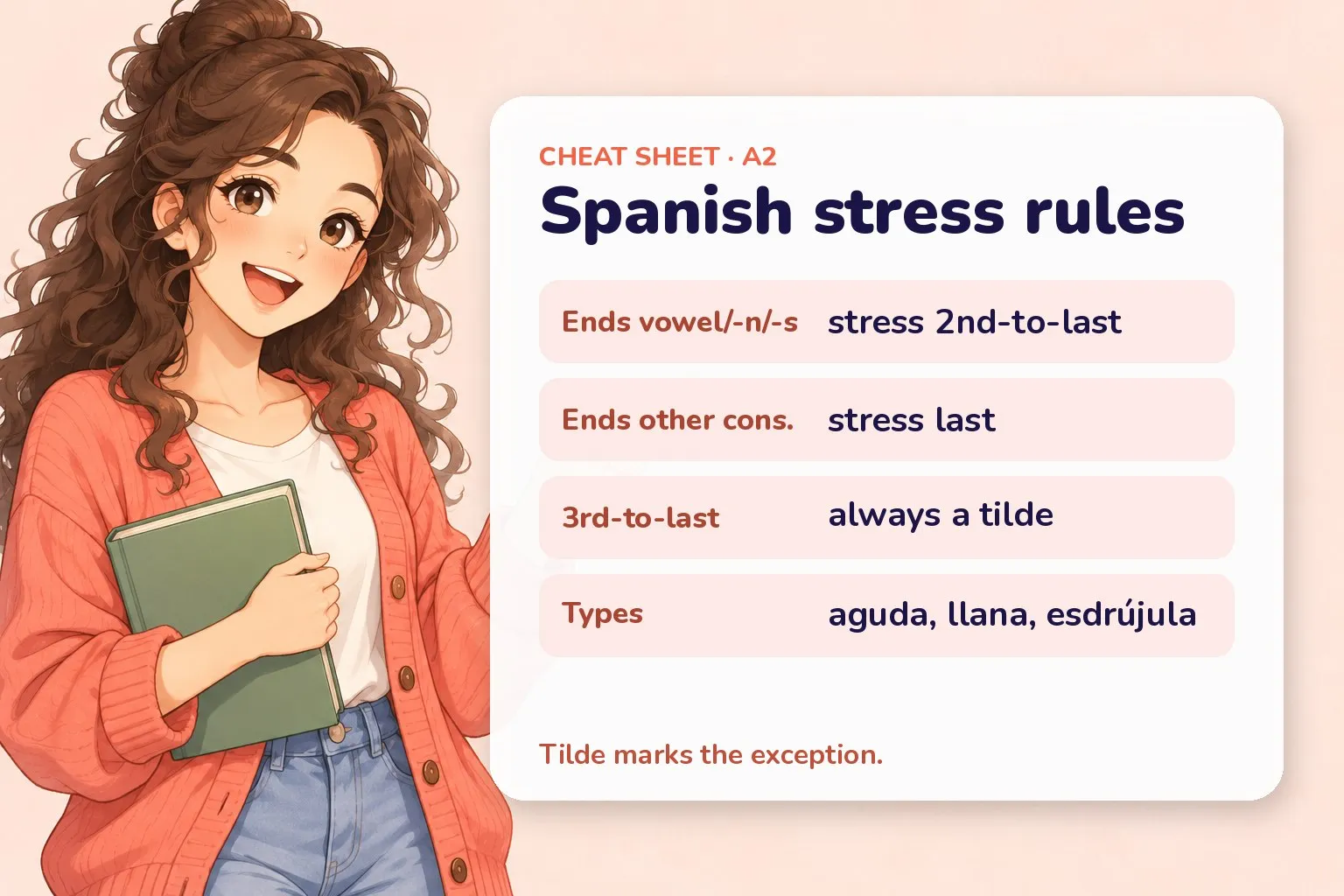
Quick recap before the quiz.
Quiz
Spanish syllables and stress quiz
8 questions · pick an answer and you'll see straight away if it's right.
-
Show answer
the vowel after it — It joins the following vowel: ca-sa, me-sa.
-
Show answer
b-r — A consonant + l or r (like br) stays together: li-bro.
-
Show answer
second-to-last syllable — That is the llana rule: ca-sa, co-men, lu-nes.
-
Show answer
last syllable — That is the aguda rule: pa-pel, ciu-dad.
-
Show answer
LU-nes — Ends in -s, so stress the second-to-last syllable: LU-nes.
-
Show answer
it ends in -z but is stressed on the first syllable — The rule predicts la-PIZ; the real stress is LA-piz, so a tilde marks it.
-
Show answer
esdrújula — Esdrújula: rá-pi-do, mé-di-co — always written with a tilde.
-
Show answer
co-che — The digraph ch is one unit and is never split: co-che.
Next
- Hear more sounds in the Spanish pronunciation overview
- Keep every vowel clean with Spanish vowels
- Build sentences in the Spanish grammar section or at Start Learning Spanish Here
All Spanish pronunciation & writing topics
Vocabulary, pronunciation, phrases, practice and exam help, ordered by level. Pick a topic and go straight to it. New lessons go live every day, so topics marked Coming soon fill in over the next weeks.
Pronunciation & writing
A1 5 topics · 5 ready
A2 3 topics · 3 ready
- 06 Tricky Spanish Consonants (c, z, j, g, r, rr)
- 07 Spanish Syllables & Word Stress You are here
- 08 Spanish Written Accents (Tildes)