Spanish Pronunciation Overview
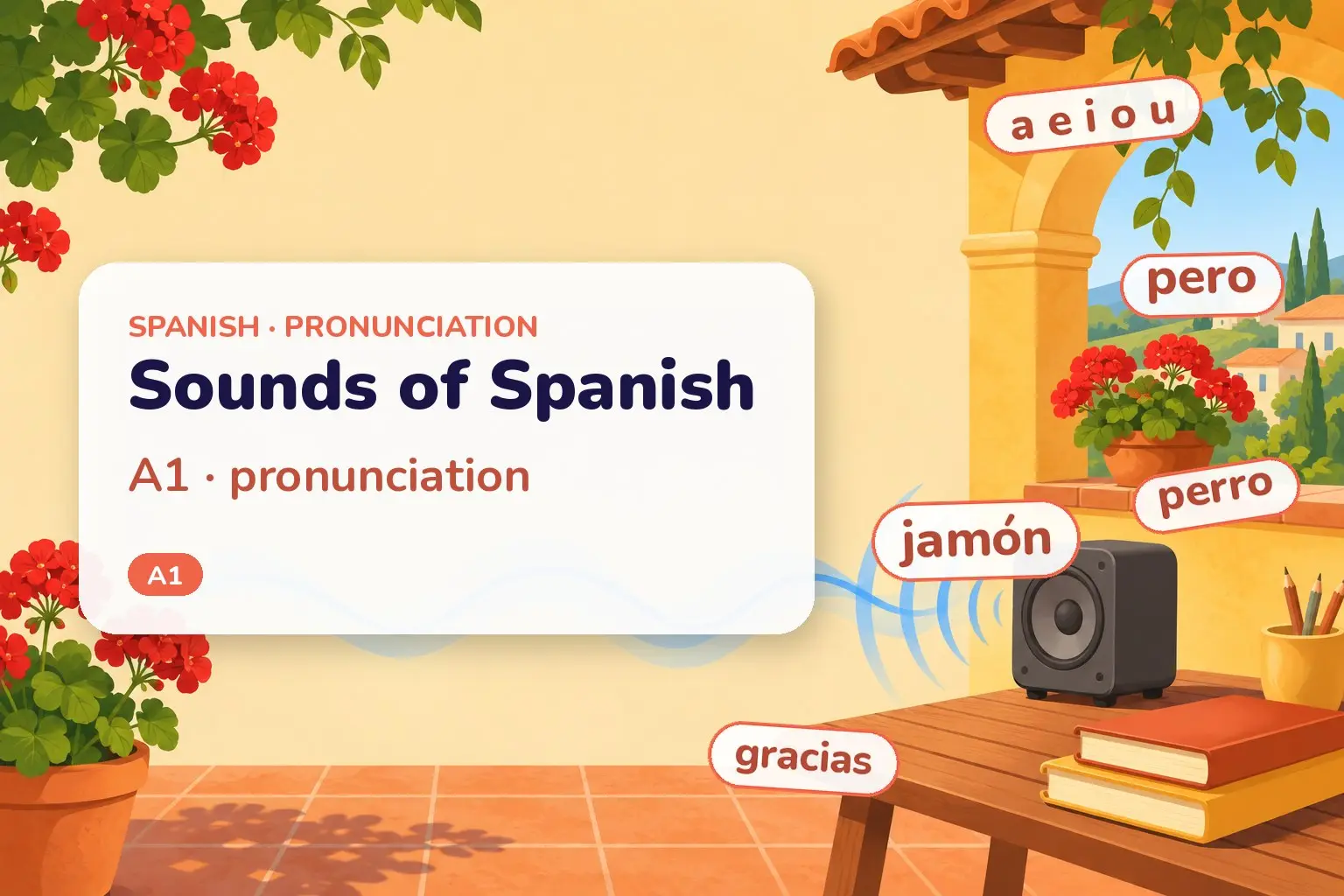
Spanish is one of the most phonetic major languages: five clear vowel sounds that never change, and spelling that almost always tells you the sound. Master a handful of consonants — the rolled rr, the throaty j, ñ and the silent h — and you will be understood.
Level: A1. Good news for your ears: Spanish is spelled almost exactly as it sounds. Once you learn the five vowels and a short list of consonants, you can read a new word and say it correctly. This page shows you what to focus on first.
By the end of this page you can…
…say the five Spanish vowels cleanly, name the consonants English speakers get wrong, place the stress correctly, and use the audio here to practise.
Spelling matches sound
Unlike English, Spanish spelling is a reliable map of its sound. Each letter almost always makes the same sound, so once you know the rules you rarely have to guess. The main things to learn are the five vowels, a handful of consonants, and where the stress falls.
A single distinct sound is called a phoneme. Spanish has only five vowel sounds — far fewer than English — and they stay the same in every word, stressed or not. That one fact removes most of the guesswork.
The five vowels
Learn these once and they never change:
| Vowel | Sound | Example |
|---|---|---|
| a | “ah” as in father | casa (house) |
| e | “eh” as in bed | mesa (table) |
| i | “ee” as in see, but short | sí (yes) |
| o | “oh” as in or, no glide | como (I eat) |
| u | “oo” as in food, but short | luna (moon) |
Two vowels together are each still pronounced, often gliding into one syllable: bien (well) is “byen”, not two slow beats.
The consonants to watch
Most consonants are close to English. Spend your effort on these:
- j, and g before e/i — a strong, throaty h from the back of the mouth: jamón (ham), gente (people).
- rr versus r — rr is a rolled trill (perro, dog); a single r between vowels is a quick tap, almost like the “dd” in “ladder” (pero, but). These two change the meaning.
- ñ — “ny” as in canyon: año (year), niño (child). Without the tilde, ano is a different word.
- ll and y — both usually sound like English “y” in “yes”: llamar (to call), yo (I). Regional variation exists (see below).
- h — always silent: hola (hello) is “OH-lah”, hora (hour) is “OH-rah”.
- b and v — the same sound, a soft b: vaca (cow) and bola (ball) start alike.
- c and z — before e/i (and z anywhere) they are “th” in most of Spain and “s” in Latin America: cinco (five), zapato (shoe).
How to say it
Four habits fix most beginner errors:
- Vowels: short and pure — never let como drift to “coh-oo-mo”.
- rr: let the tongue tip bounce on the ridge behind your teeth; practise with perro and carro.
- j: push air from the throat as in a strong “h”; practise with trabajo and mujer.
- Single r: a light tap, not an English r; pero is one quick flick of the tongue.
Listen and repeat with the audio
Press play on each word, then say it back. These contrast the sounds above.
- casahouseclean short vowels: KA-sa
- mesatablethe e is a short 'eh'
- lunamoonu is 'oo', short
- holahellothe h is silent: OH-la
- jamónhamthroaty j, stress on the ó
- gentepeopleg before e sounds like the throaty j
- perrodogrolled rr
- perobutsingle r is a light tap — a different word from perro
- añoyearñ is 'ny' as in canyon
- niñochildtwo ñ-style 'ny' and 'n' sounds
- llamarto callll sounds like English y
- yoIy like the 'y' in yes
- cincofivec before i: 'th' in Spain, 's' in Latin America
- zapatoshoez: 'th' in Spain, 's' in Latin America
- graciasthank youtwo syllables: GRA-thyas / GRA-syas
- EspañaSpainthe ñ again: es-PA-nya
Stress and the written accent
Spanish stress follows simple defaults, and the accent mark handles the rest:
- Words ending in a vowel, -n or -s are stressed on the second-to-last syllable: casa (CA-sa), hablan (HA-blan).
- Words ending in any other consonant are stressed on the last syllable: hotel (ho-TEL), reloj (re-LOJ).
- A written accent marks every exception and shows exactly where to push: café (ca-FÉ), lápiz (LÁ-piz), teléfono (te-LÉ-fo-no).
Regional variation
Spanish sounds slightly different across the Spanish-speaking world, and all of it is standard:
- c/z: “th” (distinción) in most of Spain; “s” (seseo) across Latin America and parts of southern Spain.
- ll and y: merged for most speakers (yeísmo); in some areas ll keeps a distinct sound.
- s at the end of a syllable: softened or dropped (to an “h”) in the Caribbean and southern Spain.
Pick one accent to imitate at first, then simply understand the others. None is more “correct”.
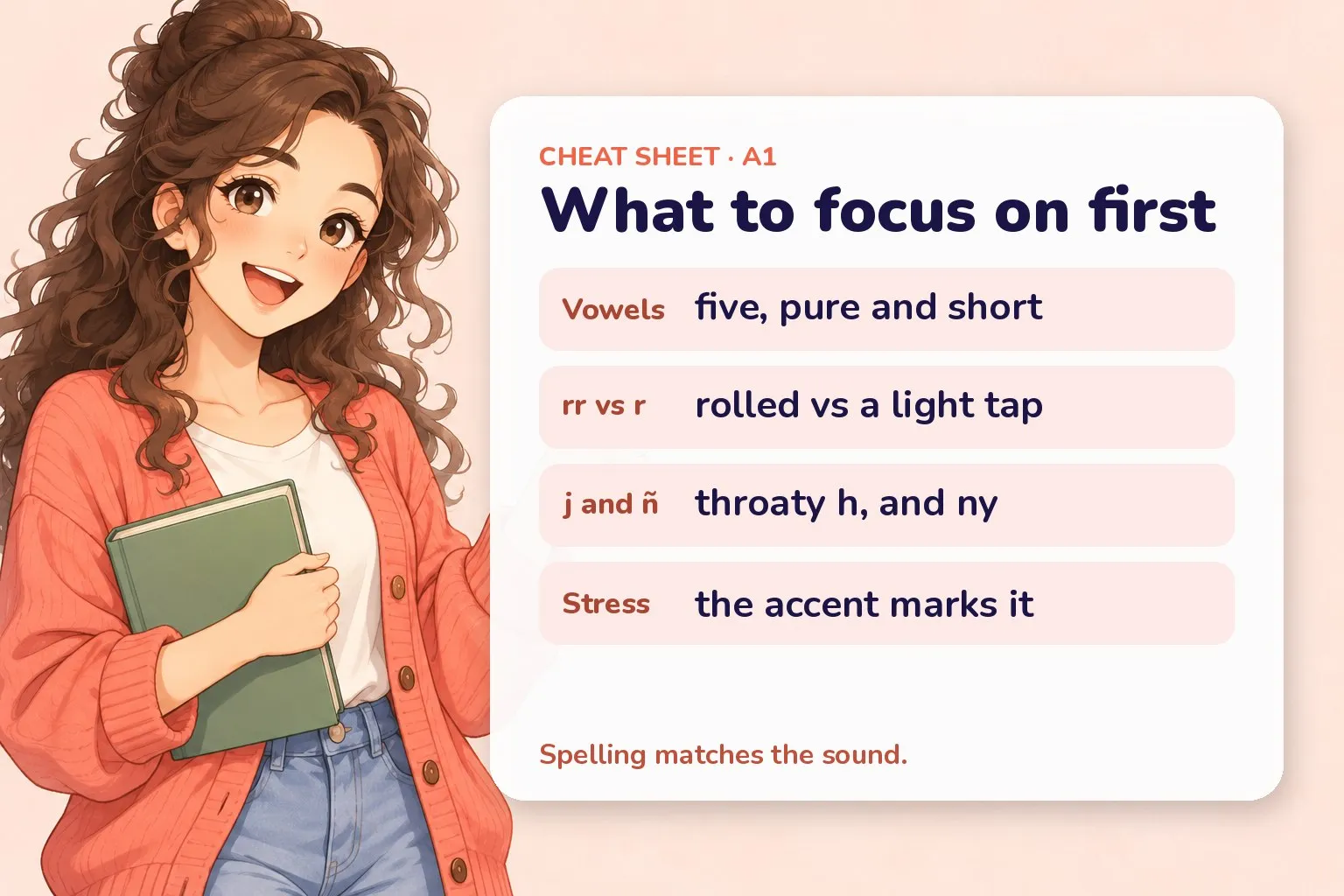
Quick recap before you practise.
Practice
Spanish pronunciation practice
Try each one, then press Check. No sign-up, nothing is sent anywhere — it all runs in your browser.
Hint: it starts 'hola' and 'hora'
Show answer
h — h is never pronounced: hola is 'OH-la'.
4 Match each letter to its sound.
- j
- ñ
- ll
- rr
Show answer
- j → throaty h
- ñ → ny as in canyon
- ll → y as in yes
- rr → rolled trill
j = throaty h, ñ = ny, ll = y, rr = rolled r.
Quiz
Spanish pronunciation overview quiz
8 questions · pick an answer and you'll see straight away if it's right.
-
Show answer
spelling almost always matches the sound — Spanish spelling is a reliable guide to pronunciation.
-
Show answer
pure, short and always the same — a, e, i, o, u keep one clean sound in every word.
-
Show answer
a throaty h — jamón and gente use a strong, throaty h sound.
-
Show answer
the rolled rr versus a single tapped r — rr is a trill; a single r is a quick tap — and the words mean different things.
-
Show answer
ny as in canyon — año and niño use the 'ny' sound.
-
Show answer
always silent — h is never pronounced: hola = OH-la.
-
Show answer
the second-to-last syllable — casa is CA-sa; the default stress is second-to-last for these endings.
-
Show answer
Latin America and parts of southern Spain — Seseo ('s') is standard across Latin America; much of Spain uses 'th'.
Next
- Build words into sentences with the regular -AR verbs lesson
- Browse every topic in the Spanish grammar section
- New here? Start with Start Learning Spanish Here
All Spanish pronunciation & writing topics
Vocabulary, pronunciation, phrases, practice and exam help, ordered by level. Pick a topic and go straight to it. New lessons go live every day, so topics marked Coming soon fill in over the next weeks.
Pronunciation & writing
A1 5 topics · 1 ready
- 01 Spanish Pronunciation Overview You are here
- 02 The Spanish Alphabet Coming soon
- 03 Spanish Vowels (5 Pure Sounds) Coming soon
- 04 Spanish b, v and silent h Coming soon
- 05 Spanish Punctuation (inverted ? and !) Coming soon
A2 3 topics
- 06 Tricky Spanish Consonants (c, z, j, g, r, rr) Coming soon
- 07 Spanish Syllables & Word Stress Coming soon
- 08 Spanish Written Accents (Tildes) Coming soon
B1 1 topics
- 09 Seseo, Ceceo & Yeismo (Regional Sounds) Coming soon