Tricky Spanish Consonants: c, z, j, g, r, rr, h
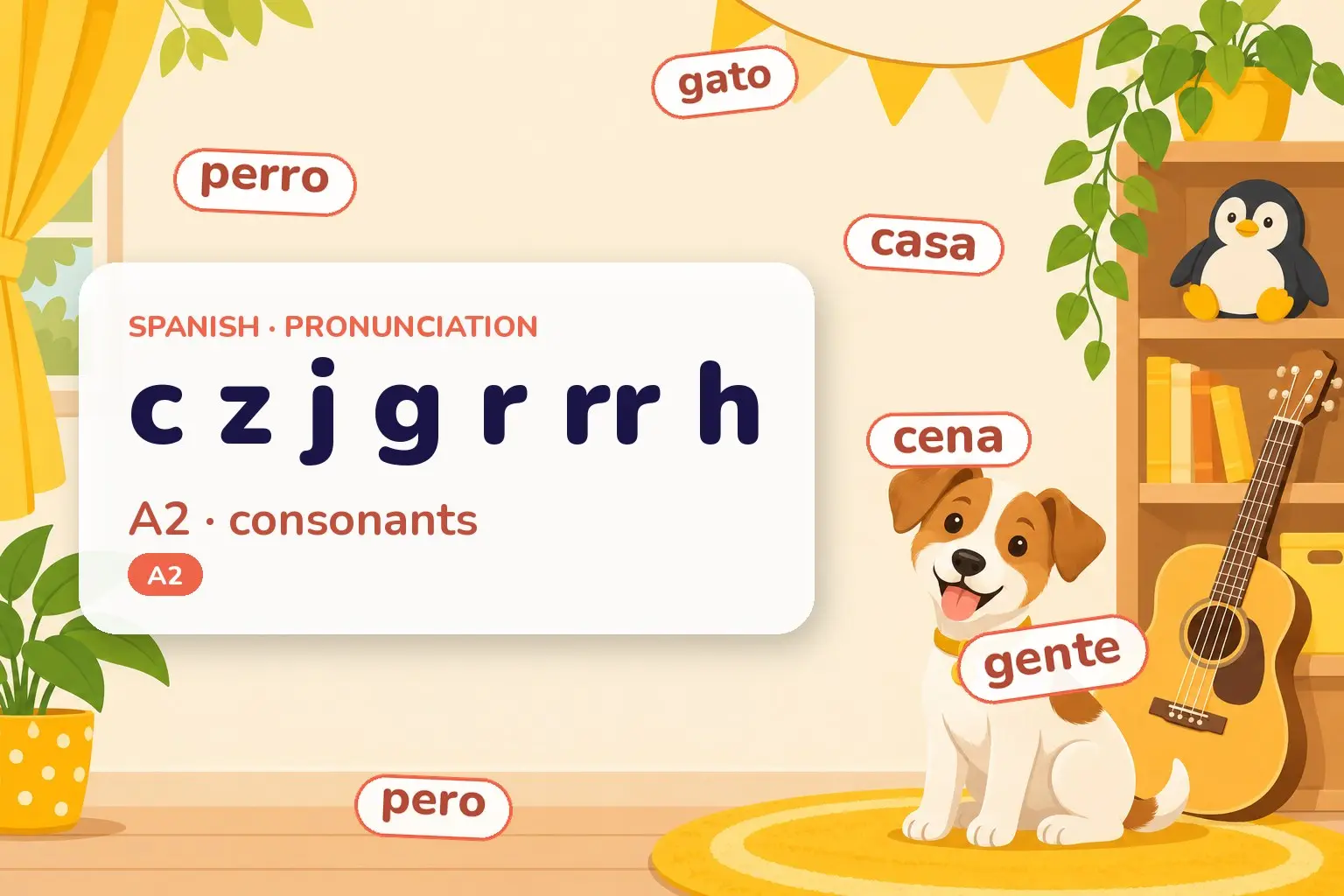
A handful of Spanish consonants trip up English speakers: c and z sound like 'th' (Spain) or 's' (Latin America) before e/i, j and soft g are a raspy 'h', a single r is a quick tap while rr is rolled, and h is always silent.
Level: A2. Spanish spelling is wonderfully regular, but a few consonants do not sound the way an English reader expects. Master this short list — c and z, j and g, the two r sounds, and the silent h — and you will read almost any Spanish word aloud correctly.
By the end of this page you can…
…predict how c, z, j, g, r, rr and h sound from their spelling, tell a tapped r from a rolled rr, and read the example words aloud with the audio here.
c and z: “th” or “s”
The letter c has two jobs:
- Before a, o, u (or a consonant) it is a hard “k”: casa, color, cuatro.
- Before e, i it softens. In most of Spain it is the “th” of thin; in Latin America and southern Spain it is a plain “s”: cena, ciudad.
The letter z makes that same soft sound in every position — “th” in Spain, “s” in Latin America: zapato, luz. Both pronunciations are standard; pick one and stay consistent.
j and soft g: the raspy “h”
The letter j is a raspy “h” made at the back of the throat, stronger than an English h: jamón, rojo, trabajo.
The letter g shares that raspy sound before e and i: gente, gigante sound as if spelled with a j. Before a, o, u the same letter g is a hard “g” as in go: gato, gota, gustar.
| Spelling | Sound | Example |
|---|---|---|
| ga, go, gu | hard “g” | gato, gota, gustar |
| ge, gi | raspy “h” (like j) | gente, gigante |
| ja, jo, ju, je, ji | raspy “h” | jamón, rojo, jirafa |
Keeping a hard g: gu and the two dots
To write a hard g before e or i, Spanish inserts a silent u: gue, gui. The u is not pronounced — it only protects the hard sound: guerra (“GEH-rra”), guitarra (“gee-TA-rra”).
If you do want that u to sound, it wears two dots, the diéresis: güe, güi, pronounced “gw”: pingüino (“peen-GWEE-no”), vergüenza.
One r or two: tap versus trill
Spanish has two r sounds, and they can change a word’s meaning:
- A single r between vowels is a quick tap, like the middle of American “water”: pero (but), cara, toro.
- A rolled rr is a trill, several taps in a row: perro (dog), carro, torre.
A single r is also trilled when it starts a word or follows n, l or s: rojo, Roma, alrededor all begin the r with a full trill.
The silent h
The letter h is never pronounced in modern Spanish. Ignore it and say the next sound: hola is “OH-la”, hombre is “OM-bre”, ahora is “ah-OH-ra”. The only time h makes a sound is inside the pair ch, which is the “ch” of chico.
Listen and read the words
Press play, then read each word aloud, using the sound noted beside it.
- casahousec before a = hard k
- cenadinnerc before e = th / s
- ciudadcityc before i = th / s
- zapatoshoez = th / s
- luzlightfinal z = th / s
- jamónhamj = raspy h
- rojoredj = raspy h
- gentepeopleg before e = raspy h
- gigantegiantg before i = raspy h
- gatocatg before a = hard g
- gustarto likeg before u = hard g
- guitarraguitargui = hard g, silent u
- guerrawargue = hard g, silent u
- pingüinopenguingüi = 'gwi', the u sounds
- perobutsingle r = one tap
- perrodogrr = rolled trill
- RomaRomeword-initial r = trill
- holahelloh is silent
- hombremanh is silent
- chicoboych = the 'ch' sound
Practice
Tricky Spanish consonants practice
Try each one, then press Check. No sign-up, nothing is sent anywhere — it all runs in your browser.
Hint: gu before i guards the hard g
Show answer
no — The u in gui is silent; it only keeps the g hard.
4 Match each spelling to its sound.
- ca
- ce
- ge
- ga
Show answer
- ca → hard k
- ce → th / s
- ge → raspy h
- ga → hard g
c and g both soften before e and i; they stay hard before a, o, u.
Hint: think about whether you hear it
Show answer
silent — h is always silent: hola is 'OH-la'.
Quiz
Tricky Spanish consonants quiz
10 questions · pick an answer and you'll see straight away if it's right.
-
Show answer
a hard k — Before a, o, u the c is a hard k.
-
Show answer
th (Spain) or s (Latin America) — Before e or i the c softens to th / s.
-
Show answer
th / s, like soft c — z makes the same th / s sound as soft c, in every position.
-
Show answer
a raspy h from the throat — j is a raspy h, stronger than an English h.
-
Show answer
a hard g like 'go' — Before a, o, u the g is hard: gato.
-
Show answer
gue, gui — gue and gui give a hard g with a silent u: guerra, guitarra.
-
Show answer
the u is now pronounced ('gw') — The diéresis (ü) makes the u sound: 'peen-GWEE-no'.
-
Show answer
one quick tap — A single r between vowels is one tap; the trill is rr.
-
Show answer
at the start of a word or after n, l, s — A word-initial r, or one after n, l or s, is trilled: Roma, rojo.
-
Show answer
silent — h is never pronounced: hombre is 'OM-bre'.
Next
- Review the vowels first in Spanish vowels
- See the whole alphabet in the Spanish alphabet guide
- New here? Start with Start Learning Spanish Here
All Spanish pronunciation & writing topics
Vocabulary, pronunciation, phrases, practice and exam help, ordered by level. Pick a topic and go straight to it. New lessons go live every day, so topics marked Coming soon fill in over the next weeks.
Pronunciation & writing
A1 5 topics · 5 ready
A2 3 topics · 3 ready
- 06 Tricky Spanish Consonants (c, z, j, g, r, rr) You are here
- 07 Spanish Syllables & Word Stress
- 08 Spanish Written Accents (Tildes)