Introduction to Kanji: What They Are and How to Learn Them
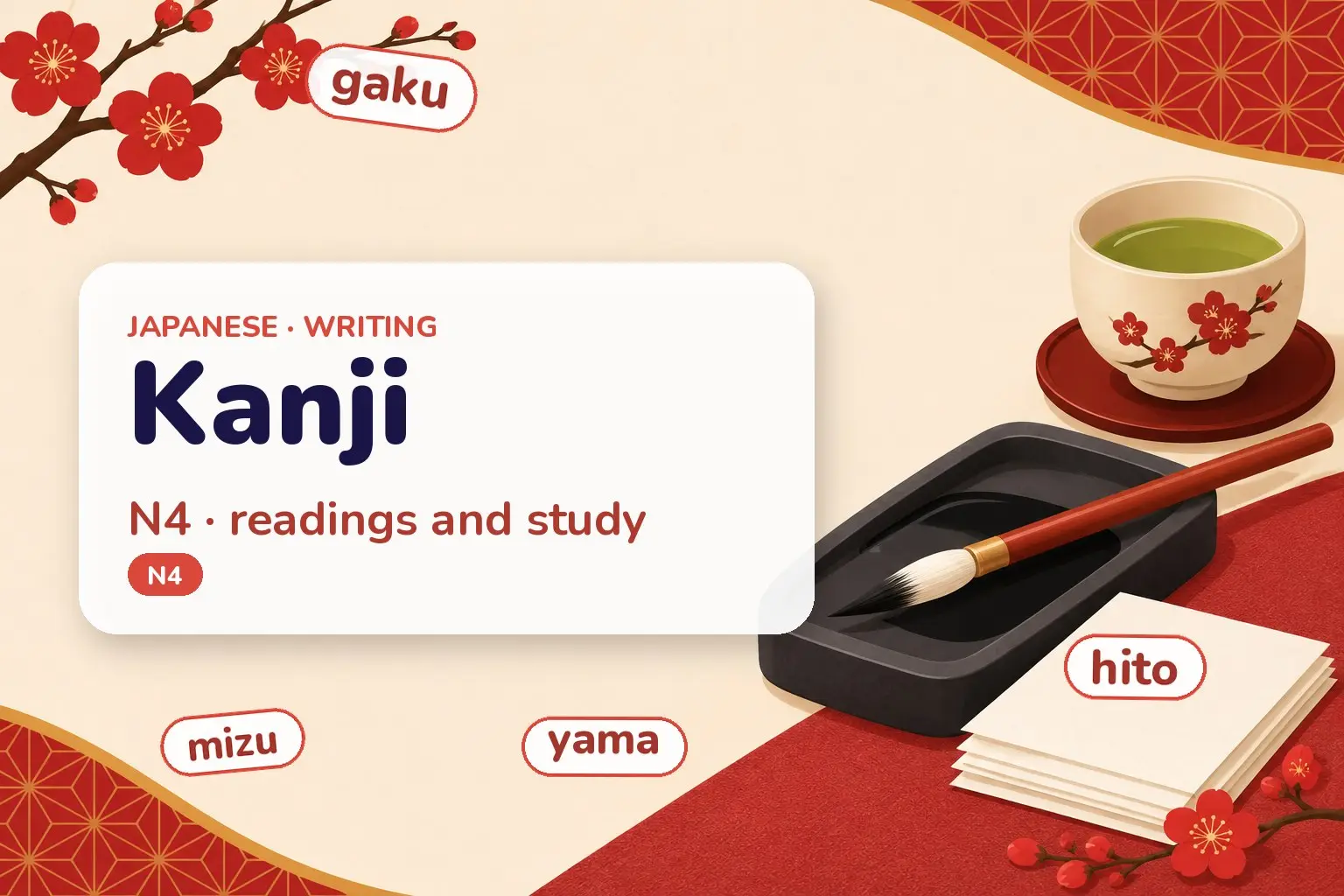
Kanji are characters borrowed from Chinese, and each one carries a meaning rather than a single sound. The reading changes with the word: 山 (yama) alone is 'mountain', but inside 火山 (kazan, volcano) the same character is read zan.
On this page12 sections · tap to jump
Level: N4. Kanji are the part of Japanese that looks impossible from outside and turns out to be a memory system once you see how it works. This page explains what the characters are, where their readings come from, and how to study them without drowning.
What kanji are
Japanese is written with three scripts at once. Hiragana spells sounds and carries the grammar: particles, verb endings, the polite endings that hold a sentence together. Katakana spells loanwords and emphasis. Kanji carry meaning: the nouns, the stems of verbs and adjectives, and most names.
A kanji is logographic, which means one character stands for a word or a piece of meaning, not for one sound. In 私は学生です (watashi wa gakusei desu, “I am a student”), the three kanji 私 (watashi, I), 学 (gaku, study) and 生 (sei, life) carry the content; the は (wa) and です (desu) around them are hiragana doing grammar.
The Japanese government fixes how many characters general writing needs. The 常用漢字 (jōyō kanji, regular-use kanji) table, issued as a cabinet notification in 2010, is that guide, and newspapers and official documents are written within it.
On’yomi and kun’yomi
Most characters have one or more 音読み (on’yomi), a reading borrowed from Chinese along with the character, and most also have one or more 訓読み (kun’yomi), native Japanese words attached to the meaning. Characters invented in Japan, 国字 (kokuji, characters made in Japan), are the exception: 畑 (hatake, field), 峠 (tōge, mountain pass) and 込 (komu) have no on’yomi at all. English textbooks call the first an on reading and the second a kun reading. Dictionaries print on’yomi in katakana and kun’yomi in hiragana, a convention worth knowing when you open one.
| Kanji | Meaning | On’yomi | Kun’yomi | Reading example |
|---|---|---|---|---|
| 山 | mountain | サン (san) | やま (yama) | 富士山 (Fujisan, Mount Fuji) |
| 水 | water | スイ (sui) | みず (mizu) | 水曜日 (suiyōbi, Wednesday) |
| 人 | person | ジン (jin), ニン (nin) | ひと (hito) | 日本人 (nihonjin, Japanese person) |
| 日 | day, sun | ニチ (nichi) | ひ (hi) | 日曜日 (nichiyōbi, Sunday) |
| 大 | big | ダイ (dai) | おおきい (ōkii) | 大学 (daigaku, university) |
| 学 | study | ガク (gaku) | まなぶ (manabu) | 学生 (gakusei, student) |
Why one character has several readings
The character keeps its meaning; the word decides the sound. That is the whole system, and it is less arbitrary than it looks. On’yomi readings cluster inside compounds, where two or more characters are pressed together to make one word. Kun’yomi readings appear when a character stands with hiragana around it, or on its own.
The clearest demonstration is 日 (nichi, hi). In 日曜日 (nichiyōbi, Sunday) the same character appears twice and is read two different ways: 日 (nichi) at the front and 日 (bi) at the end. Nothing in the character changed. The word did.
Okurigana tells you which reading
Okurigana is the hiragana written after a character as part of the same word. It marks the end of the word and points at a specific reading. 食べる (taberu, to eat) uses the kun’yomi of 食 (ta) plus the hiragana ending べる (beru); 食事 (shokuji, a meal) has no okurigana and uses the on’yomi しょく (shoku).
The same signal works for adjectives. 高い (takai, expensive, tall) has its ending in hiragana, while 高校 (kōkō, high school) is a bare compound. When you write by hand, getting the okurigana right matters as much as getting the kanji right: 食べる (taberu) with the ending left out is a misspelling, not a variant.
Radicals: the parts inside a character
Most characters are built from smaller pieces. The organising piece is the 部首 (bushu), called the radical in English, and dictionaries file characters under it. 語 (go, language) is 言 (gonben, the speech radical) plus 吾 (go); 話 (hanasu, to speak) shares the same speech radical, which is why both words are about language.
Radicals hint at a meaning family rather than give a definition. The water radical 氵 (sanzui) appears in 泳ぐ (oyogu, to swim) and 池 (ike, pond); the tree radical 木 (ki) appears in 林 (hayashi, woods) and 桜 (sakura, cherry tree). Learning the common radicals pays back twice: faster recognition and a better guess at an unknown character’s meaning.
How to study kanji
- Learn words, not characters. A character is a shape plus a meaning; a word is what you can actually say. Add 電話 (denwa, telephone) as a word and 電 (den) and 話 (wa) come with it.
- Give each new character three to five words. Words fix the readings in place and stop the reading list from floating free.
- Write by hand at first. Stroke order is not a rule you will be tested on, but the muscle memory makes the shape stick, and handwriting is still how forms and notes work.
- Review on a schedule. Ten new characters a day, reviewed the next day, the next week and the next month, beats a hundred in one sitting that vanish by Friday.
- Read something real. Signs, menus, packaging, a page of a graded reader. Recognition built in context survives; recognition built only in an app does not.
Common mistakes
- ✗ 私わ学生です (watashi wa gakusei desu) → ✓ 私は学生です (watashi wa gakusei desu). The topic particle is written は (wa), not わ (wa), even though both are pronounced the same.
- ✗ Writing the verb as the bare character 食 (shoku) → ✓ 食べる (taberu). A verb carries its okurigana; the character alone is not the word.
- ✗ Assuming 山 (yama) is always yama → ✓ 富士山 (Fujisan). Inside a compound the on’yomi san takes over.
- ✗ Treating a compound as the sum of its parts → ✓ 大人 (otona, adult) is read as a block. If the parts do not add up, look the word up.
A short conversation
A: 山は何と読みますか。(Yama wa nan to yomimasu ka.) — How do you read this character? B: やまです。(Yama desu.) — Yama. A: 富士山もやまですか。(Fujisan mo yama desu ka.) — Is it yama in Fujisan as well? B: いいえ、さんです。(Iie, san desu.) — No, it is san.
Example sentences
- 私は学生です。Watashi wa gakusei desu.I am a student.学 (gaku) and 生 (sei) are both on'yomi here.
- 水を飲みます。Mizu o nomimasu.I drink water.水 stands alone, so it takes the kun'yomi mizu.
- 山が見えます。Yama ga miemasu.I can see the mountain.山 alone is yama.
- 日本へ行きます。Nihon e ikimasu.I am going to Japan.日本 (Nihon) is a compound read with on'yomi.
- 毎日日本語を勉強します。Mainichi nihongo o benkyō shimasu.I study Japanese every day.毎日 (mainichi) uses 日 as nichi.
- 今日は天気がいいです。Kyō wa tenki ga ii desu.The weather is nice today.今日 is jukujikun: the whole word is kyō.
- 大人は千円です。Otona wa sen en desu.It is 1,000 yen for adults.大人 is jukujikun again; 千円 is sen en.
- 三月に友達が来ます。Sangatsu ni tomodachi ga kimasu.A friend is coming in March.月 (gatsu) is the on'yomi used for months.
- 友達と映画を見ました。Tomodachi to eiga o mimashita.I watched a film with a friend.映画 (eiga) is a two-character compound.
- 電車で会社へ行きます。Densha de kaisha e ikimasu.I go to the office by train.電 (den) appears again in 電話 (denwa, telephone).
- 明日は休みです。Ashita wa yasumi desu.Tomorrow is a day off.明日 is read ashita, not from its parts.
- 食べ物を買いました。Tabemono o kaimashita.I bought food.食べ物 (tabemono) mixes a kun stem with an on reading.
- 新しい先生は親切です。Atarashii sensei wa shinsetsu desu.The new teacher is kind.
- 銀行は駅の前です。Ginkō wa eki no mae desu.The bank is in front of the station.
- 日本語の新聞を読みます。Nihongo no shinbun o yomimasu.I read a Japanese newspaper.
- 漢字を書くのは楽しいです。Kanji o kaku no wa tanoshii desu.Writing kanji is fun.書 (kaku) is a kun'yomi with its okurigana.
- 時間がありません。Jikan ga arimasen.I do not have time.
- この漢字は何と読みますか。Kono kanji wa nan to yomimasu ka.How do you read this kanji?A question you will use a hundred times.
Practice
Kanji practice
Try each one, then press Check. No sign-up, nothing is sent anywhere — it all runs in your browser.
Hint: kun'yomi
Show answer
mizu — Alone, 水 takes its kun'yomi mizu; the on'yomi sui appears in compounds like 水曜日 (suiyōbi).
4 Match each character to its meaning.
- 山 (yama)
- 水 (mizu)
- 人 (hito)
- 学 (gaku)
Show answer
- 山 (yama) → mountain
- 水 (mizu) → water
- 人 (hito) → person
- 学 (gaku) → study
Four of the most frequent characters in everyday text.
5 Build the sentence: 'I study Japanese every day.'
Show answer
私は (watashi wa) 毎日 (mainichi) 日本語を (nihongo o) 勉強します (benkyō shimasu) — Topic first, then the time word, then the object with を (o), then the verb at the end.
Hint: it is the character for 'speak'
Show answer
wa — 電話 (denwa) is 電 (den) plus 話 (wa), the same 話 as in 話す (hanasu).
Quiz
Kanji introduction quiz
10 questions · pick an answer and you'll see straight away if it's right.
-
Show answer
a word or piece of meaning — Kanji are logographic: they carry meaning, while hiragana spells sounds.
-
Show answer
hiragana — Grammar endings and particles are written in hiragana.
-
Show answer
a reading borrowed from Chinese — On'yomi came into Japanese with the character; kun'yomi are native words attached to the meaning.
-
Show answer
in compounds of two or more characters — Compounds such as 大学 (daigaku) are read with on'yomi.
-
Show answer
the hiragana written after a character as part of the word — Okurigana marks the end of a word and points at a specific reading, as in 食べる (taberu).
-
Show answer
otona — 大人 (otona) is jukujikun: the whole word has a reading that cannot be built from its characters.
-
Show answer
べる (beru) — Okurigana is the hiragana after the character: 食 plus べる (beru).
-
Show answer
the government's guide to characters for general writing — It is the cabinet-notified table of characters for general social life, and official writing stays within it.
-
Show answer
nichi — The first 日 (nichi) takes the on reading, and the closing 日 (bi) takes a different one.
-
Show answer
the organising part of a character, used in dictionaries — Dictionaries file characters under a radical such as 言 (speech) in 語 (go, language).
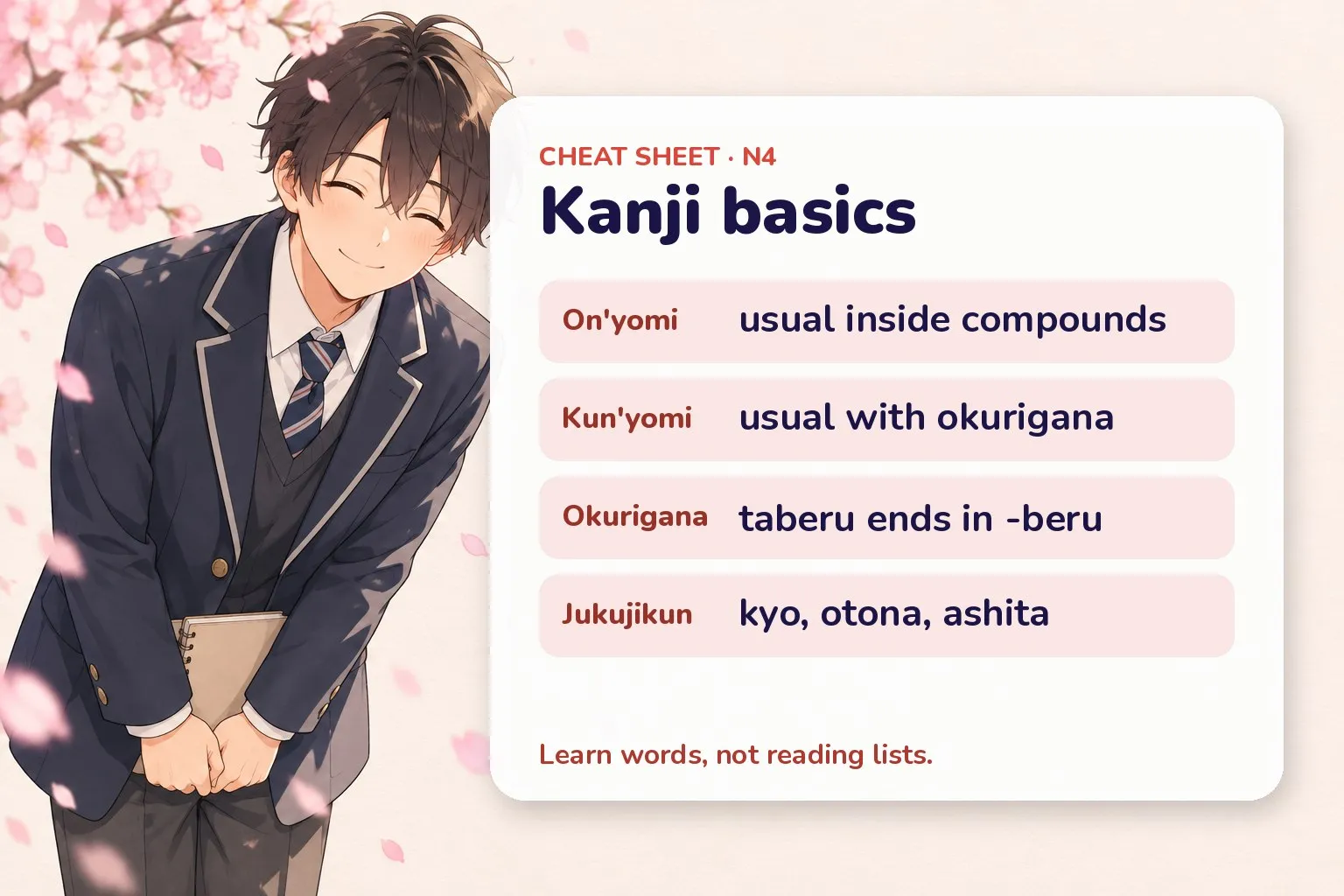
Quick recap before the quiz.
Recap cheat-sheet
| Term | What it means | Example (with reading) |
|---|---|---|
| Kanji (漢字, kanji) | Character carrying meaning, borrowed from Chinese | 山 (yama, mountain) |
| On’yomi (音読み, on’yomi) | Sino-Japanese reading, usual inside compounds | 火山 (kazan, volcano) |
| Kun’yomi (訓読み, kun’yomi) | Native reading, usual with okurigana | 食べる (taberu, to eat) |
| Okurigana (送り仮名, okurigana) | Hiragana after the character, part of the word | 高い (takai, expensive) |
| Jukujikun (熟字訓, jukujikun) | Whole-word reading that ignores the parts | 今日 (kyō, today) |
| Radical (部首, bushu) | Organising part used to file the character | 言 (gonben, speech) in 語 (go) |
Next
- Learn the sound system first with the complete hiragana chart
- Then the katakana shapes in the katakana chart
- Kanji readings change inside verbs: see the dictionary (plain) form
- New to the language? Start with Start Learning Japanese Here
All Japanese pronunciation & writing topics
Vocabulary, pronunciation, phrases, practice and exam help, ordered by level. Pick a topic and go straight to it. New lessons go live every day, so topics marked Coming soon fill in over the next weeks.
Pronunciation & writing
N5 9 topics · 6 ready
- 01 Japanese Pronunciation Overview
- 02 Hiragana Chart (Complete)
- 03 Katakana Chart (Complete)
- 04 Dakuten & Handakuten (゛ ゜)
- 05 Yoon: Combined Kana (きゃ しゅ ちょ kya shu cho)
- 06 Long Vowels & Small Tsu (Sokuon)
- 07 Kanji & Kana Stroke Order Rules Coming soon
- 08 Romaji: Systems & Why to Move Beyond It Coming soon
- 09 Essential N5 Kanji Set Coming soon
N4 4 topics · 1 ready
- 10 Introduction to Kanji You are here
- 11 Kanji Radicals (Bushu) Coming soon
- 12 Kanji Readings: On'yomi vs Kun'yomi Coming soon
- 13 Essential N4 Kanji Set Coming soon
N3 2 topics · 1 ready
- 14 Japanese Pitch Accent (Intro)
- 15 When to Use Kana vs Kanji Coming soon