Japanese Long Vowels & Small Tsu (Sokuon)
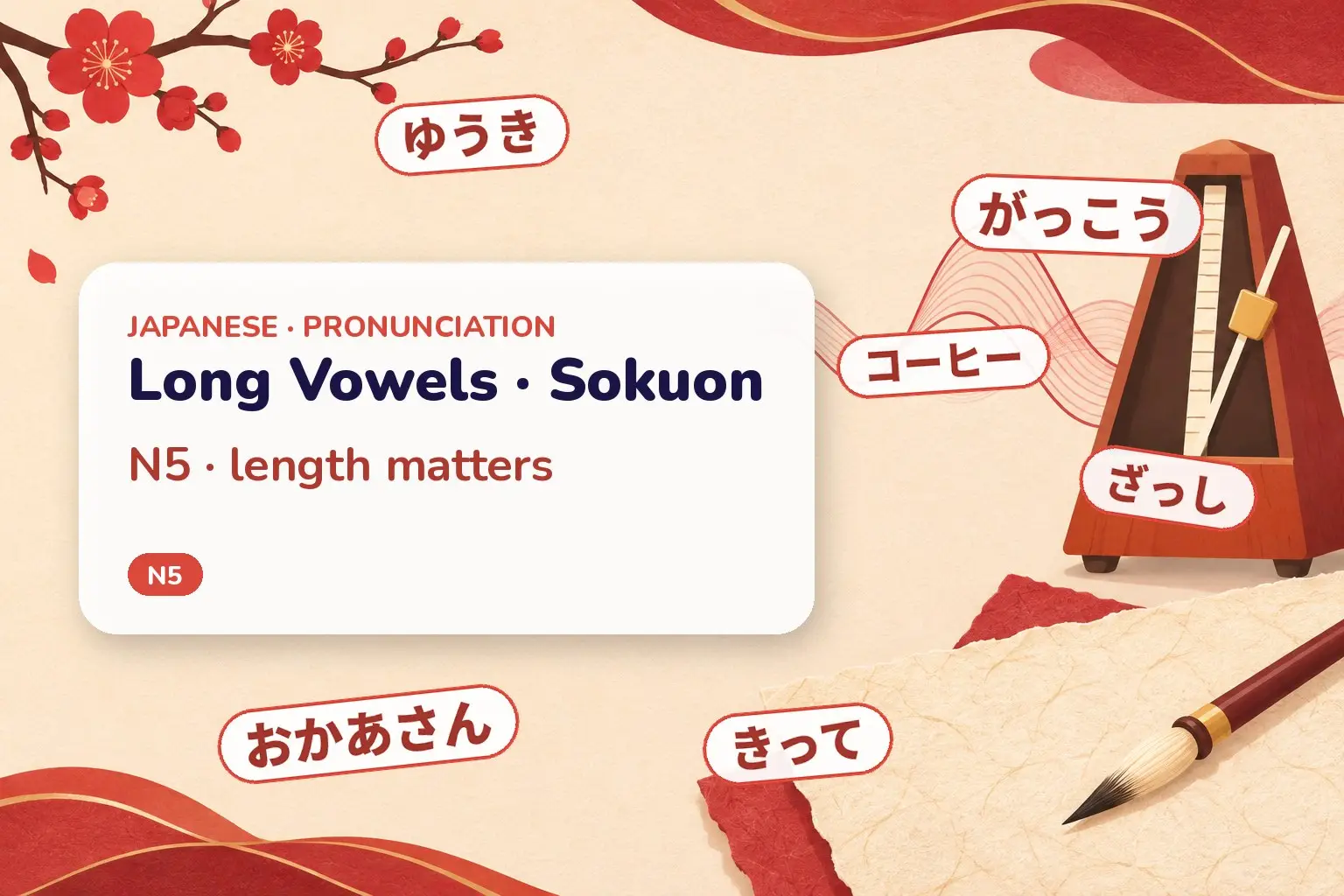
A long vowel holds a kana sound for two beats (おかあさん, okāsan, 'mother'), and the small tsu っ (sokuon) doubles the next consonant with a short pause (きって, kitte, 'stamp'). Both change meaning, so length matters.
Level: N5. Japanese is timed in even beats called mora. Two of those beats are easy to miss as a beginner — a long vowel and the tiny pause of the small tsu っ (sokuon) — yet both can change a word into a completely different one. Get the length right and you sound much clearer.
By the end of this page you can…
…spell and pronounce long vowels in hiragana and katakana, recognise the small tsu っ (sokuon), and hear the difference in minimal pairs like きて (kite) and きって (kitte).
Long vowels: hold the sound for two beats
A long vowel, or 長音 (chōon), is simply a vowel held for two mora instead of one. In hiragana you write it by adding a vowel kana after the syllable, and which vowel you add follows the row:
| Vowel row | Usually add | Example | Reading |
|---|---|---|---|
| あ (a) | あ | おかあさん | okāsan (mother) |
| い (i) | い | おにいさん | oniisan (older brother) |
| う (u) | う | くうき | kūki (air) |
| え (e) | い (sometimes え) | せんせい | sensei (teacher) |
| お (o) | う (sometimes お) | おとうさん | otōsan (father) |
Most え-row long vowels are written with い (i) — せんせい (sensei), えいが (eiga, “movie”) — and most お-row long vowels with う (u) — おとうさん (otōsan), がっこう (gakkō, “school”). A short list of words breaks the pattern and doubles the same vowel instead: おおきい (ōkii, “big”), とおい (tōi, “far”), おねえさん (onēsan, “older sister”). These are worth memorising because they look like exceptions.
In katakana, long vowels are far simpler: you draw a single bar, ー (the chōonpu), no matter the vowel. コーヒー (kōhī, “coffee”), ラーメン (rāmen), ケーキ (kēki, “cake”).
Why length changes the word
Because a long vowel is a real extra beat, dropping it makes a different word:
- おばさん (obasan, “aunt”) vs おばあさん (obāsan, “grandmother”)
- おじさん (ojisan, “uncle”) vs おじいさん (ojiisan, “grandfather”)
- ゆき (yuki, “snow”) vs ゆうき (yūki, “courage”)
- え (e, “picture”) vs ええ (ē, “yes”)
The small tsu っ (sokuon): a doubled consonant
The small tsu — written っ (sokuon) in hiragana, ッ (sokuon) in katakana — is the mark 促音 (sokuon). It is not pronounced “tsu” at all. Instead it marks a brief stop, and in romaji it shows up as a doubled consonant:
- きて (kite, “come”) vs きって (kitte, “stamp”)
- かた (kata, “shoulder”) vs かった (katta, “won / bought”)
- がっこう (gakkō, “school”), ざっし (zasshi, “magazine”), きっぷ (kippu, “ticket”)
To make the sound, hold the mouth in position for one beat of silence before releasing the next consonant — like the catch in the middle of English “bookkeeper”. The small tsu only ever sits before the か (ka), さ (sa), た (ta) and ぱ (pa) rows (k, s, t, p sounds). It never appears before な (na), ま (ma), や (ya), ら (ra), わ (wa) or a vowel.
Listen and compare
Press play, then say each word, giving long vowels two full beats and the small tsu its pause.
- おかあさんokāsanmotherあ-row long vowel
- おとうさんotōsanfatherお-row long vowel spelled with う
- せんせいsenseiteacherえ-row long vowel spelled with い
- えいがeigamovie
- コーヒーkōhīcoffeekatakana bar ー
- ラーメンrāmenramen
- くうきkūkiairう-row long vowel
- おおきいōkiibigexception: お doubled
- おばさんobasanauntshort vowel
- おばあさんobāsangrandmotherlong vowel — different word
- ゆきyukisnowshort
- ゆうきyūkicouragelong — different word
- きてkitecomeno small tsu
- きってkittestampsmall tsu doubles the t
- がっこうgakkōschoolsokuon plus long vowel
- ざっしzasshimagazinedoubled s
- いっぱいippaia lot / fulldoubled p
- ちょっとまってくださいchotto matte kudasaiplease wait a momenttwo sokuon
Practice
Long vowels and small tsu practice
Try each one, then press Check. No sign-up, nothing is sent anywhere — it all runs in your browser.
Hint: coffee
Show answer
kōhī — コーヒー (kōhī) uses the bar ー to mark each long vowel.
4 Match each word to its meaning.
- ゆき (yuki)
- ゆうき (yūki)
- きて (kite)
- きって (kitte)
Show answer
- ゆき (yuki) → snow
- ゆうき (yūki) → courage
- きて (kite) → come
- きって (kitte) → stamp
A long vowel or a small tsu changes the meaning.
Hint: it only precedes k, s, t, p
Show answer
na-row — The sokuon never comes before な, ま, や, ら or a vowel; it does appear before the た (ta) row.
Quiz
Long vowels and small tsu quiz
10 questions · pick an answer and you'll see straight away if it's right.
-
Show answer
two beats (mora) — A long vowel is held for two mora.
-
Show answer
a bar ー (chōonpu) — Katakana uses the chōonpu bar ー (chōonpu) for every long vowel.
-
Show answer
う (u) — おとうさん (otōsan), がっこう (gakkō): お-row long vowels usually take う (u).
-
Show answer
おばさん (obasan) — Short おばさん (obasan) is 'aunt'; long おばあさん (obāsan) is 'grandmother'.
-
Show answer
a doubled consonant with a short stop — It doubles the next consonant and adds a brief pause, as in きって (kitte).
-
Show answer
きって (kitte) — きって (kitte) has the small っ (sokuon), doubling the t.
-
Show answer
た (ta) row — The sokuon precedes only か (ka), さ (sa), た (ta) and ぱ (pa) sounds.
-
Show answer
by doubling お (o) — These exceptions double the vowel お (o) instead of using う (u).
-
Show answer
a long vowel — The long ū makes ゆうき (yūki) 'courage' versus ゆき (yuki) 'snow'.
-
Show answer
kitte — The small tsu doubles the t: kitte.
Recap cheat-sheet
| Feature | What it is | Example | Reading |
|---|---|---|---|
| Long vowel (hiragana) | add a vowel kana | おかあさん | okāsan |
| Long vowel (katakana) | the bar ー | コーヒー | kōhī |
| Small tsu っ (sokuon) | doubled consonant | きって | kitte |
| Both together | hold then double | がっこう | gakkō |
Next
- Review the base kana in the hiragana chart
- Learn voiced kana in dakuten and handakuten
- New here? Start with Start Learning Japanese Here
All Japanese pronunciation & writing topics
Vocabulary, pronunciation, phrases, practice and exam help, ordered by level. Pick a topic and go straight to it. New lessons go live every day, so topics marked Coming soon fill in over the next weeks.
Pronunciation & writing
N5 9 topics · 6 ready
- 01 Japanese Pronunciation Overview
- 02 Hiragana Chart (Complete)
- 03 Katakana Chart (Complete)
- 04 Dakuten & Handakuten (゛ ゜)
- 05 Yoon: Combined Kana (きゃ しゅ ちょ kya shu cho)
- 06 Long Vowels & Small Tsu (Sokuon) You are here
- 07 Kanji & Kana Stroke Order Rules Coming soon
- 08 Romaji: Systems & Why to Move Beyond It Coming soon
- 09 Essential N5 Kanji Set Coming soon
N4 4 topics
- 10 Introduction to Kanji Coming soon
- 11 Kanji Radicals (Bushu) Coming soon
- 12 Kanji Readings: On'yomi vs Kun'yomi Coming soon
- 13 Essential N4 Kanji Set Coming soon
N3 2 topics · 1 ready
- 14 Japanese Pitch Accent (Intro)
- 15 When to Use Kana vs Kanji Coming soon