Dakuten & Handakuten: Voiced Kana (゛ ゜)
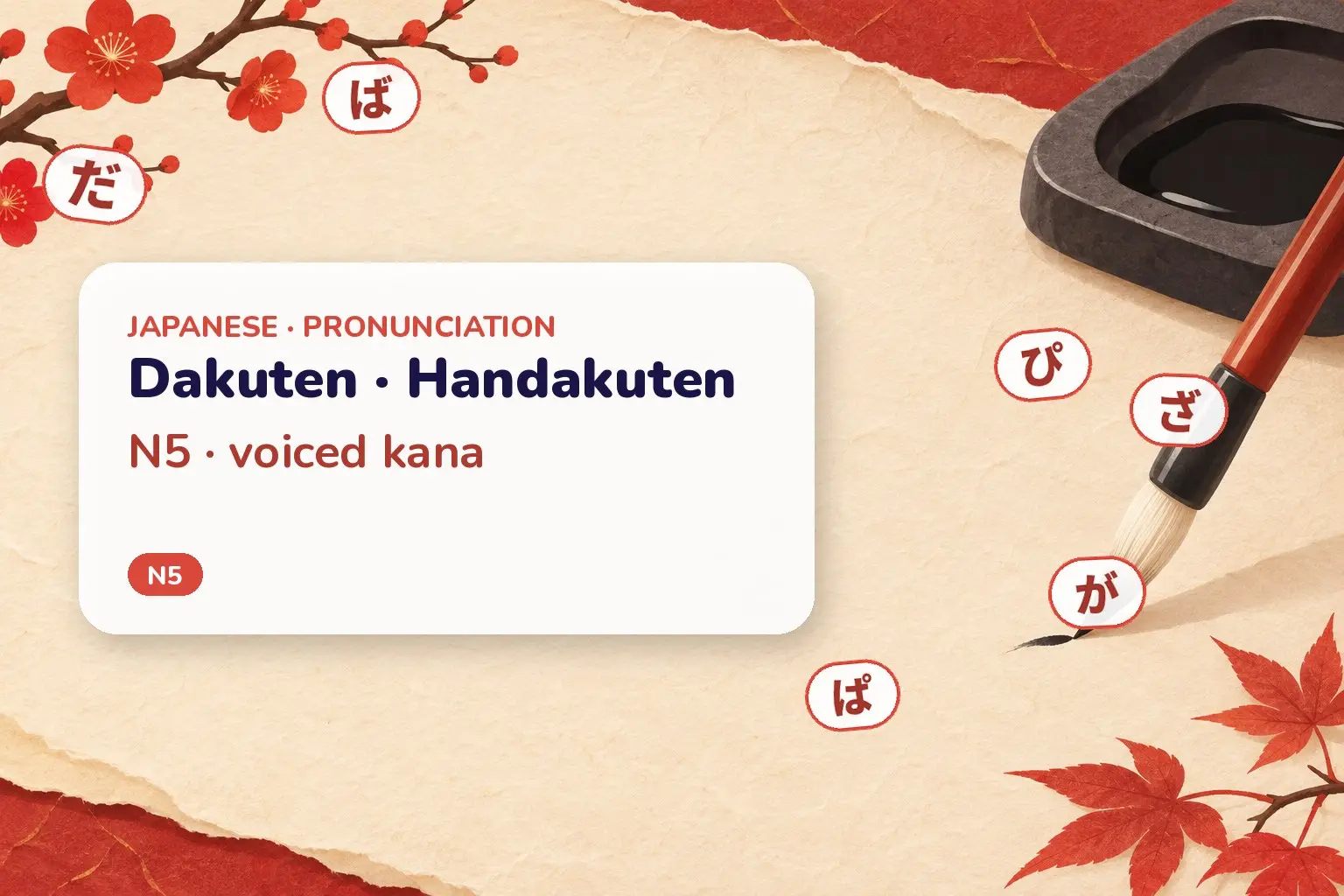
Dakuten (゛), two small strokes, voices a kana: か (ka) becomes が (ga), and the same mark makes ざ (za), だ (da) and ば (ba). Handakuten (゜), a small circle, turns the は-row (ha-row) into p-sounds, so は (ha) becomes ぱ (pa).
Level: N5. Once you can read the 46 basic hiragana, two tiny marks unlock 25 more sounds without learning a single new character shape. They are the dakuten ゛ (two strokes) and the handakuten ゜ (a small circle), and they are how Japanese writes its voiced and “p” sounds.
By the end of this page you can…
…recognise the dakuten and handakuten marks, read every voiced kana (ga/za/da/ba) and p-kana (pa), and use the audio here to practise real words.
What the two marks are
A voiced sound is one where your vocal cords vibrate: the difference between “k” (voiceless) and “g” (voiced), or “s” and “z”. Japanese shows voicing with a small add-on mark rather than a new letter.
- Dakuten ゛ (two strokes), also called ten-ten, sits at the top-right of a kana. It voices the consonant: か (ka) becomes が (ga).
- Handakuten ゜ (a small circle), also called maru, sits at the top-right too. It applies only to the は-row (ha-row) and makes a “p” sound: は (ha) becomes ぱ (pa).
The mark never changes the vowel. が (ga) keeps the “a” of か (ka); ぴ (pi) keeps the “i” of ひ (hi). You are only switching the consonant on.
The voiced kana (dakuten)
Four rows take the dakuten. Read across; every cell shows the kana and its reading.
| Row (base to voiced) | a | i | u | e | o |
|---|---|---|---|---|---|
| k to g | が (ga) | ぎ (gi) | ぐ (gu) | げ (ge) | ご (go) |
| s to z | ざ (za) | じ (ji) | ず (zu) | ぜ (ze) | ぞ (zo) |
| t to d | だ (da) | ぢ (ji) | づ (zu) | で (de) | ど (do) |
| h to b | ば (ba) | び (bi) | ぶ (bu) | べ (be) | ぼ (bo) |
Three readings are not the plain voiced sound you might expect: し (shi) voices to じ (ji), ち (chi) voices to ぢ (ji), and つ (tsu) voices to づ (zu). So the さ-row (sa-row) and た-row (ta-row) each hide a “ji” and a “zu”.
The p-sounds (handakuten)
Only the は-row (ha-row) takes the handakuten, and it gives the “p” sounds.
| Row (base to p) | a | i | u | e | o |
|---|---|---|---|---|---|
| h to p | ぱ (pa) | ぴ (pi) | ぷ (pu) | ぺ (pe) | ぽ (po) |
So the single kana は (ha) has three possible readings: は (ha) on its own, ば (ba) with a dakuten, and ぱ (pa) with a handakuten. The mark alone tells you which.
Listen and read voiced words
Press play, then say each word aloud. Notice the voiced or p-kana inside it.
- かぎkagikeyぎ (gi) is voiced き
- ごはんgohancooked rice; a mealご (go) from こ
- まどmadowindowど (do) is voiced と
- みずmizuwaterず (zu) is voiced す
- かぜkazewind; a coldぜ (ze) is voiced せ
- ざっしzasshimagazineざ (za) is voiced さ
- ぎんこうginkōbankぎ (gi) plus a long vowel
- だいがくdaigakuuniversityだ (da) and が (ga) in one word
- でんわdenwatelephoneで (de) is voiced て
- ぶたbutapigぶ (bu) is voiced ふ
- べんとうbentōboxed lunchべ (be) from へ
- ぱんpanbreadぱ (pa): handakuten on は
- きっぷkipputicketぷ (pu) p-sound
- さんぽsanpoa walkぽ (po) p-sound
- てんぷらtenpuratempuraぷ (pu) after ん
Practice
Dakuten and handakuten practice
Try each one, then press Check. No sign-up, nothing is sent anywhere — it all runs in your browser.
Hint: it is not 'zi'
Show answer
ji — し (shi) voices to じ (ji), an irregular reading.
4 Match each kana to its reading.
- が (ga)
- ざ (za)
- だ (da)
- ぱ (pa)
Show answer
- が (ga) → voiced か (ka)
- ざ (za) → voiced さ (sa)
- だ (da) → voiced た (ta)
- ぱ (pa) → は (ha) + handakuten
Dakuten voices か (ka), さ (sa), た (ta) and は (ha); handakuten makes は (ha) into ぱ (pa).
Hint: the small circle
Show answer
pa — The handakuten turns は (ha) into ぱ (pa).
Quiz
Dakuten and handakuten quiz
8 questions · pick an answer and you'll see straight away if it's right.
-
Show answer
two short strokes — Dakuten is two short strokes at the top-right of a kana.
-
Show answer
が (ga) — The dakuten voices か (ka) into が (ga).
-
Show answer
the は-row (ha-row) — Only the は-row (ha-row) takes the handakuten, giving p-sounds.
-
Show answer
ぱ (pa) — は (ha) plus a handakuten is ぱ (pa).
-
Show answer
none of them — The mark changes only the consonant; the vowel stays the same.
-
Show answer
ji — し (shi) voices to じ (ji), not 'zi'.
-
Show answer
ず (zu) and づ (zu) — ず (zu) and づ (zu) are pronounced the same; spelling usually uses ず (zu).
-
Show answer
mado — ま (ma) + ど (do, voiced と) = mado, 'window'.
Recap cheat-sheet
| Mark | Shape | Effect | Example |
|---|---|---|---|
| dakuten | two strokes | voices か (ka), さ (sa), た (ta), は (ha) | か (ka), が (ga) |
| handakuten | small circle | は-row (ha-row) to p-sounds | は (ha), ぱ (pa) |
| irregular | — | し (shi), ち (chi), つ (tsu) voiced | じ (ji), ぢ (ji), づ (zu) |
Next
- Review the base sounds in the complete hiragana chart
- See the same marks in katakana in the katakana chart
- New here? Start with Start Learning Japanese Here
All Japanese pronunciation & writing topics
Vocabulary, pronunciation, phrases, practice and exam help, ordered by level. Pick a topic and go straight to it. New lessons go live every day, so topics marked Coming soon fill in over the next weeks.
Pronunciation & writing
N5 9 topics · 6 ready
- 01 Japanese Pronunciation Overview
- 02 Hiragana Chart (Complete)
- 03 Katakana Chart (Complete)
- 04 Dakuten & Handakuten (゛ ゜) You are here
- 05 Yoon: Combined Kana (きゃ しゅ ちょ kya shu cho)
- 06 Long Vowels & Small Tsu (Sokuon)
- 07 Kanji & Kana Stroke Order Rules Coming soon
- 08 Romaji: Systems & Why to Move Beyond It Coming soon
- 09 Essential N5 Kanji Set Coming soon
N4 4 topics
- 10 Introduction to Kanji Coming soon
- 11 Kanji Radicals (Bushu) Coming soon
- 12 Kanji Readings: On'yomi vs Kun'yomi Coming soon
- 13 Essential N4 Kanji Set Coming soon
N3 2 topics · 1 ready
- 14 Japanese Pitch Accent (Intro)
- 15 When to Use Kana vs Kanji Coming soon