How to Practise Italian Writing
To practise Italian writing, write a little daily and build in stages: get single sentences right, join them into paragraphs with connectors, then get feedback and rewrite. Check every adjective agrees with its noun and that your accents (è, perché) are in place.
On this page11 sections · tap to jump
- 01By the end of this page you can…
- 02Why write at all
- 03Stage 1 — correct single sentences
- 04Stage 2 — join sentences into paragraphs
- 05Stage 3 — the feedback loop
- 06What to write, by level
- 07Model answers — use them well
- 08Example sentences to build from
- 09The errors to hunt in your own drafts
- 10Practice
- 11Quiz
Level: B1. Writing is the skill where Italian agreement becomes real. Speaking, you can slur an ending; writing, you must decide whether it is bianco, bianca, bianchi or bianche. That makes writing the best place to drill the endings until they come automatically.
By the end of this page you can…
…run a daily Italian writing routine, move from single sentences to paragraphs, set up a feedback loop that improves your drafts, and target the agreement, accent and false-friend errors that mark a learner’s Italian.
Why write at all
Writing gives you time to make the choices Italian demands: the gender of the noun, the ending of the adjective, the right preposition-plus-article (del, nella, alla). A rule you apply correctly on paper, with time to think, is nearly ready for speech.
Stage 1 — correct single sentences
Write five to ten short sentences a day about real life, and check each against a rule you know:
- Does the adjective agree with its noun? (un libro rosso, una macchina rossa, due libri rossi.)
- Is the article right for the sound that follows? (lo studente, gli studenti, l’amico.)
- Did you drop the subject pronoun? Italian usually does: Vado a casa, not Io vado a casa unless you stress it.
Stage 2 — join sentences into paragraphs
Link your sentences with connectors, and watch the mood they trigger:
- Plain connectors (e, ma, perché, quindi) keep the indicative: Resto a casa perché piove.
- Some connectors ask for the subjunctive at B1 and up (benché, affinché, sebbene): Esco benché piova. Leave these until the indicative is solid.
Write a five-sentence paragraph with at least one perché reason, then reread it checking every ending agrees.
Stage 3 — the feedback loop
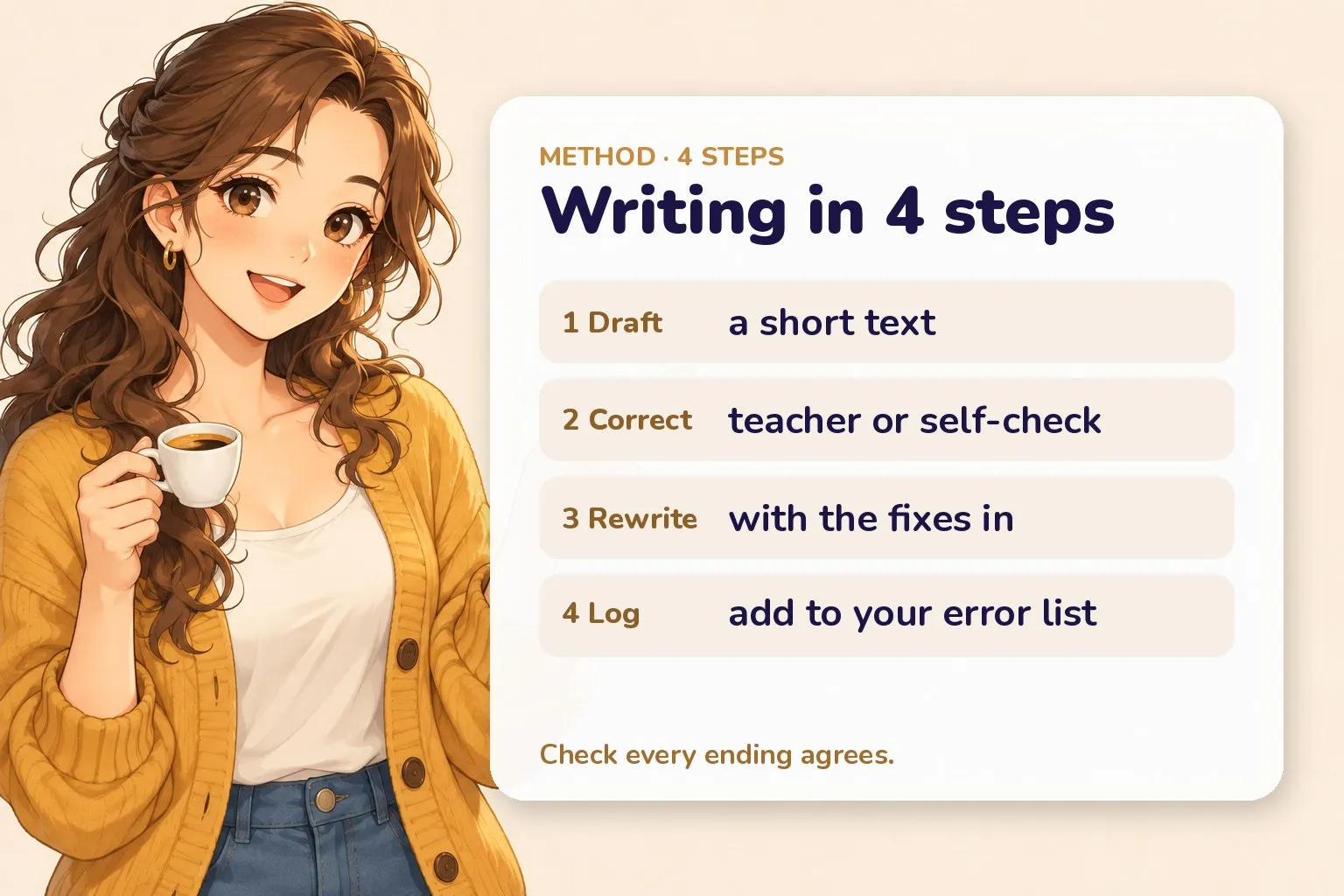
- Draft a short text — a paragraph, an email, a diary entry.
- Get it corrected by a teacher, a partner, or a careful self-check against your grammar pages.
- Rewrite the whole thing with the corrections in place. This is the step that teaches.
- Log the error — wrong form, right form, one word on why.
What to write, by level
- A1–A2: a daily diary in the present, a self-introduction, a shopping list with articles, a postcard.
- B1: a 120–150 word email (a booking, a complaint, an invitation), an opinion paragraph with perché reasons, a short summary.
- B2 and up: a structured argument with da un lato … dall’altro, a formal letter, a narrative in the passato prossimo and imperfetto.
The CILS exam materials from the Università per Stranieri di Siena are organised by CEFR level, so you can match a writing task to where you are.
Model answers — use them well
Write your own version first, then read the model and compare. Mark what it did that you did not: the connectors, the set phrases (Gentile Signore, Cordiali saluti, Le scrivo perché…), the way it kept tenses consistent. Then rewrite yours, borrowing a move or two.
Example sentences to build from
Clean frames to adapt — keep the structure, change the content words:
- Mi piace molto la cucina italiana.I really like Italian cooking.piace + singular noun
- Mi piacciono i film italiani.I like Italian films.piacciono + plural noun
- Resto a casa perché piove.I'm staying home because it's raining.perché = because, indicative
- Vorrei prenotare un tavolo per due.I'd like to book a table for two.polite request frame
- Le scrivo perché ho una domanda.I'm writing to you because I have a question.formal email opener
- Da un lato è caro, dall'altro è comodo.On one hand it's expensive, on the other it's convenient.balanced argument
- Ieri il tempo era brutto, ma oggi è bello.Yesterday the weather was bad, but today it's nice.imperfetto era vs è
- Spero che tu stia bene.I hope you're well.che + subjunctive (stia)
- Cordiali salutiKind regards (formal letter close)set phrase
- Prima ... poi ... infine ...First ... then ... finally ...sequence connectors for a paragraph
Quick recap before you practise.
The errors to hunt in your own drafts
- Adjective not agreeing: una macchina rosso → una macchina rossa.
- Missing accent that changes meaning: e bello (and nice?) → è bello (it’s nice).
- perché without its accent or stressed wrong: write perché, say “pehr-KEH”.
- Wrong preposition + article: a il cinema → al cinema; in la casa → nella casa.
- False friend: attualmente means “currently”, not “actually” — for “actually” use in realtà.
Practice
Italian writing-routine practice
Try each one, then press Check. No sign-up, nothing is sent anywhere — it all runs in your browser.
Hint: macchina is feminine singular
Show answer
rossa — Feminine singular: una macchina rossa.
4 Build: 'I'm staying home because it's raining.'
Show answer
Resto a casa perché piove — perché links the reason in the indicative.
5 Match the contraction to its parts.
- al
- nella
- del
- sulla
Show answer
- al → a + il
- nella → in + la
- del → di + il
- sulla → su + la
Italian merges many prepositions with the article.
Quiz
Italian writing-practice quiz
8 questions · pick an answer and you'll see straight away if it's right.
-
Show answer
correct single sentences — Build accuracy at sentence level first.
-
Show answer
adjective/noun agreement — Endings must match in gender and number.
-
Show answer
una casa bianca — Feminine singular casa takes bianca.
-
Show answer
is — è = 'is'; e (no accent) = 'and'.
-
Show answer
it applies the fix actively — Rewriting turns a passive note into practice.
-
Show answer
al — a + il = al (al cinema).
-
Show answer
currently — A false friend: attualmente = currently; use in realtà for 'actually'.
-
Show answer
piacciono — With a plural thing, use piacciono.
Next
- Turn writing into reading practice: Italian Reading Practice: Intermediate (B1)
- Drill agreement first in the Italian grammar section
- New here? Start with Start Learning Italian Here
All Italian practice topics
Vocabulary, pronunciation, phrases, practice and exam help, ordered by level. Pick a topic and go straight to it. New lessons go live every day, so topics marked Coming soon fill in over the next weeks.
Practice
A1 1 topics · 1 ready
A2 4 topics · 2 ready
- 02 How to Practise Italian Listening
- 03 Italian Reading Practice: Elementary
- 04 Essere vs Avere Practice Set Coming soon
- 05 Italian Preposition+Article Practice Coming soon
B1 4 topics · 3 ready
- 06 Shadowing to Improve Italian Speaking
- 07 Italian Reading Practice: Intermediate
- 08 How to Practise Italian Writing You are here
- 09 Passato Prossimo vs Imperfetto Practice Coming soon
B2 3 topics · 1 ready
- 10 Italian Reading Practice: Upper-Intermediate
- 11 Italian Subjunctive (Congiuntivo) Practice Coming soon
- 12 Italian Combined Pronouns Practice Coming soon