Italian: Greetings & Introductions
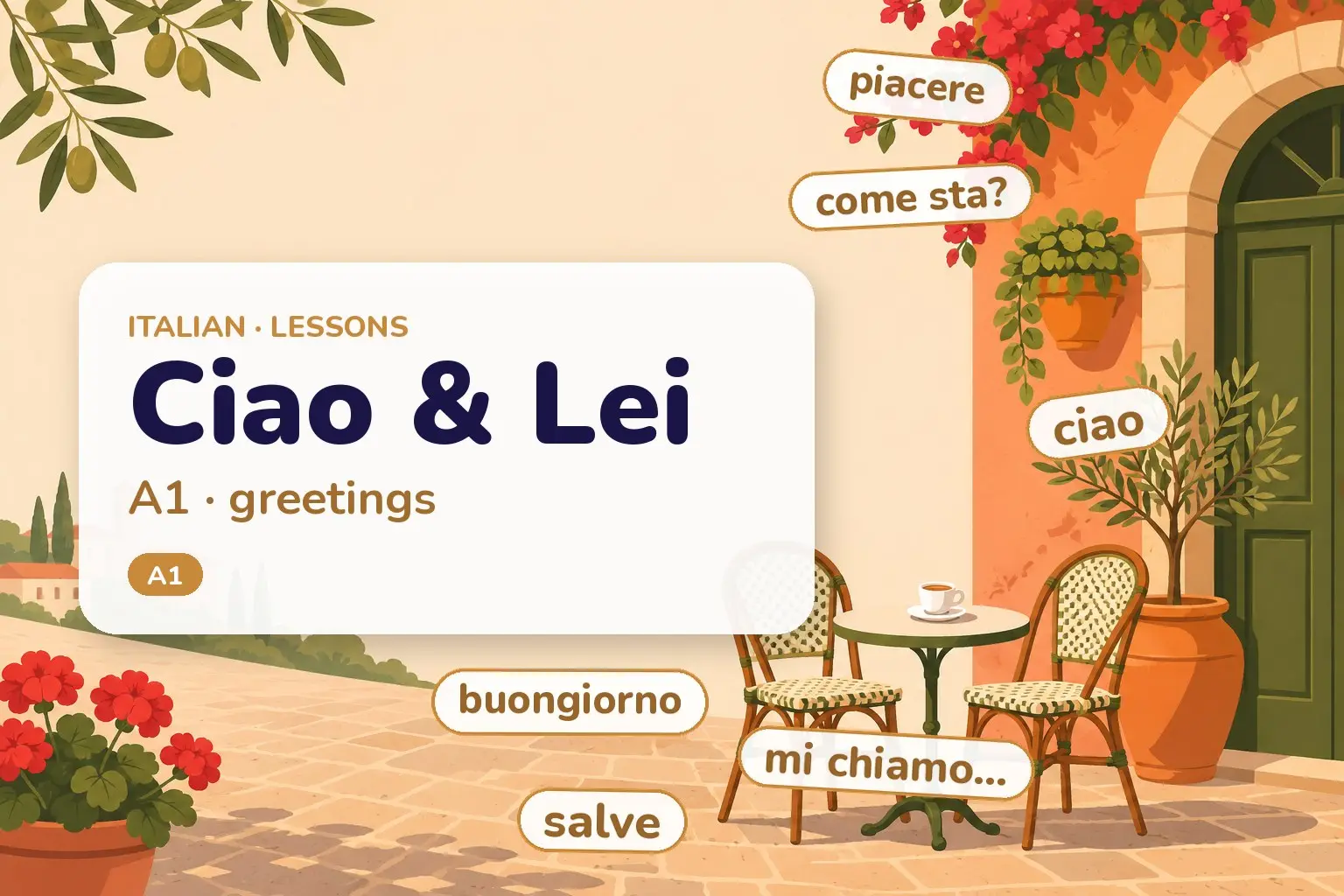
Italian greetings split by formality: ciao for friends and family, buongiorno and arrivederci for anyone else, and salve in between. Introduce yourself with Mi chiamo… or Sono…, add Piacere, and choose tu or Lei before you speak.
Level: A1. Italian gives you more than one way to say hello, and the choice is not decoration — it tells the other person how you are placing the relationship. Learn the pairs (informal and formal) from the first day and you will never sound rude by accident.
By the end of this lesson you can…
…greet someone appropriately at any time of day, say goodbye, ask how they are, give your name and where you are from, introduce a third person, and pick between tu and Lei without guessing.
Hello and goodbye
Two decisions run through this whole page: when in the day, and how formal the situation is.
| Italian | English | Register |
|---|---|---|
| Ciao | Hi / bye | informal — friends, family, children |
| Buongiorno | Good morning / good day | neutral-polite, until mid-afternoon |
| Buonasera | Good evening | neutral-polite, from late afternoon |
| Buonanotte | Goodnight | only when parting for the night |
| Salve | Hello | middle formality — neither warm nor stiff |
| Arrivederci | Goodbye | neutral-polite, the default goodbye |
| Arrivederla | Goodbye | formal, with Lei |
| A presto | See you soon | friendly-neutral |
| A domani | See you tomorrow | friendly-neutral |
Ciao does double duty: it is both hello and goodbye, which is why it feels so convenient — and why it is wrong in a bank queue. The Accademia della Crusca traces it to Venetian schiavo, “your servant”, and lists it as the informal greeting par excellence, opposite the formal set buongiorno, arrivederci, arrivederla.
Salve exists because Italian has a gap: Crusca describes a rich supply of formal greetings and one dominant informal one, with the middle band poorly served. Salve was revived to fill it, and it is the word to use when you are not sure whether ciao is too familiar.
tu or Lei
Italian has two ways of saying “you”, and the choice is social, not grammatical preference. Treccani sets out the modern system clearly: tu is reciprocal between people in informal relationships — friendships, family, work with colleagues you see regularly — while Lei is reciprocal in formal relationships, in institutional and workplace settings between people who do not know each other, and across a hierarchy.
Two practical consequences follow.
First, the verb changes. Lei takes third-person singular forms, as if you were speaking about he or she:
| With tu | With Lei | English |
|---|---|---|
| Come stai? | Come sta? | How are you? |
| Come ti chiami? | Come si chiama? | What’s your name? |
| Di dove sei? | Di dove è? | Where are you from? |
| Hai tempo? | Ha tempo? | Do you have time? |
Second, the formality can be visible in writing: polite Lei is conventionally capitalised in letters and emails (La ringrazio, “thank you”), which keeps it distinct from lei meaning “she”. In speech you hear no difference at all — only the verb tells you.
Treccani also notes two trends worth knowing. Tu has gradually widened into situations that once required Lei, including some teacher–student relationships, and asymmetric usage (one person saying tu, the other Lei) is in decline. The older formal voi has almost disappeared, surviving in some southern regional Italian. The advice Treccani gives is blunt and useful: do not overuse tu in formal situations, and keep Lei with people you do not know.
Asking how someone is
The question has an informal and a formal version, and the answers are short.
| Question | Register | Natural answer |
|---|---|---|
| Come stai? | tu | Sto bene, grazie. |
| Come sta? | Lei | Sto bene, grazie. |
| Come va? | tu, casual | Va bene. / Non c’è male. |
| Tutto bene? | either, friendly | Sì, tutto bene. |
Sto bene is literally “I stay well” — stare is the verb for states and conditions, which is why the greeting and the answer both use it. Non c’è male (literally “there is no bad”) is the idiomatic “not bad”; it belongs to casual conversation, not to a formal exchange.
Introducing yourself
Three frames cover almost everything:
| Function | Frame | Example |
|---|---|---|
| Your name | Mi chiamo… / Sono… | Mi chiamo Anna. / Sono Anna. |
| Nice to meet you | Piacere. | Piacere, Marco. |
| Your origin | Sono di… / Vengo da… | Sono di Singapore. |
| Your age | Ho … anni. | Ho venticinque anni. |
| Your job | Faccio… / Sono… | Faccio l’insegnante. |
| Introducing someone else | Ti presento… / Questo è… | Ti presento Luca. |
Mi chiamo is literally “I call myself”; Sono is simply “I am”. Both are correct, and Sono is shorter in a noisy room. Piacere is the fixed formula for a first meeting — it is a noun (“pleasure”), not a verb, and it takes no ending: Piacere, optionally Piacere mio (“the pleasure is mine”).
Ages and jobs use two different verbs, and mixing them is the classic beginner slip: age takes avere (Ho venticinque anni, “I have twenty-five years”), jobs take fare or essere (Faccio l’insegnante, Sono insegnante).
Example sentences
- Ciao, come stai?Hi, how are you?informal pair: ciao + tu
- Buongiorno, come sta?Good morning, how are you?polite: buongiorno + Lei
- Buonasera, signora Rossi.Good evening, Mrs Rossi.evening greeting
- Salve, posso entrare?Hello, may I come in?salve: middle formality
- Sto bene, grazie. E tu?I'm fine, thanks. And you?sto bene + e tu
- Non c'è male, grazie.Not bad, thanks.casual answer
- Mi chiamo Anna.My name is Anna.mi chiamo + name
- Sono Marco, piacere.I'm Marco, nice to meet you.sono + piacere
- Piacere mio.The pleasure is mine.the polite return
- Come ti chiami?What's your name?informal question
- Come si chiama, scusi?What's your name, excuse me?polite question with Lei
- Di dove sei?Where are you from?informal
- Sono di Singapore.I'm from Singapore.sono di + city or country
- Vengo dall'Italia.I come from Italy.venire da + place
- Ho venticinque anni.I'm twenty-five years old.age uses avere
- Faccio l'insegnante.I'm a teacher.fare + article + job
- Ti presento Luca.This is Luca.introducing a third person
- Questo è il mio collega.This is my colleague.questo è + person
- Arrivederci, a domani!Goodbye, see you tomorrow!neutral goodbye + a domani
- Arrivederla, buona giornata.Goodbye, have a good day.formal goodbye with Lei
A short conversation
Al corso di italiano — at an Italian class: — Buongiorno! Lei è una nuova studentessa? (Good morning! Are you a new student?) — Sì, mi chiamo Mei. Piacere. (Yes, my name is Mei. Nice to meet you.) — Piacere mio, sono il professor Bianchi. Di dove è? (The pleasure is mine, I’m Professor Bianchi. Where are you from?) — Sono di Singapore, ma vivo a Milano da due anni. (I’m from Singapore, but I’ve lived in Milan for two years.) — Benissimo. Allora ci vediamo in classe. A presto! (Excellent. See you in class then. See you soon!)
Note the two directions in one exchange: the teacher keeps Lei (Lei è, Di dove è), while the student could answer either way. Until someone says diamoci del tu, the formal frame holds.
Teaching points
- Subjects are usually invisible. Sono di Singapore has no word for “I” — the verb ending already says it. Add io only for contrast: Io sono di Singapore, lui è di Roma. See Italian subject pronouns.
- Questions can be statements with a rise. Come stai? is fixed, but many Italian questions are just word order plus intonation — Tu sei Marco? works as a question with no change of words.
How to say it
| Point | How to say it |
|---|---|
| c before e/i | “ch” as in church: ciao = “chow”, piacere = “pya-CHEH-reh”. |
| c before a/o/u | a hard “k”: come = “KOH-meh”, scusi = “SKOO-zee”. |
| gli | like the “lli” in million: biglietto = “bee-LYET-toh”, famiglia = “fa-MEE-lya”. |
| double consonants | held longer: arrivederci has a long “rr”, studentessa a long “ss”. |
Your turn — a two-minute introduction
Imagine a neighbour greets you at the door. Answer aloud, choosing tu or Lei first, then run the whole exchange:
— Buongiorno! Come sta? — Buongiorno. Sto bene, grazie. E Lei? — Bene, grazie. Lei è nuovo del palazzo? — Sì, mi chiamo [your name]. Piacere. Sono di [your city], ma vivo qui da [time]. — Piacere mio. Benvenuto!
Swap in your details and repeat until the formality stops feeling like a decision.
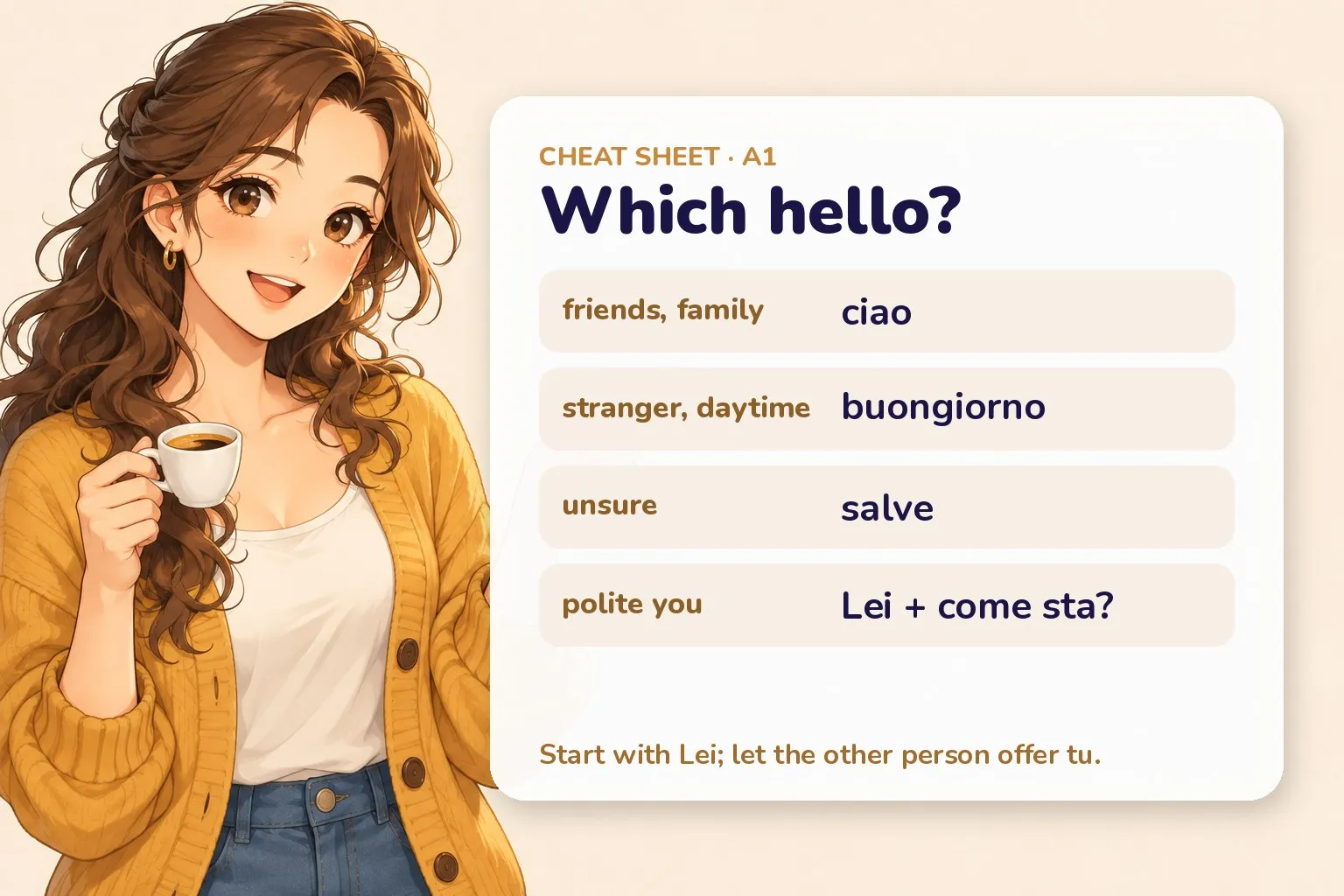
Quick recap before the quiz.
Practice
Greetings and introductions practice
Try each one, then press Check. No sign-up, nothing is sent anywhere — it all runs in your browser.
Hint: third-person form for Lei
Show answer
sta — With Lei the verb is third person singular: come sta.
Hint: age uses avere
Show answer
Ho — Italian gives age with avere: ho venticinque anni.
5 Build: 'My name is Anna, nice to meet you.'
Show answer
Mi chiamo Anna Piacere — Mi chiamo + name, then the fixed formula Piacere.
6 Match each Italian greeting to its use.
- ciao
- buongiorno
- salve
- buonanotte
Show answer
- ciao → friends and family
- buongiorno → strangers, morning
- salve → middle formality
- buonanotte → parting for the night
Register, not translation, decides which greeting you pick.
Quiz
Italian greetings and introductions
11 questions · pick an answer and you'll see straight away if it's right.
-
Show answer
Ciao — Ciao belongs to friends, family and children.
-
Show answer
middle formality — Crusca: salve fills the missing middle band between formal and informal.
-
Show answer
when parting for the night — It is a going-to-bed goodbye, not a general evening hello.
-
Show answer
third person singular — Lei takes third-person forms: come sta, si chiama.
-
Show answer
a friend — ti chiami is the tu form, so it is informal.
-
Show answer
Piacere — Piacere = 'pleasure', used with no verb and no ending.
-
Show answer
avere — Ho venticinque anni — 'I have twenty-five years'.
-
Show answer
fare or essere — Faccio l'insegnante or Sono insegnante.
-
Show answer
Arrivederla — Arrivederla contains the polite object pronoun La.
-
Show answer
has almost disappeared, surviving in some southern regions — Voi as a formal alternative is nearly gone, with southern regional exceptions.
-
Show answer
Sono — Sono di + place; the subject pronoun is not needed.
Recap cheat-sheet
| Situation | Say | Answer to expect |
|---|---|---|
| Friend, any time | Ciao! | Ciao! |
| Stranger, morning | Buongiorno. | Buongiorno. |
| Stranger, evening | Buonasera. | Buonasera. |
| Unsure of register | Salve. | Salve. |
| Leaving, neutral | Arrivederci. | Arrivederci. |
| Leaving, formal | Arrivederla. | Arrivederla. |
| Frame | Use |
|---|---|
| Mi chiamo… / Sono… | your name |
| Piacere. | first meeting |
| Sono di… / Vengo da… | origin |
| Ho … anni. | age |
| Faccio… / Sono… | job |
| Come sta? / Come stai? | how are you, formal / informal |
Next
- The pronouns behind tu and Lei: Italian subject pronouns
- The verb in every introduction: essere (to be)
- The verb for ages and possession: avere (to have)
- Why ciao starts with a “ch” sound: Italian c and g sounds
- Start at Start Learning Italian Here
All Italian lessons topics
Vocabulary, pronunciation, phrases, practice and exam help, ordered by level. Pick a topic and go straight to it. New lessons go live every day, so topics marked Coming soon fill in over the next weeks.
Lessons
A1 9 topics · 1 ready
- 01 Italian: Greetings & Introductions You are here
- 02 Italian: Numbers 0 to 100 Coming soon
- 03 Italian: Introducing Yourself Coming soon
- 04 Italian: Days, Months & Dates Coming soon
- 05 Italian: Telling the Time Coming soon
- 06 Italian: Giving Personal Information Coming soon
- 07 Italian: Family Members Coming soon
- 08 Italian: Colours & Shapes Coming soon
- 09 Italian: Food & Drink Basics Coming soon
A2 14 topics
- 10 Italian: Describing People Coming soon
- 11 Italian: Ordering at a Cafe Coming soon
- 12 Italian: Shopping & Prices Coming soon
- 13 Italian: Clothing & Sizes Coming soon
- 14 Italian: Asking for Directions Coming soon
- 15 Italian: Using Public Transport Coming soon
- 16 Italian: At the Hotel Coming soon
- 17 Italian: Weather & Seasons Coming soon
- 18 Italian: Hobbies & Free Time Coming soon
- 19 Italian: Daily Routine Coming soon
- 20 Italian: Housing & Rooms Coming soon
- 21 Italian: Parts of the Body Coming soon
- 22 Italian: Emotions & Feelings Coming soon
- 23 Italian: Supermarket & Groceries Coming soon
B1 18 topics
- 24 Italian: Household Chores Coming soon
- 25 Italian: At the Doctor Coming soon
- 26 Italian: Making Appointments Coming soon
- 27 Italian: Making Plans & Invitations Coming soon
- 28 Italian: Phone & Messaging Coming soon
- 29 Italian: Expressing Opinions Coming soon
- 30 Italian: Talking About Past Experiences Coming soon
- 31 Italian: Future Plans & Goals Coming soon
- 32 Italian: School & Education Coming soon
- 33 Italian: Jobs & Professions Coming soon
- 34 Italian: Money & Banking Coming soon
- 35 Italian: Restaurant & Dining Out Coming soon
- 36 Italian: Travel & the Airport Coming soon
- 37 Italian: Sightseeing & Tourism Coming soon
- 38 Italian: Emergencies & Safety Coming soon
- 39 Italian: Technology & the Internet Coming soon
- 40 Italian: Complaints & Solving Problems Coming soon
- 41 Italian: Small Talk & Networking Coming soon
B2 11 topics
- 42 Italian: At the Office Coming soon
- 43 Italian: The Job Interview Coming soon
- 44 Italian: Formal Writing & Emails Coming soon
- 45 Italian: News & Current Affairs Coming soon
- 46 Italian: Environment & Nature Coming soon
- 47 Italian: Health & Lifestyle Coming soon
- 48 Italian: Culture & Traditions Coming soon
- 49 Italian: Describing Trends & Data Coming soon
- 50 Italian: Storytelling & Narration Coming soon
- 51 Italian: Giving a Short Presentation Coming soon
- 52 Writing Formal Letters in Italian Coming soon
C1 3 topics
- 53 Italian: Debating & Argumentation Coming soon
- 54 Italian: Idioms & Colloquialisms Coming soon
- 55 Italian: Formal vs Informal Register Coming soon