How to Practise Indonesian Writing

To practise Indonesian writing, write a little daily and build in stages: get single sentences right, join them into paragraphs with connectors, then get feedback and rewrite. Keep one register (formal or casual) and use time words instead of tenses, since verbs never change.
On this page11 sections · tap to jump
- 01By the end of this page you can…
- 02Why write at all
- 03Stage 1 — correct single sentences
- 04Stage 2 — join sentences into paragraphs
- 05Stage 3 — the feedback loop
- 06What to write, by level
- 07Model answers — use them well
- 08Example sentences to build from
- 09The errors to hunt in your own drafts
- 10Practice
- 11Quiz
Level: Intermediate. Indonesian is kind to writers in one big way — verbs never change for person or tense — and demanding in another: affixes and register do a lot of quiet work. Writing is the place to get both right, because you can slow down and check every word.
By the end of this page you can…
…run a daily Indonesian writing routine, move from single sentences to paragraphs, set up a feedback loop that improves your drafts, and handle the affixes, word order and register choices that mark good written Indonesian.
Why write at all
Writing gives you time to pick the right affix, the right time word, and the right register. Because the verb itself never conjugates, your job is to arrange words and choose forms — exactly the kind of decision you can make calmly on paper and then carry into speech.
Stage 1 — correct single sentences
Write five to ten short sentences a day about real life, and check each against something you know:
- Is the word order right? The noun comes first, the adjective after: rumah besar (“big house”), not besar rumah.
- Did you mark time with a word, not the verb? Kemarin saya pergi (“I went yesterday”), besok saya pergi (“I’ll go tomorrow”) — pergi never changes.
- Is your register consistent? Formal saya / tidak / tidak ada, or casual aku / nggak — not a mix.
Stage 2 — join sentences into paragraphs
Link sentences with connectors — this is where Indonesian paragraphs come to life:
- Reason and result: karena (because), jadi / sehingga (so), tetapi / tapi (but).
- Sequence: pertama … kemudian … akhirnya (first … then … finally).
Write a five-sentence paragraph with at least one karena reason, then reread it checking the word order and your register.
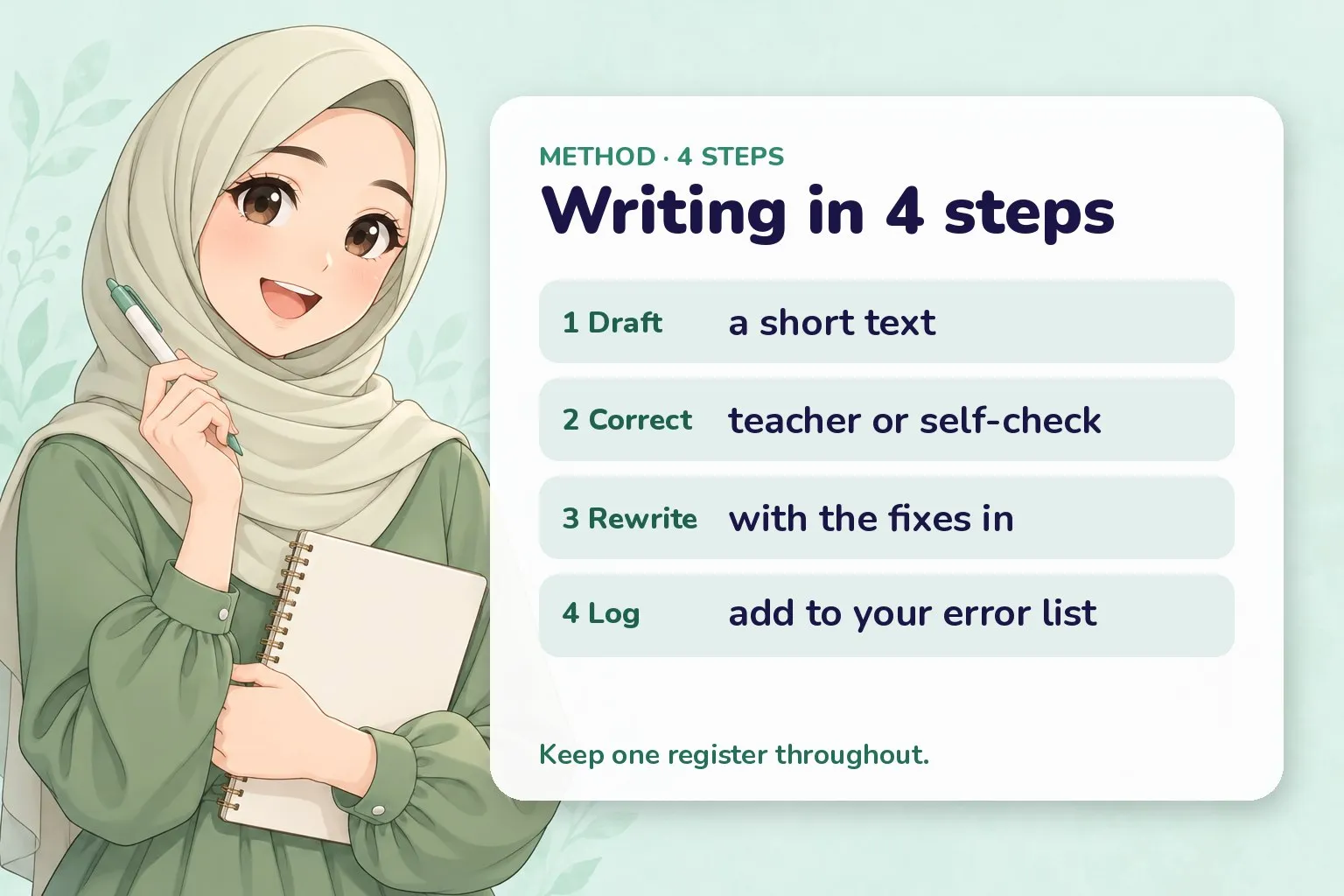
Stage 3 — the feedback loop
- Draft a short text — a paragraph, a message, a diary entry.
- Get it corrected by a teacher, a partner, or a careful self-check against your grammar pages.
- Rewrite the whole text with the corrections in. This is the step that teaches.
- Log the error — wrong form, right form, one word on why.
What to write, by level
- Beginner: a daily diary with time words, a self-introduction, a shopping list, a short message to a friend.
- Intermediate: a 120–150 word email or formal message, an opinion paragraph with karena reasons, a summary of something you read.
- Advanced: a structured argument with di satu sisi … di sisi lain, a formal letter, a report that keeps one consistent register and correct affixes throughout.
The BIPA materials and the UKBI proficiency test from Badan Bahasa describe the written levels, so you can match a task to where you are.
Model answers — use them well
Write your own version first, then compare with the model. Mark what it did: the connectors, the set phrases (Dengan hormat, Hormat saya, Saya menulis surat ini untuk…), the consistent formal affixes. Then rewrite yours, borrowing a move or two.
Example sentences to build from
Clean frames to adapt — keep the structure, change the content words:
- Saya suka makanan Indonesia.I like Indonesian food.simple statement, no verb 'to be'
- Kemarin saya pergi ke pasar.Yesterday I went to the market.time word marks the past
- Besok saya akan pergi ke Jakarta.Tomorrow I will go to Jakarta.akan = future marker
- Saya tinggal di rumah besar.I live in a big house.noun before adjective: rumah besar
- Saya tidak bisa datang karena sibuk.I can't come because I'm busy.karena = because
- Saya menulis surat ini untuk melamar pekerjaan.I'm writing this letter to apply for a job.formal affix: menulis, melamar
- Di satu sisi murah, di sisi lain jauh.On one hand it's cheap, on the other it's far.balanced argument
- Pertama, kemudian, akhirnya.First, then, finally.sequence connectors for a paragraph
- Terima kasih atas perhatian Anda.Thank you for your attention.formal closing phrase
- Hormat saya,Respectfully (formal letter close)set phrase
Quick recap before you practise.
The errors to hunt in your own drafts
- Adjective before the noun: besar rumah → rumah besar.
- Trying to conjugate for tense: add a time word instead — kemarin, sekarang, besok, sudah, akan.
- Dropping formal affixes in an essay: casual beli → formal membeli; casual kasih → formal memberi.
- Mixing register: Saya nggak bisa mixes formal saya with casual nggak; write Saya tidak bisa.
- Reduplication for every plural: context or a number often shows plural already — tiga buku (“three books”), no need for buku-buku.
Practice
Indonesian writing-routine practice
Try each one, then press Check. No sign-up, nothing is sent anywhere — it all runs in your browser.
Hint: noun before adjective
Show answer
rumah besar — Indonesian puts the adjective after the noun: rumah besar.
4 Build: 'I can't come because I'm busy.'
Show answer
Saya tidak bisa datang karena sibuk — karena introduces the reason.
5 Match formal to casual register.
- saya
- tidak
- membeli
- tetapi
Show answer
- saya → aku
- tidak → nggak
- membeli → beli
- tetapi → tapi
Keep one register across a whole text.
Quiz
Indonesian writing-practice quiz
8 questions · pick an answer and you'll see straight away if it's right.
-
Show answer
correct single sentences — Build accuracy at sentence level first.
-
Show answer
time words like kemarin, besok — Verbs don't change; time words do the work.
-
Show answer
rumah besar — Noun before adjective: rumah besar.
-
Show answer
Saya tidak bisa datang. — Formal saya with formal tidak is consistent.
-
Show answer
it applies the fix actively — Rewriting turns a passive note into practice.
-
Show answer
membeli — Formal writing uses the me- affix: membeli.
-
Show answer
because — karena introduces a reason: 'because'.
-
Show answer
the future — akan = future: besok saya akan pergi.
Next
- Turn writing into reading practice: Indonesian Reading Practice: Intermediate (B1)
- Build affixes and word order in the Indonesian grammar section
- New here? Start with Start Learning Indonesian Here
All Indonesian practice topics
Vocabulary, pronunciation, phrases, practice and exam help, ordered by level. Pick a topic and go straight to it. New lessons go live every day, so topics marked Coming soon fill in over the next weeks.
Practice
Beginner 1 topics · 1 ready
Elementary 2 topics · 2 ready
Intermediate 5 topics · 3 ready
- 04 Shadowing to Improve Indonesian Speaking
- 05 Indonesian Reading Practice: Intermediate
- 06 How to Practise Indonesian Writing You are here
- 07 Indonesian me- Verb Practice Coming soon
- 08 Indonesian di-/ter- Passive Practice Coming soon