How to Use Flashcards for Arabic
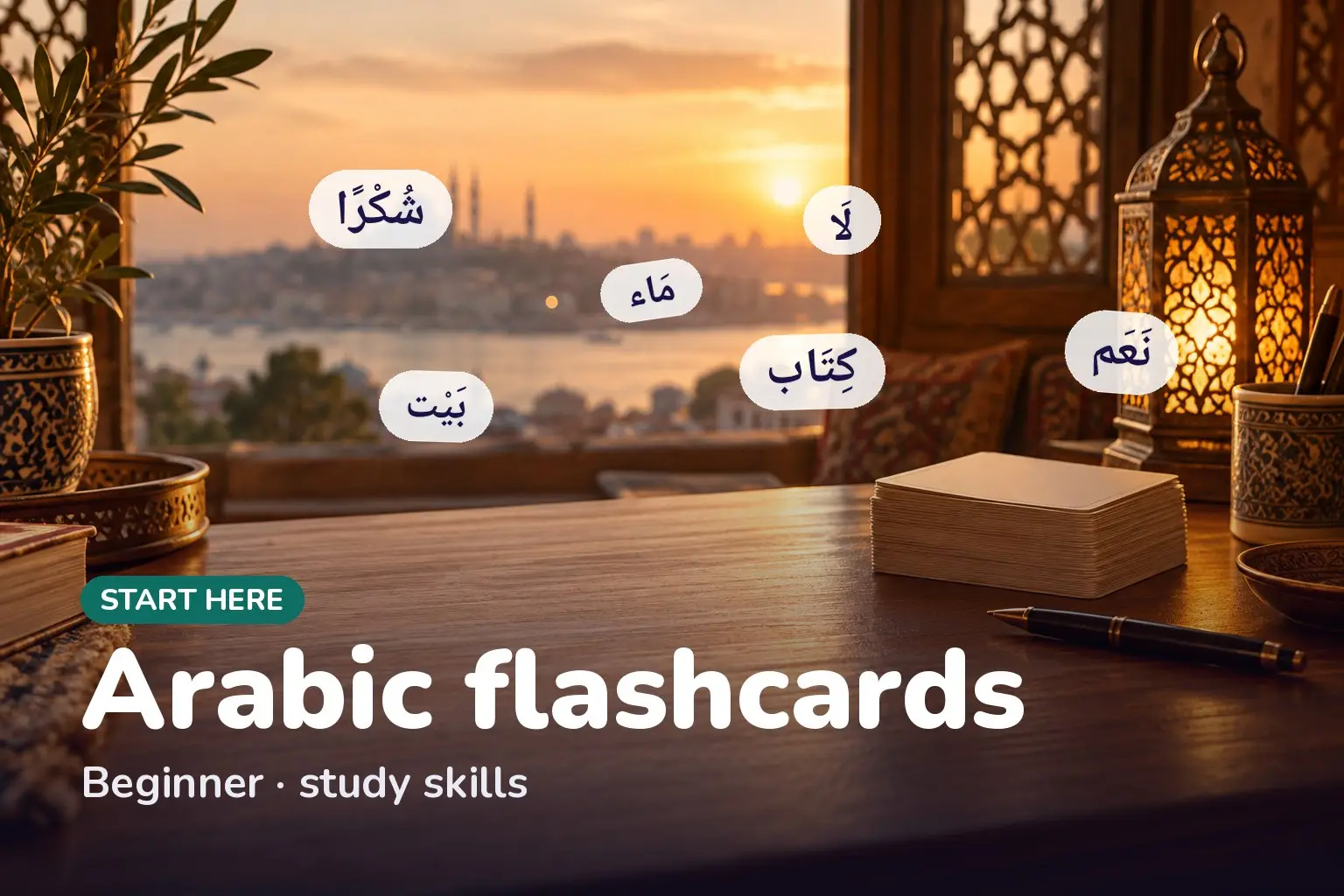
Make flashcards that force you to recall, not just recognise: put a prompt on one side and the answer on the other, build decks from the most common words first, and review on a spacing schedule so you see hard cards more often.
Level: Beginner. Flashcards are the fastest way to turn Arabic words you have met into words you actually know — if you use them to recall, not just to re-read. This page shows how to build a deck, make good cards, and review them.
By the end of this page you can…
…build an Arabic flashcard deck from common words and review it with active recall and spacing.
Build your deck from vocabulary sets
Don’t make cards for random words. Start from frequency-ranked lists (the most common words first), filter out names and noise, and add a handful of new cards at a time. Learning the commonest few hundred words gives you the fastest return, because they appear in almost everything you read or hear.
A simple starting set of high-frequency words:
- نَعَمnaʿamyes
- لَاlāno
- شُكْرًاshukranthank you
- مَاءmāʾwater
- بَيْتbaythouse
- يَوْمyawmday
- كِتَابkitābbook
- كَبِيرkabīrbig
Use active recall, not re-reading
The point of a card is the moment you try to remember before you flip it. Look at the prompt, say the answer out loud, then check. If you simply read both sides, you feel productive but learn little. The struggle to recall is what fixes the word in memory.
Space your reviews
Review a card again just before you would forget it. Each time you recall it correctly, wait a little longer before the next review; each time you fail, bring it back soon. Most flashcard apps (spaced-repetition systems, or SRS) schedule this for you automatically — you just answer honestly whether you remembered.
Make good cards
- One idea per card. A single word, not a list.
- Both directions. Make an Arabic to English card and an English to Arabic card, so you can recognise and produce the word.
- Add the reading and vowels. Put the harakat (vowel marks) and a transliteration on the card, e.g. كِتَاب (kitāb), so you always know how to say it.
- Add context. One short example sentence beats a bare word. Pull natural sentences from a public corpus such as Tatoeba.
- Note the gender. For a noun, record whether it is masculine or feminine — مَدِينَة (madīna) is feminine, بَيْت (bayt) is masculine — because it changes the adjectives you use.
Arabic-specific tip
Make one side of some cards show the word without short vowels, the way everyday Arabic is written, and the other side with full harakat plus the reading. That trains you to read real text while still checking your pronunciation. For script practice, add a card that shows a letter in its isolated and connected shapes.
Tools on this site
- Generate quick self-tests with the vocabulary quiz generator.
- Print review sheets with the printable language worksheets.
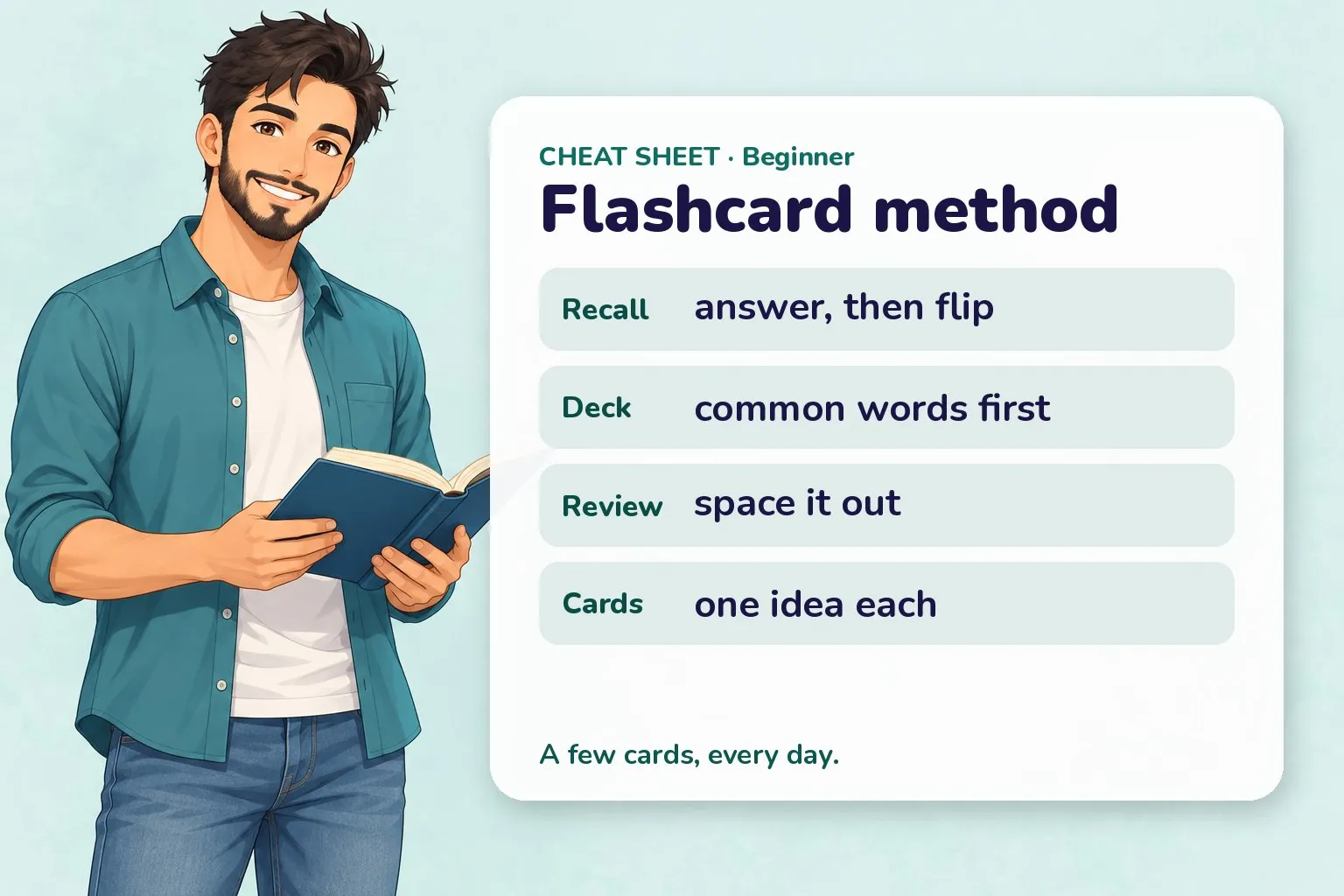
Quick recap before you practise.
Practice
Flashcard method practice
Try each one, then press Check. No sign-up, nothing is sent anywhere — it all runs in your browser.
Hint: it widens the gap as you succeed
Show answer
spaced — Spaced repetition increases the interval each time you recall a card correctly.
4 Match each card-making tip to its reason.
- one idea per card
- both directions
- add harakat
- add a sentence
Show answer
- one idea per card → easier to recall
- both directions → recognise and produce
- add harakat → say it correctly
- add a sentence → learn in context
Good cards are short, two-way, readable, and show the word in use.
Quiz
Flashcards for Arabic quiz
7 questions · pick an answer and you'll see straight away if it's right.
-
Show answer
it forces active recall — Trying to recall the answer before flipping is what makes cards effective.
-
Show answer
a frequency-ranked list, common words first — Start with the most common words for the fastest return.
-
Show answer
reviewing a card just before you would forget it — You widen the gap after each success and shorten it after a failure.
-
Show answer
one idea, with the reading and an example — One idea per card, with the harakat, reading and a short example.
-
Show answer
so you can both recognise and produce the word — Producing a word is a different skill from recognising it.
-
Show answer
gender (masculine or feminine) — Gender changes the adjectives and agreement, so record it with the word.
-
Show answer
add a few new cards and review the old ones — A small, steady flow of new cards plus daily review is sustainable.
Next
- Browse all topics in the Arabic start-here section
- New here? Start with Start Learning Arabic Here
All Arabic study topics
Vocabulary, pronunciation, phrases, practice and exam help, ordered by level. Pick a topic and go straight to it. New lessons go live every day, so topics marked Coming soon fill in over the next weeks.
Study topics
Start here 5 topics · 5 ready
- 01 Start Learning Arabic Here
- 02 Arabic Level Self-Test (A1-C1 Guide)
- 03 How to Use Flashcards for Arabic You are here
- 04 Top Mistakes Arabic Learners Make
- 05 Building a Daily Arabic Habit
Lessons 56 topics
See the lessons page →- 06 Arabic: Greetings & Introductions Coming soon
- 07 Arabic: Numbers 0 to 100 Coming soon
- 08 Arabic: Introducing Yourself Coming soon
- 09 Arabic: Days, Months & Dates Coming soon
- 10 Arabic: Telling the Time Coming soon
- 11 Arabic: Giving Personal Information Coming soon
- 12 Arabic: Family Members Coming soon
- 13 Arabic: Describing People Coming soon
- 14 Arabic: Colours & Shapes Coming soon
- 15 Arabic: Food & Drink Basics Coming soon
- 16 Arabic: Ordering at a Cafe Coming soon
- 17 Arabic: Shopping & Prices Coming soon
- 18 Arabic: Clothing & Sizes Coming soon
- 19 Arabic: Asking for Directions Coming soon
- 20 Arabic: Using Public Transport Coming soon
- 21 Arabic: At the Hotel Coming soon
- 22 Arabic: Weather & Seasons Coming soon
- 23 Arabic: Hobbies & Free Time Coming soon
- 24 Arabic: Daily Routine Coming soon
- 25 Arabic: Housing & Rooms Coming soon
- 26 Arabic: Household Chores Coming soon
- 27 Arabic: At the Doctor Coming soon
- 28 Arabic: Parts of the Body Coming soon
- 29 Arabic: Emotions & Feelings Coming soon
- 30 Arabic: Making Appointments Coming soon
- 31 Arabic: Making Plans & Invitations Coming soon
- 32 Arabic: Phone & Messaging Coming soon
- 33 Arabic: Expressing Opinions Coming soon
- 34 Arabic: Talking About Past Experiences Coming soon
- 35 Arabic: Future Plans & Goals Coming soon
- 36 Arabic: School & Education Coming soon
- 37 Arabic: Jobs & Professions Coming soon
- 38 Arabic: At the Office Coming soon
- 39 Arabic: The Job Interview Coming soon
- 40 Arabic: Formal Writing & Emails Coming soon
- 41 Arabic: Money & Banking Coming soon
- 42 Arabic: Restaurant & Dining Out Coming soon
- 43 Arabic: Supermarket & Groceries Coming soon
- 44 Arabic: Travel & the Airport Coming soon
- 45 Arabic: Sightseeing & Tourism Coming soon
- 46 Arabic: Emergencies & Safety Coming soon
- 47 Arabic: Technology & the Internet Coming soon
- 48 Arabic: News & Current Affairs Coming soon
- 49 Arabic: Environment & Nature Coming soon
- 50 Arabic: Health & Lifestyle Coming soon
- 51 Arabic: Culture & Traditions Coming soon
- 52 Arabic: Describing Trends & Data Coming soon
- 53 Arabic: Debating & Argumentation Coming soon
- 54 Arabic: Idioms & Colloquialisms Coming soon
- 55 Arabic: Formal vs Informal Register Coming soon
- 56 Arabic: Storytelling & Narration Coming soon
- 57 Arabic: Complaints & Solving Problems Coming soon
- 58 Arabic: Giving a Short Presentation Coming soon
- 59 Arabic: Small Talk & Networking Coming soon
- 60 Arabic Case Endings (I'rab) Overview Coming soon
- 61 MSA vs Spoken Dialects (Overview) Coming soon
Vocabulary 45 topics
See the vocabulary page →- 62 100 Most Common Arabic Words Coming soon
- 63 Arabic Words 101-250 (Frequency) Coming soon
- 64 Arabic Words 251-500 (Frequency) Coming soon
- 65 Arabic Words 501-1000 (Frequency) Coming soon
- 66 Arabic Words 1001-1500 (Frequency) Coming soon
- 67 Arabic Words 1501-2000 (Frequency) Coming soon
- 68 Arabic Words 2001-3000 (Frequency) Coming soon
- 69 100 Essential Arabic Verbs Coming soon
- 70 Common Arabic Adjectives Coming soon
- 71 Everyday Arabic Adverbs Coming soon
- 72 Arabic Connectors & Linking Words Coming soon
- 73 Arabic Question Words & Phrases Coming soon
- 74 Arabic Time Expressions Coming soon
- 75 Arabic Food & Cooking Vocabulary Coming soon
- 76 Arabic Animals Vocabulary Coming soon
- 77 Arabic Body & Health Vocabulary Coming soon
- 78 Arabic Clothing Vocabulary Coming soon
- 79 Arabic House & Furniture Vocabulary Coming soon
- 80 Arabic Kitchen & Tableware Vocabulary Coming soon
- 81 Arabic Transport & Travel Vocabulary Coming soon
- 82 Arabic Places in Town Vocabulary Coming soon
- 83 Arabic Nature & Geography Vocabulary Coming soon
- 84 Arabic Weather Vocabulary Coming soon
- 85 Arabic Jobs & Professions Vocabulary Coming soon
- 86 Arabic Technology & Internet Vocabulary Coming soon
- 87 Arabic Money & Shopping Vocabulary Coming soon
- 88 Arabic Emotions & Feelings Vocabulary Coming soon
- 89 Arabic Sports & Exercise Vocabulary Coming soon
- 90 Arabic Education & School Vocabulary Coming soon
- 91 Arabic Business & Work Vocabulary Coming soon
- 92 Arabic Family & Relationships Vocabulary Coming soon
- 93 Arabic Colours Vocabulary Coming soon
- 94 Arabic Verbs of Motion Coming soon
- 95 Arabic Opinion & Attitude Vocabulary Coming soon
- 96 Arabic Academic Vocabulary Coming soon
- 97 Arabic Medical & Pharmacy Vocabulary Coming soon
- 98 Arabic Admin & Paperwork Vocabulary Coming soon
- 99 Arabic Environment & Climate Vocabulary Coming soon
- 100 Arabic Arts, Music & Film Vocabulary Coming soon
- 101 The Arabic Root & Pattern System Coming soon
- 102 Arabic Verb Forms (I-X) Reference Coming soon
- 103 Arabic Broken Plurals Reference Coming soon
- 104 Arabic Numbers, Dates & Money Coming soon
- 105 100 High-Frequency Arabic Roots Coming soon
- 106 Arabic Connectors for Writing Coming soon
Pronunciation & writing 13 topics · 1 ready
See the pronunciation & writing page →- 107 Arabic Pronunciation Overview
- 108 The Arabic Script & Abjad Coming soon
- 109 Arabic Letters: Connecting Forms Coming soon
- 110 Harakat: Short Vowels & Sukun Coming soon
- 111 Arabic Long Vowels (alif, waw, ya) Coming soon
- 112 Sun & Moon Letters Coming soon
- 113 Arabic Emphatic & Throat Letters Coming soon
- 114 Hamza & Its Seats Coming soon
- 115 Ta Marbuta & Alif Maqsura Coming soon
- 116 Reading Arabic Without Vowels Coming soon
- 117 Arabic Handwriting & Numerals Coming soon
- 118 How to Type Arabic (Keyboard Guide) Coming soon
- 119 Arabic Transliteration Systems & Limits Coming soon
Practice 8 topics · 6 ready
See the practice page →- 120 Shadowing to Improve Arabic Speaking
- 121 How to Practise Arabic Listening
- 122 Arabic Reading Practice: Beginner
- 123 Arabic Reading Practice: Elementary
- 124 Arabic Reading Practice: Intermediate
- 125 Arabic Reading Practice: Upper-Intermediate
- 126 How to Practise Arabic Writing Coming soon
- 127 Idafa (Possessive Construction) Practice Coming soon
Phrases 20 topics
See the phrases page →- 128 50 Arabic Survival Phrases Coming soon
- 129 Arabic Greetings & Goodbyes Coming soon
- 130 Arabic Politeness & Please/Thank-You Coming soon
- 131 Arabic Travel Phrases Coming soon
- 132 Arabic Restaurant Phrases Coming soon
- 133 Arabic Hotel Phrases Coming soon
- 134 Arabic Shopping Phrases Coming soon
- 135 Arabic Asking Directions Phrases Coming soon
- 136 Arabic Emergency Phrases Coming soon
- 137 Arabic Small Talk Phrases Coming soon
- 138 Arabic Phone & Call Phrases Coming soon
- 139 Arabic Business Meeting Phrases Coming soon
- 140 Arabic Social & Making-Friends Phrases Coming soon
- 141 Arabic Airport Phrases Coming soon
- 142 Arabic Doctor & Pharmacy Phrases Coming soon
- 143 Arabic Opinion & Discussion Phrases Coming soon
- 144 Arabic Agreeing & Disagreeing Phrases Coming soon
- 145 Arabic Texting & Chat Phrases Coming soon
- 146 Arabic Classroom Phrases Coming soon
- 147 Arabic Complaint & Problem Phrases Coming soon