Shadowing to Improve Arabic Speaking
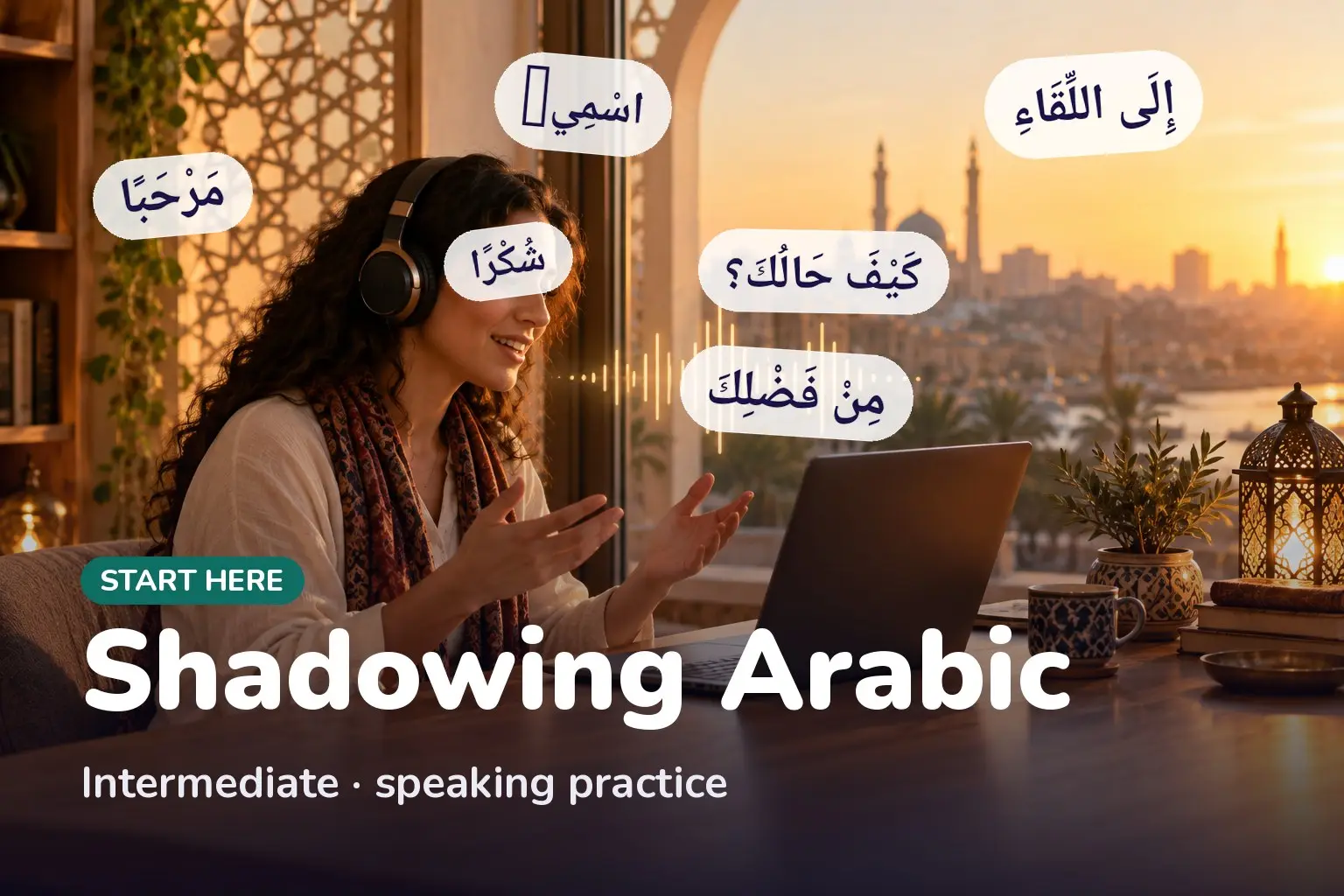
Shadowing means playing a short clip of spoken Arabic and speaking along with it almost at the same time, copying the sounds, stress and rhythm without reading. Work in short daily bursts on clips you already understand, and record yourself to hear what to fix.
Level: intermediate. Shadowing is one of the most efficient ways to make your spoken Arabic clearer and more natural. You copy a speaker almost in real time, so your mouth learns the rhythm of Arabic — and its unfamiliar sounds — instead of falling back on the habits of your first language.
By the end of this page you can…
…run a short Arabic shadowing session on your own, avoid the common mistakes, and fit the practice into a daily routine.
What shadowing is
Shadowing means listening to a short piece of spoken Arabic and speaking along with it at almost the same time — a beat behind the speaker — while you copy their sounds, stress and intonation. You are not translating and you are not reading aloud from a page. You are imitating a voice.
Because you speak with the audio rather than after it, you cannot stop to think. That pressure is the point: it forces your mouth to produce the flowing sound of real Arabic instead of one careful word at a time.
How to shadow, step by step
- Choose a short clip, 10–30 seconds. A sentence or two of clear Modern Standard Arabic is plenty — a slow news item, a simple dialogue, or the audio on this site.
- Listen once or twice for meaning. Make sure you understand it before you try to speak.
- Shadow with your eyes closed, no text. Play the clip and speak along, a fraction behind the voice. Hold on to the melody and the beat.
- Replay the same clip several times. Each pass, catch a little more: a linked phrase, a stressed syllable, an emphatic consonant.
- Now open the transcript. Read along while you shadow to find the exact words you were blurring.
- Record yourself shadowing once more, then play your voice next to the original. The gaps you hear are your to-do list.
Common pitfalls
- Reading instead of listening. If your eyes are glued to the Arabic script from the start, you copy spelling, not sound. Ears first, text later.
- Skipping the hard consonants. Arabic has sounds English does not — the throaty ʿayn and ḥāʾ, the deep qāf, and the emphatic letters. Do not substitute the nearest English sound; copy exactly what you hear.
- Chasing speed. Speaking fast but flat is not fluency. Copy the rhythm and the long vowels (ā, ī, ū), which carry much of the meaning.
- Practising silently. Shadowing only works out loud; mouthing the words gives your muscles no workout.
- One pass and move on. The improvement comes from repeating the same clip until it feels easy.
Choose the right audio
Good shadowing audio is clear, not too fast, and comes with a transcript so you can check yourself. Modern Standard Arabic (the Arabic of news and formal writing) is the most useful starting point because it is consistent across the region. The spoken examples in these lessons each have an audio button, so you can shadow a single phrase, then a full sentence. Start with the short ones below.
Example sentences
Shadow each line below: play the audio, then speak along a beat behind. Start slow, repeat, and copy the rhythm.
- مَرْحَبًا، كَيْفَ حَالُكَ؟marḥaban, kayfa ḥāluka?Hello, how are you?
- أَنَا بِخَيْرٍ، شُكْرًا.anā bi-khayrin, shukran.I'm fine, thank you.
- مَا اسْمُكَ؟mā ismuka?What is your name?
- اسْمِي سَامِي.ismī Sāmī.My name is Sami.
- مِنْ أَيْنَ أَنْتَ؟min ayna anta?Where are you from?
- أَنَا مِنْ مِصْرَ.anā min Miṣra.I'm from Egypt.
- أُرِيدُ قَهْوَةً، مِنْ فَضْلِكَ.urīdu qahwatan, min faḍlika.I'd like a coffee, please.
- كَمِ السَّاعَةُ الآنَ؟kami s-sāʿatu l-ān?What time is it now?
- هَلْ تَتَكَلَّمُ الإِنْجِلِيزِيَّةَ؟hal tatakallamu l-injilīziyyata?Do you speak English?
- لَا أَفْهَمُ، مِنْ فَضْلِكَ أَعِدْ.lā afhamu, min faḍlika aʿid.I don't understand, please repeat.
- أَيْنَ المَحَطَّةُ؟ayna l-maḥaṭṭatu?Where is the station?
- الطَّعَامُ لَذِيذٌ جِدًّا.aṭ-ṭaʿāmu ladhīdhun jiddan.The food is very delicious.
- شُكْرًا جَزِيلًا عَلَى مُسَاعَدَتِكَ.shukran jazīlan ʿalā musāʿadatika.Thank you very much for your help.
- سُرِرْتُ بِلِقَائِكَ.surirtu bi-liqāʾika.Pleased to meet you.
- إِلَى اللِّقَاءِ.ilā l-liqāʾi.See you / goodbye.
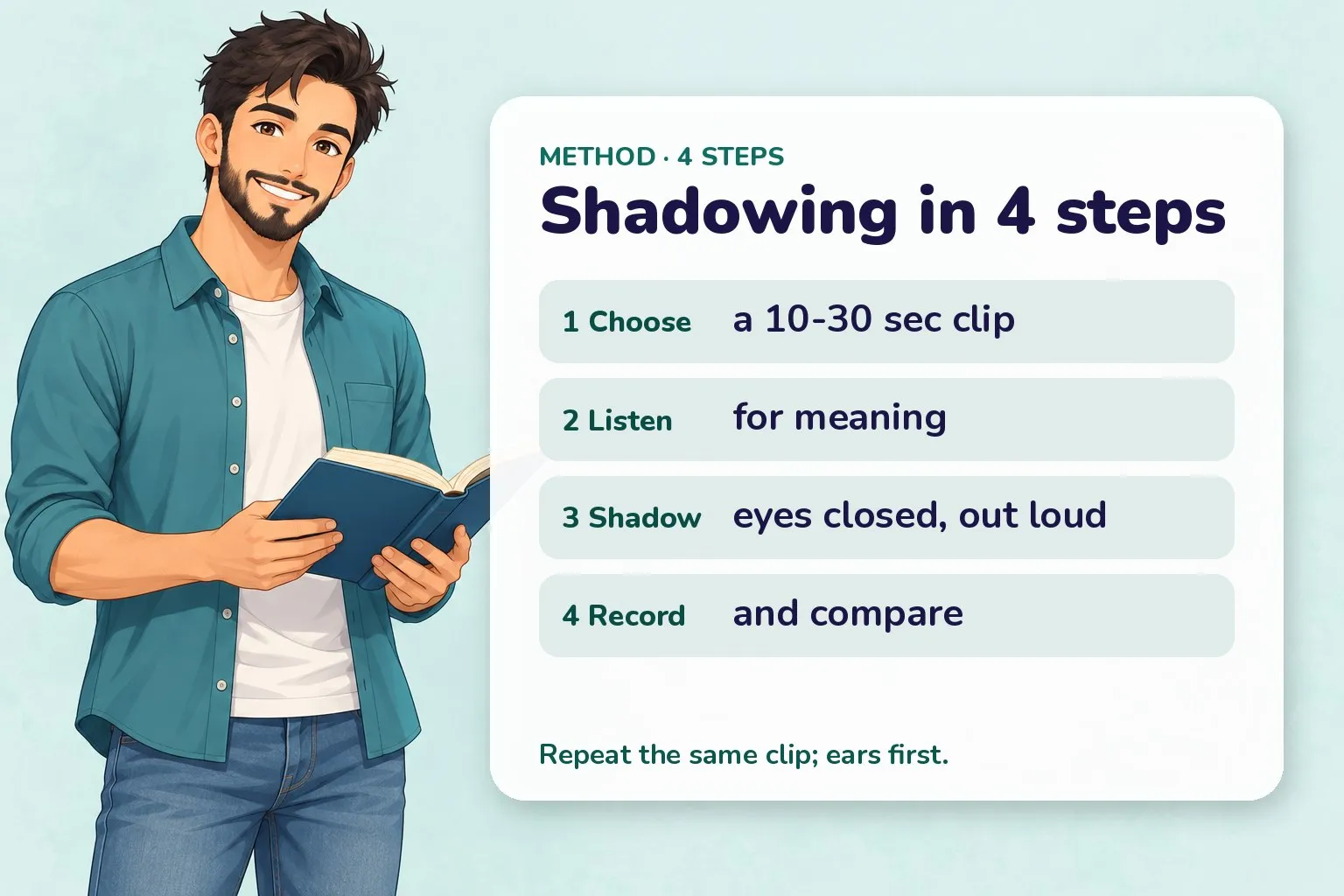
Quick recap before you practise.
Practice
Shadowing method practice
Try each one, then press Check. No sign-up, nothing is sent anywhere — it all runs in your browser.
Hint: the written version of the audio
Show answer
transcript — Ears first, then use the transcript to catch words you blurred.
4 Put a shadowing session in order.
Show answer
choose a short clip listen for meaning shadow with no text record and compare — Choose, understand, shadow by ear, then record and compare.
5 Match each pitfall to its fix.
- reading from the start
- swapping a hard consonant
- practising silently
- one pass only
Show answer
- reading from the start → listen first, text later
- swapping a hard consonant → copy the exact sound you hear
- practising silently → say it out loud
- one pass only → repeat the same clip
Each fix turns a common shadowing mistake into good practice.
Quiz
Shadowing quiz
8 questions · pick an answer and you'll see straight away if it's right.
-
Show answer
to copy the sounds, stress and rhythm of Arabic — Shadowing reshapes how you sound by imitating a speaker closely.
-
Show answer
about 10–30 seconds — A short clip you can repeat beats a long one you cannot.
-
Show answer
so you copy the sound, not the spelling — Starting by ear stops you copying spelling instead of real pronunciation.
-
Show answer
copied exactly as you hear them — Shadowing lets you imitate sounds English lacks instead of substituting them.
-
Show answer
fluency is about rhythm, stress and long vowels, not raw pace — Copy the rhythm and the long vowels; speaking fast but flat is not fluent.
-
Show answer
repeating the same clip until it feels easy — Repetition of one clip is what builds the muscle memory.
-
Show answer
hear the gaps between your voice and the original — Comparing your recording to the original shows you exactly what to fix.
-
Show answer
Modern Standard Arabic — Modern Standard Arabic is shared across the region, so it is a dependable base.
Next
- Build the sounds it relies on in the Arabic grammar section
- New here? Start with Start Learning Arabic Here
All Arabic practice topics
Vocabulary, pronunciation, phrases, practice and exam help, ordered by level. Pick a topic and go straight to it. New lessons go live every day, so topics marked Coming soon fill in over the next weeks.
Practice
Beginner 1 topics · 1 ready
Elementary 3 topics · 2 ready
- 02 How to Practise Arabic Listening
- 03 Arabic Reading Practice: Elementary
- 04 Idafa (Possessive Construction) Practice Coming soon
Intermediate 3 topics · 2 ready
- 05 Shadowing to Improve Arabic Speaking You are here
- 06 Arabic Reading Practice: Intermediate
- 07 How to Practise Arabic Writing Coming soon