Best Apps to Learn Mandarin Chinese (2026)
HelloChinese is the best all-round app for most Mandarin beginners: an HSK-based course with pinyin, characters, speech practice and a usable free tier. Duolingo is the runner-up for a free daily habit, and the free Pleco dictionary is the one tool every learner should add.
On this page12 sections · tap to jump
- 01Quick verdict
- 02Price at a glance
- 03HelloChinese — best all-round course
- 04Duolingo — best free habit-builder
- 05Pleco — the free dictionary worth installing first
- 06Du Chinese — best for reading
- 07Skritter — best for handwriting
- 08Anki — best free vocabulary tool
- 09HSK exam prep
- 10Who should skip the winner
- 11Which app fits you?
- 12Frequently asked questions
Mandarin has two hard parts — tones and characters — and no single app handles both well. The best setup is a course for grammar and speaking, a dictionary for reading, and a flashcard app for memory. Here is how the main tools compare on published features and price, with a pick for each kind of learner. Prices are US store prices read on 2 November 2026 and vary by country and store. We take no payment from any app listed here.
Quick verdict
- Best all-round course (our winner): HelloChinese. It runs a systematic, HSK-based course with a proper pinyin lesson set, character handwriting, speech recognition, graded stories and native-speaker videos. The free tier teaches enough early content to decide before you pay.
- Runner-up, and best free daily habit: Duolingo. Free, gamified and consistent, with pinyin built in — but very light on explanation.
- The one tool everyone should install: Pleco. A free dictionary, document reader and flashcard app; tap any character for pinyin, meaning and stroke order. Extra features are one-time purchases, not a subscription.
- Best for reading: Du Chinese. Graded, HSK-levelled stories with native audio, tap-for-pinyin and tone colours.
- Best for handwriting: Skritter. Focused on writing and recognising characters with spaced repetition.
- Best free vocabulary tool: Anki. Spaced repetition for the hundreds of words a course app will not review often enough.
Learning Korean instead, or as well? See our companion guide to the best apps to learn Korean.
Price at a glance
| App | Type | Free tier | Characters / writing | Price (US, 2 Nov 2026) |
|---|---|---|---|---|
| Duolingo | Gamified course | Yes, whole course | Recognition only | Free; Super about US$84-96/yr |
| HelloChinese | HSK course | Early levels free | Handwriting practice | Premium US$11.99/mo or US$69.99/yr; Premium+ US$149.99/yr |
| Pleco | Dictionary + SRS | Large free app | Stroke order (500 free) | Free; one-time paid add-ons |
| Du Chinese | Graded reading | Free lessons | Reading, not writing | US$14.99/mo or US$79.99/yr |
| Skritter | Characters (SRS) | Trial only | Full handwriting | US$14.99/mo or US$59.99/6mo |
| Anki | Flashcards (SRS) | Free on web/Android | You add decks | Free; paid one-time iOS app |
| HSK Online (SuperTest) | Exam prep | Free with ads | Exam tasks | Free; paid VIP |
A worked example (illustrative): a beginner who pays HelloChinese Premium at US$69.99/year and nothing else spends about US$70 for a full year and gets a structured course, graded stories and speech practice. Adding Pleco and Anki — both free — covers dictionary and review with no extra cost. Writing-focused learners who add Skritter at US$59.99 for six months roughly double that outlay.
HelloChinese — best all-round course
HelloChinese is our overall pick because it is the most complete course for a beginner. It builds systematic courses around HSK levels, opens with a well-made pinyin course, and teaches characters through handwriting as well as recognition. Speech recognition checks pronunciation, and higher tiers add 1,000+ graded stories and 2,000+ native-speaker videos. Both simplified and traditional are supported.
It is free to download, but you cannot progress past certain levels without paying. Premium is US$11.99/month, US$25.99 for three months or US$69.99/year; Premium+ (which adds the graded stories, the full character course and immersion lessons) is US$19.99/month, US$89.99 for six months or US$149.99/year. US prices; they vary by country and store.
Duolingo — best free habit-builder
Duolingo’s free Chinese (Simplified) course is the easiest way to build a daily habit, and pinyin is built in. For a beginner who wants low-friction, consistent practice at no cost, it is hard to beat on reach.
As with Korean, the trade-off is explanation: Duolingo rarely tells you why a sentence works, and it tests character recognition rather than handwriting. When you want the rule — say, when to use 是 (shì) versus an adjective with 很 (hěn) — reach for a page like our 是 (shì) grammar lesson rather than the app.
Pleco — the free dictionary worth installing first
Almost every serious Mandarin learner installs Pleco, and it is free. The basic app bundles the CC-CEDICT and in-house PLC dictionaries — together about 130,000 words with 20,000 example sentences — plus handwriting input, a light document reader and 500 stroke-order animations, with no ads.
Pleco’s clever bit is that extra features — OCR, more dictionaries, 28,000 stroke orders, better audio — are one-time in-app purchases, not a subscription, so you pay once and keep them. It is not a course and will not teach you grammar; it is the reference you keep open beside whatever course you use.
Du Chinese — best for reading
Du Chinese teaches through graded stories marked by HSK level, each with native audio, tap-for-pinyin, tone colours, sentence translations and an SRS flashcard system; it supports simplified and traditional and syncs words to Pleco, Skritter and others. It is the best way to turn grammar and vocabulary into real reading practice.
A range of lessons is free; Premium unlocks the full 3,000+ library at US$14.99/month or US$79.99/year. It pairs naturally with a course app rather than replacing one.
Skritter — best for handwriting
If you want to write Chinese by hand, not just recognise it, Skritter is the specialist. It drills writing, reading and pronunciation of characters with spaced repetition, in simplified or traditional and with pinyin or zhuyin. Most course apps test recognition only, so this fills a real gap.
It costs US$14.99/month or US$59.99 for six months (reduced from US$89.99), with a 7-day free trial. Skip it if you only need to type and read characters rather than write them.
Anki — best free vocabulary tool
As with any language, a course app will not review words often enough to beat forgetting. Anki is a free spaced-repetition flashcard program (free on the web and Android; the paid official iOS app is AnkiMobile). You build or download HSK decks and it schedules reviews. It is the most powerful free way to lock in vocabulary, at the cost of setting it up yourself.
HSK exam prep
If you are sitting the HSK, add an exam-focused tool near the test. HSK Online (SuperTest), by Shanghai Yuxuan Information Technology, offers mock tests, vocabulary practice, listening/reading/writing training and essay correction, free with a paid VIP tier. For official-style practice, HSK Mock describes itself as developed with Chinese Testing International, the body behind the exam. Use these to rehearse task types and timing — not as your main course.
Who should skip the winner
HelloChinese is not for everyone. Skip it if:
- You refuse to pay. The free levels are a taster; the course gates later content. Use Duolingo plus Pleco and Anki for a free path.
- You only want reading or only want writing. Then Du Chinese or Skritter, respectively, is a better single buy.
- You just need a dictionary. That is Pleco, and it is free.
Which app fits you?
Answer these to find your starting point, then open the Chinese start-here guide or browse the Chinese grammar section.
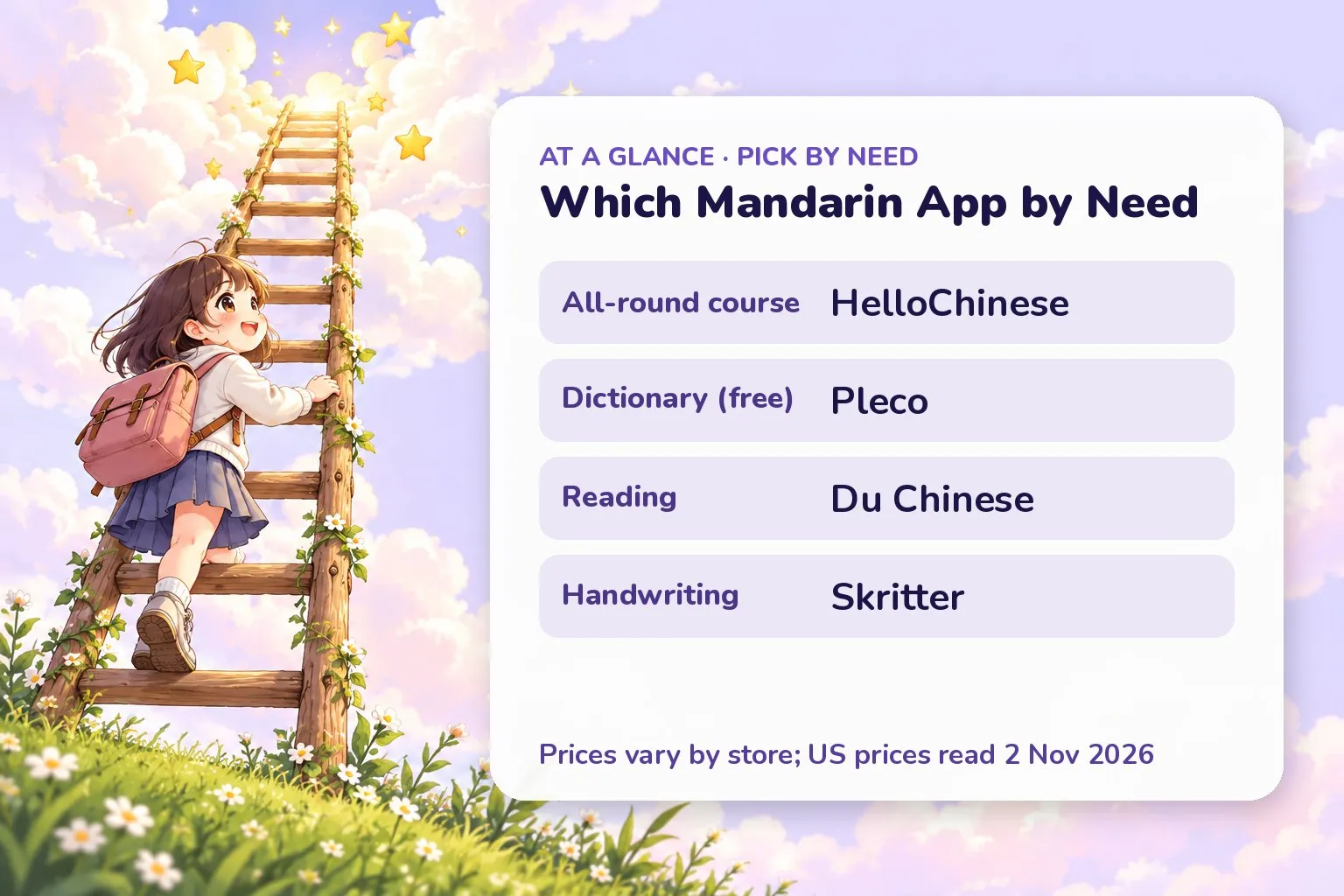
Quick recap before the quiz.
Which Mandarin app fits you?
6 questions · pick an answer and you'll see straight away if it's right.
-
Show answer
HelloChinese — HelloChinese runs a full HSK-based course with pinyin, handwriting and speech practice.
-
Show answer
Duolingo plus Pleco plus Anki (all free) — Duolingo, Pleco and Anki are all free and together cover course, dictionary and review.
-
Show answer
Pleco — Pleco is a free dictionary and reader; tap any character for pinyin and meaning.
-
Show answer
Skritter — Skritter specialises in handwriting with spaced repetition; most apps test recognition only.
-
Show answer
Du Chinese — Du Chinese offers HSK-levelled stories with native audio and tap-for-pinyin.
-
Show answer
Use HSK Online or HSK Mock to rehearse tasks and timing — Near the exam, practise the real task types and timing rather than starting fresh.
Frequently asked questions
Is there a free way to learn Mandarin? Yes. Duolingo’s whole Chinese course is free, Pleco is a free dictionary and reader, and Anki is free for review. That trio covers a beginner’s needs without paying.
Do I need to learn pinyin and tones before characters? Yes. The tone changes the word, so drill pinyin with tone marks first; HelloChinese and Duolingo both start with pinyin, and you can add characters gradually.
Which app is best for characters? For recognition, most course apps work; for writing by hand, Skritter is the specialist. Pleco shows stroke-order animations for reference.
Is Duolingo enough for Chinese on its own? For a daily habit and basic vocabulary, yes; for reading, writing and grammar depth, no. Pair it with Pleco, a reading app and a grammar reference.
Are these prices final? No. App prices change by country, store and promotion. The figures above are US prices read on 2 November 2026 — check the in-app price before buying.