Best Apps to Learn Korean: 2026 Comparison
For most beginners, LingoDeer is the best all-round Korean app: clear grammar explanations, Hangul first and a usable free tier. Duolingo is the runner-up for a free daily habit, and the Online King Sejong Institute is the best fully free course.
On this page10 sections · tap to jump
- 01Quick verdict
- 02Price at a glance
- 03King Sejong Institute Online — the free government course
- 04LingoDeer — best structured course
- 05Duolingo — best free habit-builder
- 06Talk To Me In Korean — best for depth and speaking
- 07Anki and Memrise — best for vocabulary
- 08Who should skip the winner
- 09Which app fits you?
- 10Frequently asked questions
No single app teaches you Korean on its own. The honest answer is a small kit: one structured course, one dictionary and one flashcard app. Below is how the main tools really compare on published features and price, with a pick for each kind of learner. Prices are US store prices read on 2 November 2026 and vary by country and store. We take no payment from any app listed here.
Quick verdict
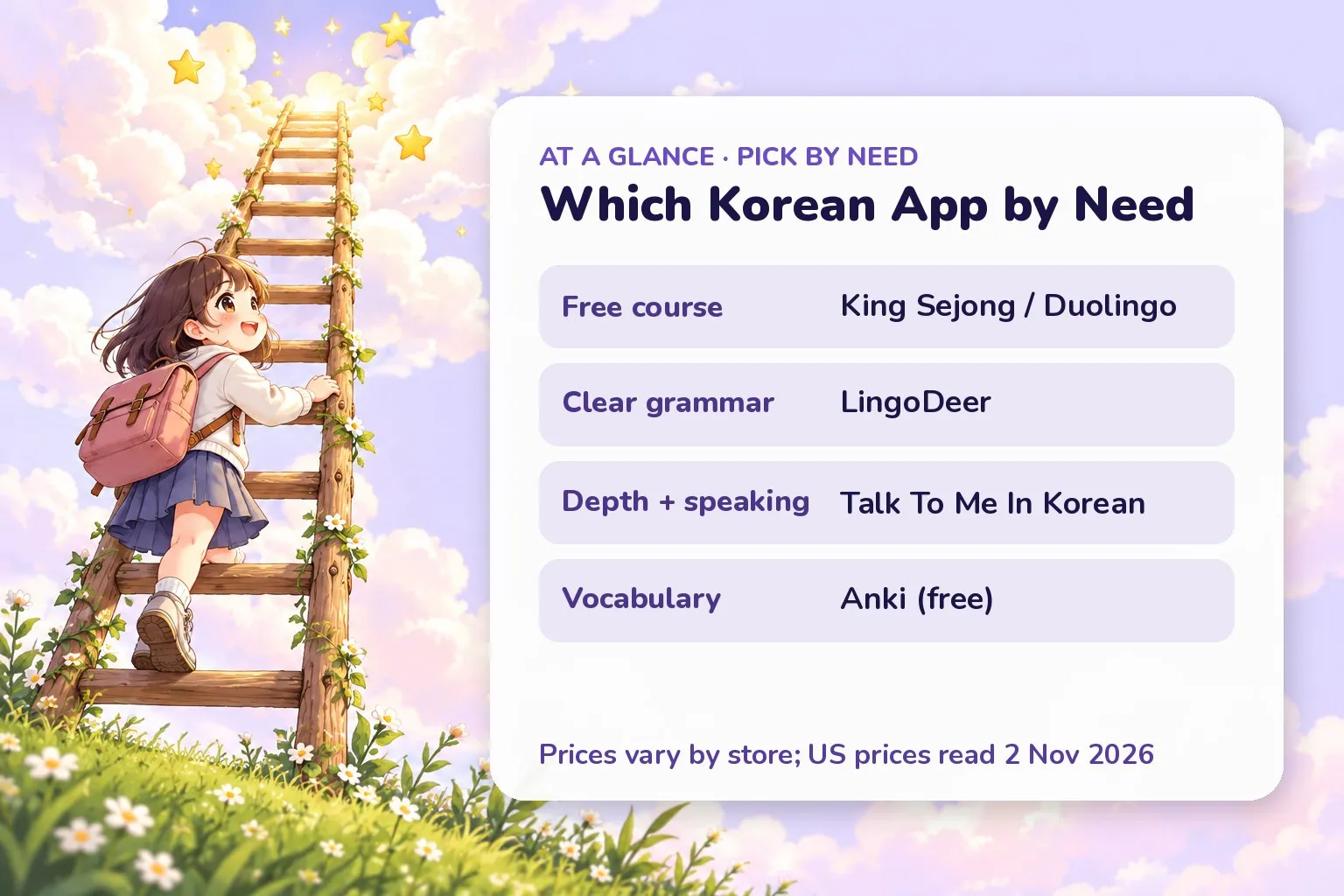
- Best all-round course (our winner): LingoDeer. It is built by language teachers, starts you on Hangul, and actually explains grammar instead of only drilling it. Its free tier (the alphabet, the first unit, test-outs and the travel phrasebook) is enough to decide before you pay.
- Runner-up, and best free daily habit: Duolingo. Free, with a rebuilt Korean course that now goes up to B2, a dedicated Hangul tab and optional transliterations. Light on explanation, strong on consistency.
- Best fully free course with real teachers: the Online King Sejong Institute. A free government service with video lessons from introductory to advanced, plus live classes.
- Best for depth and speaking: Talk To Me In Korean (TTMIK). 1,600+ video and audio lessons with notes and live classes — the most “course-like” of the commercial options.
- Best for vocabulary: Anki (free) or Memrise. Spaced repetition is how words stick; your course app is not enough on its own.
If you are still choosing a language, our companion guide to the best apps to learn Mandarin Chinese uses the same tests.
Price at a glance
| App | Type | Free tier | Grammar explained | Price (US, 2 Nov 2026) |
|---|---|---|---|---|
| King Sejong Institute Online | Course (gov) | Full course free | Yes, in lessons | Free |
| Duolingo | Gamified course | Yes, whole course | Minimal | Free; Super about US$84-96/yr |
| LingoDeer | Structured course | Alphabet, unit 1, test-outs | Yes, clear notes | From US$14.99/mo; Korean monthly US$12.99 |
| Talk To Me In Korean | Lesson library | Essential courses free | Yes, in depth | Courses US$4.99-19.99; subscription about US$122/yr |
| Memrise | Vocab + video | Limited, with ads | Some | About US$8.99-24.99/mo (varies) |
| Anki | Flashcards (SRS) | Free on web/Android | No (you add decks) | Free; paid one-time iOS app |
A worked example (illustrative): a learner who pays for one year of LingoDeer at the US$14.99/month rate spends about US$180, while the same year of Duolingo Super runs roughly US$84-96 and the Online King Sejong Institute costs nothing. The difference buys clearer grammar notes and the “Fluent” conversation track, not more hours in the day.
King Sejong Institute Online — the free government course
The Online King Sejong Institute is a free Korean course run by the King Sejong Institute Foundation, usable on computer and phone. It runs in three formats: a self-learning track of video lessons (VOD), a learning-assisted track with teacher feedback on assignments, and a lecture-assisted track with live Zoom classes. Courses go from introductory to advanced, and there are completion certificates.
The catch is structure over polish: intakes are term-based (the introductory course for the 2026 fourth term registered 26 October to 8 November, with lessons from 16 November), and the interface is plainer than a commercial app. For a learner who wants a genuine, free, teacher-made course and can keep to a schedule, nothing else here competes on value.
LingoDeer — best structured course
LingoDeer is our overall pick because it does the one thing beginners most need and most apps skip: it teaches grammar. Lessons are built by language teachers, start from the alphabet, and include clear grammar notes, native-speaker audio, and writing practice. Its “Fluent” track adds real-life conversation practice and is available for Korean.
The free tier is unusually honest — the whole alphabet, all of unit one, every unit’s test-out and the travel phrasebook — so you can judge the teaching before paying. Full access needs a subscription, from US$14.99/month, with a Korean monthly plan at US$12.99 and a quarterly at US$32.99; a multilingual annual pass is roughly US$79.99-95.99 and there are lifetime offers. Prices vary by region and store.
Duolingo — best free habit-builder
Duolingo’s strength is that it is free and that you will actually open it. The Korean course was rebuilt in mid-2026: it now teaches up to B2, gives the Korean writing system its own tab, and lets you switch transliterations on or off for each sentence. With over 1.9 million learners it is also the most supported course here.
The weakness is explanation. Duolingo shows you patterns and asks you to infer the rule; when you want to know why 은/는 (eun/neun) differs from 이/가 (i/ga), you will reach for a page like our topic particle lesson rather than the app. A free Super subscription (about US$84-96/year in the US) removes ads and energy limits but does not add grammar teaching.
Talk To Me In Korean — best for depth and speaking
TTMIK is Korean-only and the closest thing here to a full course: over 1,600 lessons in video and audio with lesson notes, sample-dialogue videos, quizzes and live classes. It suits learners who have outgrown a gamified app and want structured explanation and speaking input.
Pricing is mixed: there are free “Essential” courses, individual paid courses from US$4.99 to US$19.99, and a subscription shown on its courses site at about US$122/year (billed annually) or US$16.99/month. Because the model is mid-change, check what plan you are offered before buying.
Anki and Memrise — best for vocabulary
No course app reviews words often enough to beat forgetting. Anki is a free spaced-repetition flashcard program (free on the web and Android; the official iOS app, AnkiMobile, is a paid one-time purchase). You build or download Korean decks and it schedules reviews for you — the most powerful and the least hand-held option.
Memrise is gentler: it teaches with “Learn with Locals” video clips of native speakers and review games, but needs a subscription for full access (roughly US$8.99-24.99/month depending on region and offer), and its free tier is limited and ad-supported. Choose Anki for control and zero cost; choose Memrise if you want ready-made content and video.
Who should skip the winner
LingoDeer is not for everyone. Skip it if:
- You will not pay at all. The free tier is a taster; the full course needs a subscription. Use the King Sejong Institute or Duolingo instead.
- You want heavy speaking and listening input. LingoDeer teaches structure well but is not a conversation library — TTMIK or live tutoring fits better.
- You only want vocabulary drilling. Then a flashcard app (Anki) plus a frequency list does the job for free.
Which app fits you?
Answer these to find your starting point, then open a first Korean lesson or the copula 이다 (ida) grammar page to begin.
Quick recap before the quiz.
Which Korean app fits you?
6 questions · pick an answer and you'll see straight away if it's right.
-
Show answer
Online King Sejong Institute or Duolingo (free) — The King Sejong Institute course and Duolingo are genuinely free; Anki covers review at no cost.
-
Show answer
LingoDeer — LingoDeer is built by teachers and explains grammar, not just drills it.
-
Show answer
Duolingo — Duolingo is free and keeps you coming back; pair it with a grammar reference.
-
Show answer
Use a spaced-repetition app like Anki — Spaced repetition (Anki or Memrise) is designed to beat forgetting.
-
Show answer
Talk To Me In Korean — TTMIK has 1,600+ video and audio lessons with notes and live classes.
-
Show answer
Hangul, the alphabet — Hangul takes only days and makes every app easier to use.
Frequently asked questions
Is there a genuinely free way to learn Korean? Yes. The Online King Sejong Institute is a free government course, Duolingo’s whole Korean course is free, and Anki is free for review. You can reach a solid beginner level without paying.
Do I need to learn Hangul before using these apps? It helps enormously and takes only days. Duolingo and LingoDeer both start with the alphabet, and once you can read Hangul every tool is easier.
Which app explains grammar best? LingoDeer and Talk To Me In Korean both teach grammar explicitly. Duolingo and Memrise lean on pattern practice, so you will want a grammar reference alongside them.
Is Duolingo enough on its own? For a daily habit and basic vocabulary, yes; for grammar and speaking, no. Most learners pair it with a grammar-first resource and a flashcard app.
Are the paid prices here final? No. App prices change by country, store and promotion. Treat the figures above as US prices read on 2 November 2026 and check the in-app price before you buy.