Spanish Greetings and Introductions: First Words That Work
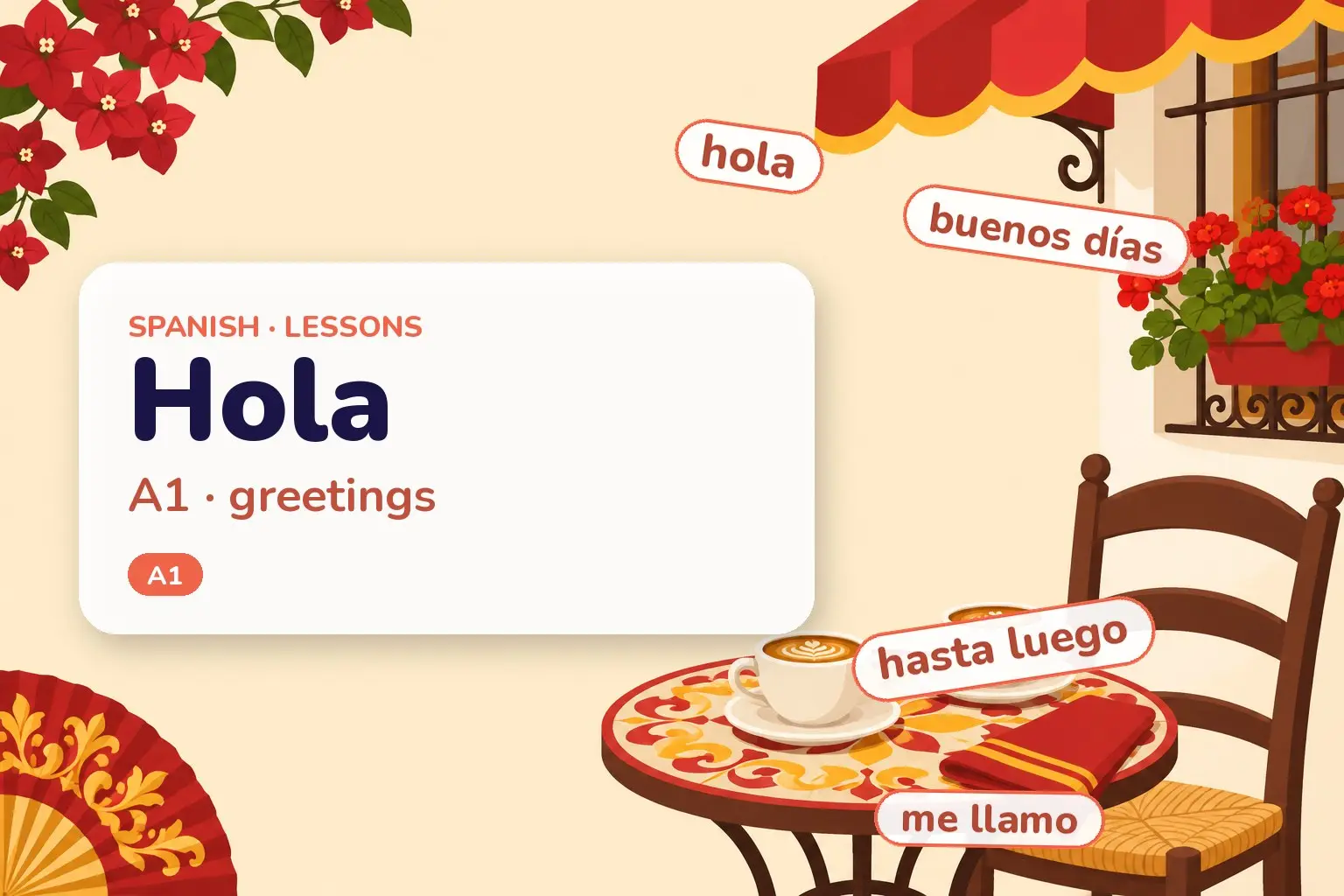
Start with hola (hello), which works at any hour, or buenos días in the morning and buenas noches after dark. Introduce yourself with me llamo… (my name is…) or soy… (I am…), and answer ¿cómo estás? with estoy bien, gracias.
Level: A1. The first ten minutes of any Spanish conversation follow a script, and it is a short one: hello, how are you, my name is, nice to meet you, goodbye. This lesson gives you that script with the register switches that decide whether you sound polite or familiar.
How to say it
Spanish spelling is regular, so the words below are readable as soon as you know four habits.
| Sound | How to say it | In this lesson |
|---|---|---|
| h | Always silent | hola = “OH-lah”, hasta = “AHS-tah” |
| j | Like the h in hat, but raspier | trabajo, mejor, jueves |
| ll / y | Like the y in yes (in most places) | llamo = “YAH-moh”, llegar |
| Vowels a e i o u | Short and pure, never glided | buenos = “BWEH-nohs”, días = “DEE-ahs” |
The letter v is pronounced like b in Spanish, and z or ce/ci sounds like the th in think in most of Spain but like s in Latin America. Neither matters for these greetings, but both explain why Spanish speakers say Hola, ¿qué tal? with such even, clipped vowels.
Greetings by time of day
| Spanish | English | When |
|---|---|---|
| Hola | Hello, hi | Any time, any register |
| Buenos días | Good morning | From waking up until the midday meal |
| Buenas tardes | Good afternoon, good evening | After the midday meal until dark |
| Buenas noches | Good evening, good night | After dark, and when going to bed |
| ¿Qué tal? | How is it going? | Informal, any time |
Hola is the safest word in the language: it works with a friend, a shopkeeper and a professor. The time-of-day greetings are slightly more formal, which is why a shop assistant says buenos días as you walk in and a friend texts hola.
Asking how someone is
The question and the answer both change with register, the level of formality you choose for the person in front of you.
| Register | Question | Typical answer |
|---|---|---|
| Informal (tú) | ¿Cómo estás? | Estoy bien, gracias. |
| Informal, relaxed | ¿Qué tal? | Bien, ¿y tú? |
| Formal (usted) | ¿Cómo está usted? | Estoy bien, gracias. ¿Y usted? |
| Very formal, written | ¿Cómo está? | Muy bien, gracias. |
¿Cómo estás? uses the verb estar, which is the verb for states and moods rather than permanent traits; that is why “I am fine” is estoy bien and not soy bien. The answer así así means “so-so”, and mal means “bad” — useful when you do not want to pretend.
Introducing yourself
Three sentences cover almost every introduction you will need.
| Spanish | English | Note |
|---|---|---|
| Me llamo Ana. | My name is Ana. | Literally “I call myself Ana” |
| Soy Ana. | I am Ana. | Shorter and equally common |
| ¿Cómo te llamas? | What is your name? | Informal |
| ¿Cómo se llama usted? | What is your name? | Formal |
| Mucho gusto. | Nice to meet you. | Said by either person |
| Encantado / Encantada. | Delighted. | Agrees with the speaker’s gender |
| ¿De dónde eres? | Where are you from? | Informal |
| Soy de Sevilla. | I am from Seville. | Ser plus de |
Me llamo is the reflexive verb llamarse, so the literal sense is “I call myself”. Mucho gusto is the neutral, universally safe response to an introduction; encantado (from a man) or encantada (from a woman) is warmer and slightly more formal. The ending follows the person speaking, not the person being greeted.
Saying goodbye
| Spanish | English | Register |
|---|---|---|
| Adiós | Goodbye | Neutral, can feel final |
| Hasta luego | See you later | Neutral, very common |
| Hasta mañana | See you tomorrow | Neutral |
| Nos vemos | See you | Informal |
| Chao | Bye | Informal, widespread in Spain and Latin America |
Adiós is not rude, but it closes a conversation more firmly than hasta luego, which implies you expect to meet again. In a shop, hasta luego is what you say as you leave; on the phone with a friend, chao is enough.
A short conversation
Ana and Marco meet at a language exchange in Madrid.
Ana: ¡Hola! Buenos días. (OH-lah! BWEH-nohs DEE-ahs.) — Hello! Good morning. Marco: Buenos días. ¿Qué tal? (BWEH-nohs DEE-ahs. keh TAHL?) — Good morning. How is it going? Ana: Muy bien, gracias. ¿Y tú? (mwee byehn, GRAH-syahs. ee too?) — Very well, thanks. And you? Marco: Bien. ¿Cómo te llamas? (byehn. KOH-moh teh YAH-mahs?) — Good. What is your name? Ana: Me llamo Ana. ¿Y tú? (meh YAH-moh AH-nah. ee too?) — My name is Ana. And you? Marco: Soy Marco. Mucho gusto. (soy MAR-koh. MOO-choh GOOS-toh.) — I am Marco. Nice to meet you. Ana: Encantada. ¿De dónde eres? (ehn-kahn-TAH-dah. deh DOHN-deh EH-rehs?) — Delighted. Where are you from? Marco: Soy de México. Hasta luego. (soy deh MEH-hee-koh. AHS-tah LWEH-goh.) — I am from Mexico. See you later.
Example sentences
- ¡Hola! ¿Qué tal?Hi! How is it going?The most informal pair in the lesson.
- Buenos días, señora García.Good morning, Mrs García.Polite, morning.
- Buenas tardes. ¿Cómo está usted?Good afternoon. How are you?Formal register.
- Buenas noches, hasta mañana.Good evening, see you tomorrow.
- ¿Cómo estás? — Muy bien, gracias.How are you? — Very well, thank you.
- Estoy así así hoy.I am so-so today.
- Me llamo Ana.My name is Ana.
- ¿Cómo te llamas?What is your name?
- Soy Marco, mucho gusto.I am Marco, nice to meet you.
- Encantada de conocerte.Delighted to meet you.Said by a woman; a man says encantado.
- ¿De dónde eres?Where are you from?
- Soy de Sevilla, ¿y tú?I am from Seville, and you?
- ¿Cómo se llama usted?What is your name?Formal, with usted.
- Nos vemos el lunes.See you on Monday.
- Adiós, que tengas un buen día.Goodbye, have a good day.
- Hasta luego, chao.See you later, bye.
Practice
Greetings practice
Try each one, then press Check. No sign-up, nothing is sent anywhere — it all runs in your browser.
Hint: the tú form of estar
Show answer
estás — ¿Cómo estás? uses the tú form of estar.
Hint: the verb llamarse
Show answer
llamo — Me llamo Ana is the standard self-introduction.
4 Match each phrase to its meaning.
- Mucho gusto
- Hasta luego
- ¿De dónde eres?
- Encantada
Show answer
- Mucho gusto → nice to meet you
- Hasta luego → see you later
- ¿De dónde eres? → where are you from?
- Encantada → delighted (said by a woman)
Four phrases that carry most first conversations.
5 Build: 'I am from Mexico.'
Show answer
Soy (soy) de (deh) México (MEH-hee-koh) — Origin uses ser plus de: soy de México.
Quiz
Greetings quiz
10 questions · pick an answer and you'll see straight away if it's right.
-
Show answer
Buenas noches — Buenas noches covers the evening and the night.
-
Show answer
formal — Usted marks the formal register.
-
Show answer
¿Cómo te llamas? — The tú form of llamarse gives ¿cómo te llamas?
-
Show answer
Me llamo Ana — Me llamo is the first person of llamarse.
-
Show answer
encantada — The ending follows the speaker's gender.
-
Show answer
your origin — It asks where you are from, and the answer uses ser de.
-
Show answer
Hasta luego — Hasta luego means 'see you later', so it expects another meeting.
-
Show answer
Estoy bien, gracias — States and moods use estar: estoy bien.
-
Show answer
vosotros — Spain uses vosotros for an informal group; Latin America generally uses ustedes.
-
Show answer
días — Buenos días is the morning greeting.
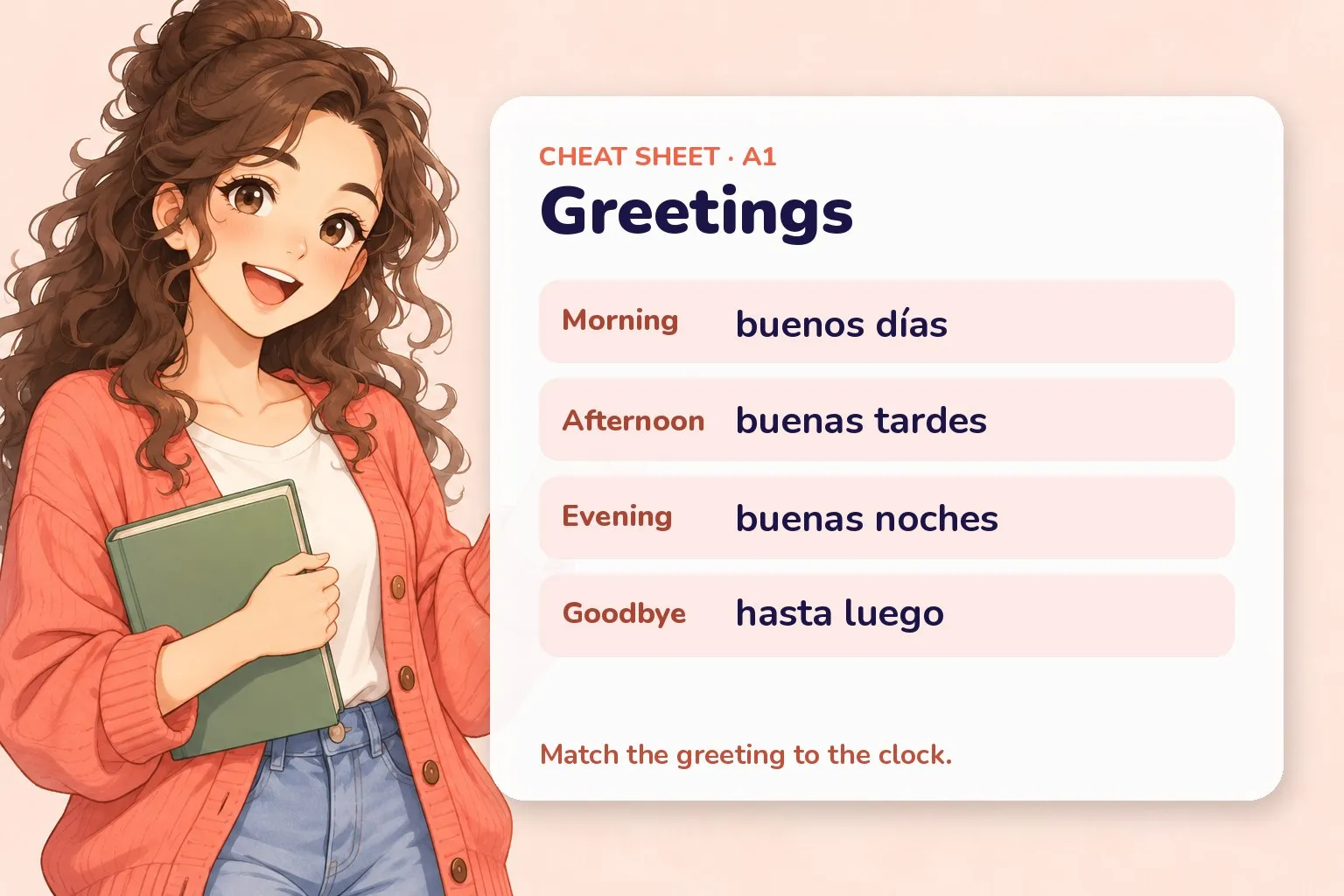
Quick recap before the quiz.
Recap cheat-sheet
| Moment | Spanish | Register |
|---|---|---|
| Any time | Hola | Neutral |
| Morning | Buenos días | Neutral, slightly formal |
| Afternoon | Buenas tardes | Neutral, slightly formal |
| Evening or night | Buenas noches | Neutral, slightly formal |
| Informal how-are-you | ¿Cómo estás? | tú |
| Formal how-are-you | ¿Cómo está usted? | usted |
| Introductions | Me llamo… / Soy… | Neutral |
| Farewell | Hasta luego / Adiós | Neutral |
Next
- Identity sentences with ser and states with estar
- The pronouns behind tú and usted: Spanish subject pronouns
- Question words for the next conversation: Spanish question words
- New here? Start with Start Learning Spanish Here
All Spanish lessons topics
Vocabulary, pronunciation, phrases, practice and exam help, ordered by level. Pick a topic and go straight to it. New lessons go live every day, so topics marked Coming soon fill in over the next weeks.
Lessons
A1 9 topics · 1 ready
- 01 Spanish: Greetings & Introductions You are here
- 02 Spanish: Numbers 0 to 100 Coming soon
- 03 Spanish: Introducing Yourself Coming soon
- 04 Spanish: Days, Months & Dates Coming soon
- 05 Spanish: Telling the Time Coming soon
- 06 Spanish: Giving Personal Information Coming soon
- 07 Spanish: Family Members Coming soon
- 08 Spanish: Colours & Shapes Coming soon
- 09 Spanish: Food & Drink Basics Coming soon
A2 14 topics
- 10 Spanish: Describing People Coming soon
- 11 Spanish: Ordering at a Cafe Coming soon
- 12 Spanish: Shopping & Prices Coming soon
- 13 Spanish: Clothing & Sizes Coming soon
- 14 Spanish: Asking for Directions Coming soon
- 15 Spanish: Using Public Transport Coming soon
- 16 Spanish: At the Hotel Coming soon
- 17 Spanish: Weather & Seasons Coming soon
- 18 Spanish: Hobbies & Free Time Coming soon
- 19 Spanish: Daily Routine Coming soon
- 20 Spanish: Housing & Rooms Coming soon
- 21 Spanish: Parts of the Body Coming soon
- 22 Spanish: Emotions & Feelings Coming soon
- 23 Spanish: Supermarket & Groceries Coming soon
B1 18 topics
- 24 Spanish: Household Chores Coming soon
- 25 Spanish: At the Doctor Coming soon
- 26 Spanish: Making Appointments Coming soon
- 27 Spanish: Making Plans & Invitations Coming soon
- 28 Spanish: Phone & Messaging Coming soon
- 29 Spanish: Expressing Opinions Coming soon
- 30 Spanish: Talking About Past Experiences Coming soon
- 31 Spanish: Future Plans & Goals Coming soon
- 32 Spanish: School & Education Coming soon
- 33 Spanish: Jobs & Professions Coming soon
- 34 Spanish: Money & Banking Coming soon
- 35 Spanish: Restaurant & Dining Out Coming soon
- 36 Spanish: Travel & the Airport Coming soon
- 37 Spanish: Sightseeing & Tourism Coming soon
- 38 Spanish: Emergencies & Safety Coming soon
- 39 Spanish: Technology & the Internet Coming soon
- 40 Spanish: Complaints & Solving Problems Coming soon
- 41 Spanish: Small Talk & Networking Coming soon
B2 10 topics
- 42 Spanish: At the Office Coming soon
- 43 Spanish: The Job Interview Coming soon
- 44 Spanish: Formal Writing & Emails Coming soon
- 45 Spanish: News & Current Affairs Coming soon
- 46 Spanish: Environment & Nature Coming soon
- 47 Spanish: Health & Lifestyle Coming soon
- 48 Spanish: Culture & Traditions Coming soon
- 49 Spanish: Describing Trends & Data Coming soon
- 50 Spanish: Storytelling & Narration Coming soon
- 51 Spanish: Giving a Short Presentation Coming soon
C1 3 topics
- 52 Spanish: Debating & Argumentation Coming soon
- 53 Spanish: Idioms & Colloquialisms Coming soon
- 54 Spanish: Formal vs Informal Register Coming soon