Best Apps to Learn Japanese Compared
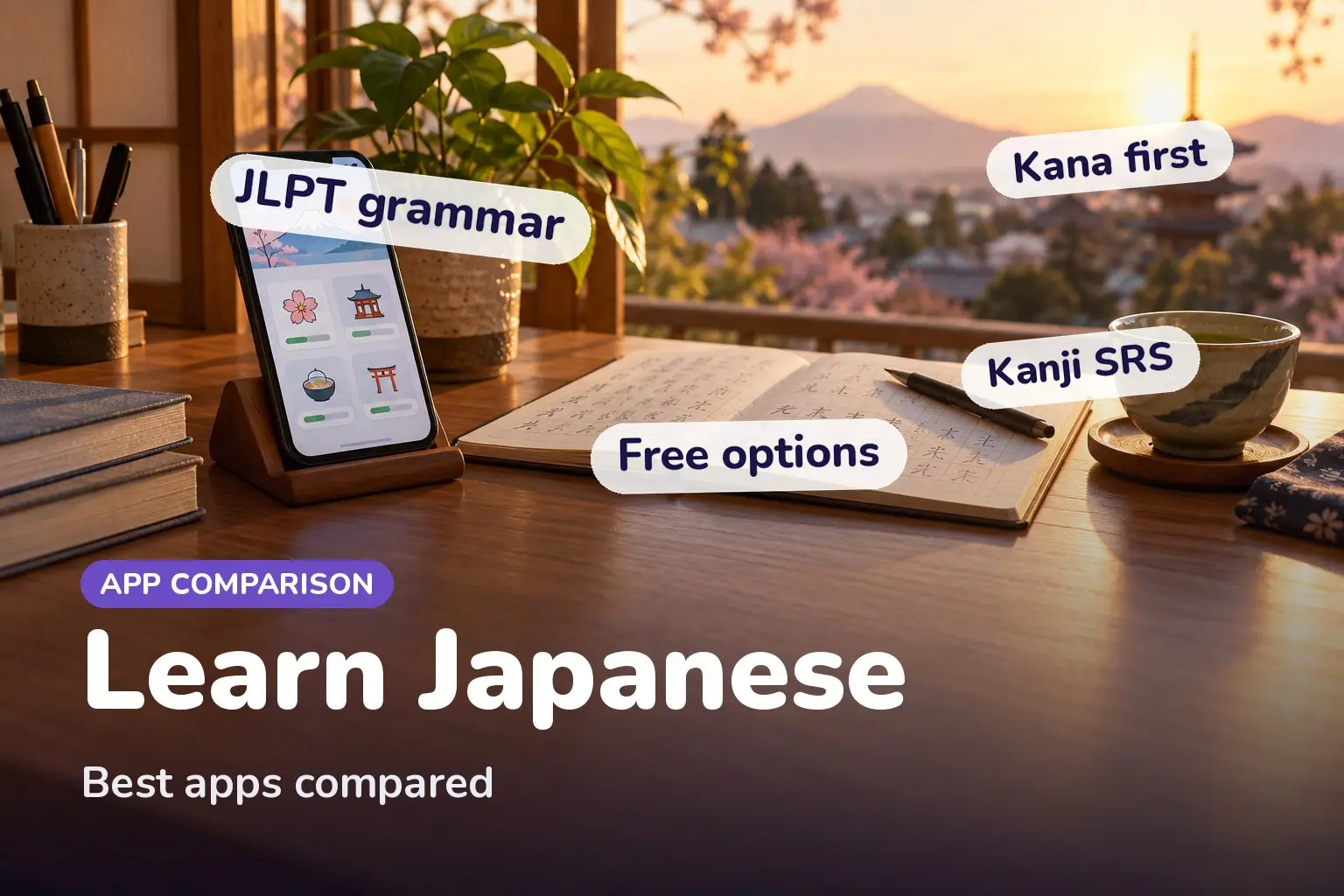
No single app does it all. WaniKani wins for kanji, Bunpro for JLPT grammar, and Duolingo or LingoDeer for a gentle beginner start; Renshuu is the best free all-rounder and Anki the best free flashcard tool.
On this page13 sections · tap to jump
- 01Quick verdict
- 02Duolingo: friendly, gamified start
- 03LingoDeer: a structured grammar course
- 04WaniKani: kanji and vocabulary by SRS
- 05Bunpro: grammar drilling for the JLPT
- 06Anki: free, open-source flashcards
- 07Renshuu: adaptive, generous free tier
- 08Busuu: lessons plus human feedback
- 09Which app wins for what
- 10What they cost
- 11Who should not pick the winner alone
- 12Frequently asked questions
- 13Which app fits you?
Japanese is really three jobs at once: the kana syllabaries, about two thousand kanji, and a grammar system unlike English. No one app is best at all three, so this page names the best tool for each job, based on what each vendor publishes — not an affiliate ranking.
Quick verdict
Start here: a complete beginner should begin with Duolingo or LingoDeer to learn kana and basic sentences in a friendly, structured way. For kanji, the winner is WaniKani; for grammar aimed at the JLPT, the winner is Bunpro. The best free all-rounder is Renshuu, and the best free flashcard tool is Anki (runner-up for custom vocabulary). Most learners end up combining two: one for daily vocabulary and one for kanji or grammar.
Duolingo: friendly, gamified start
Duolingo offers a free Japanese course and is the easiest on-ramp: gamified, bite-sized and free to finish, since its course content is the same for everyone and the paid Super tier only “removes ads”, adds unlimited hearts and personalised practice. It is good for kana, early vocabulary and sentence rhythm, but light on grammar explanation and kanji depth — which is why it pairs well with a dedicated tool below. If you also want a general app comparison, see Duolingo vs Babbel vs Busuu.
LingoDeer: a structured grammar course
LingoDeer is built as “a comprehensive Japanese course designed for English speakers” that teaches “practical Japanese grammar, one step at a time.” Every sentence is voiced by native speakers, it works offline, and the course takes you from A1 to B1. It is more explanatory than Duolingo and a strong paid alternative for someone who wants a guided path rather than a game.
WaniKani: kanji and vocabulary by SRS
For kanji, WaniKani is the specialist. It teaches “~2,000 kanji (both meaning and reading) and 6,000+ Japanese vocabulary words”, pairing every radical, kanji and word with “a hand-crafted mnemonic.” Crucially it uses typed recall — “no multiple choice or self-evaluation allowed” — and a spaced-repetition system, and it claims members reach ~2,000 kanji in one or two years. You level up by getting each level’s kanji to the “Guru” stage.
Bunpro: grammar drilling for the JLPT
For grammar, Bunpro is the standout. It uses “manual-input SRS to truly test your grammar knowledge”, so you produce the grammar rather than just recognising it, and you can study by JLPT level with related grammar compared side-by-side. Its path starts with the copulas だ (da) and です (desu) — “the Japanese equivalents of ‘is’”. Learn those two forms in depth on our desu copula lesson, then drill them in Bunpro.
Anki: free, open-source flashcards
Anki is the free, open-source flashcard engine many Japanese learners build their routine around. It “helps you spend more time on challenging material, and less on what you already know”, syncs free across devices via AnkiWeb, supports audio and images, and handles decks of “100,000+ cards.” It has no Japanese course of its own — you download or build decks — so it rewards learners who like to customise.
Renshuu: adaptive, generous free tier
Renshuu is the best value if you want one app to cover a lot for free. It “can instantly adjust what and how you see Japanese to match your knowledge level, down to each, individual kanji”, and leans on “varied practice, not flipping a card over repeatedly” — covering kanji, vocabulary, grammar, listening and games around one central dictionary. For a learner who wants structure without paying, it is the strongest all-rounder here.
Busuu: lessons plus human feedback
Busuu includes Japanese among its 14 languages and adds something the specialist tools don’t: a free community where “fluent speakers” correct your writing and speaking, plus certificates on its paid plans. It won’t take you as deep on kanji as WaniKani or grammar as Bunpro, but it is a good general course if human feedback matters to you.
Which app wins for what
- Kanji — winner WaniKani (mnemonics + SRS, ~2,000 kanji). Runner-up: Anki with a shared kanji deck, for free.
- JLPT grammar — winner Bunpro (manual-input SRS by JLPT level). Runner-up: LingoDeer’s structured grammar course.
- Absolute beginner / kana — winner Duolingo (free, gamified). Runner-up: LingoDeer for a more guided path.
- Best free all-rounder — winner Renshuu (kanji, vocabulary and grammar, generous free tier). Runner-up: Anki for custom flashcards.
- Human feedback — winner Busuu (free community corrections). Runner-up: LingoDeer’s native-speaker audio (no live feedback).
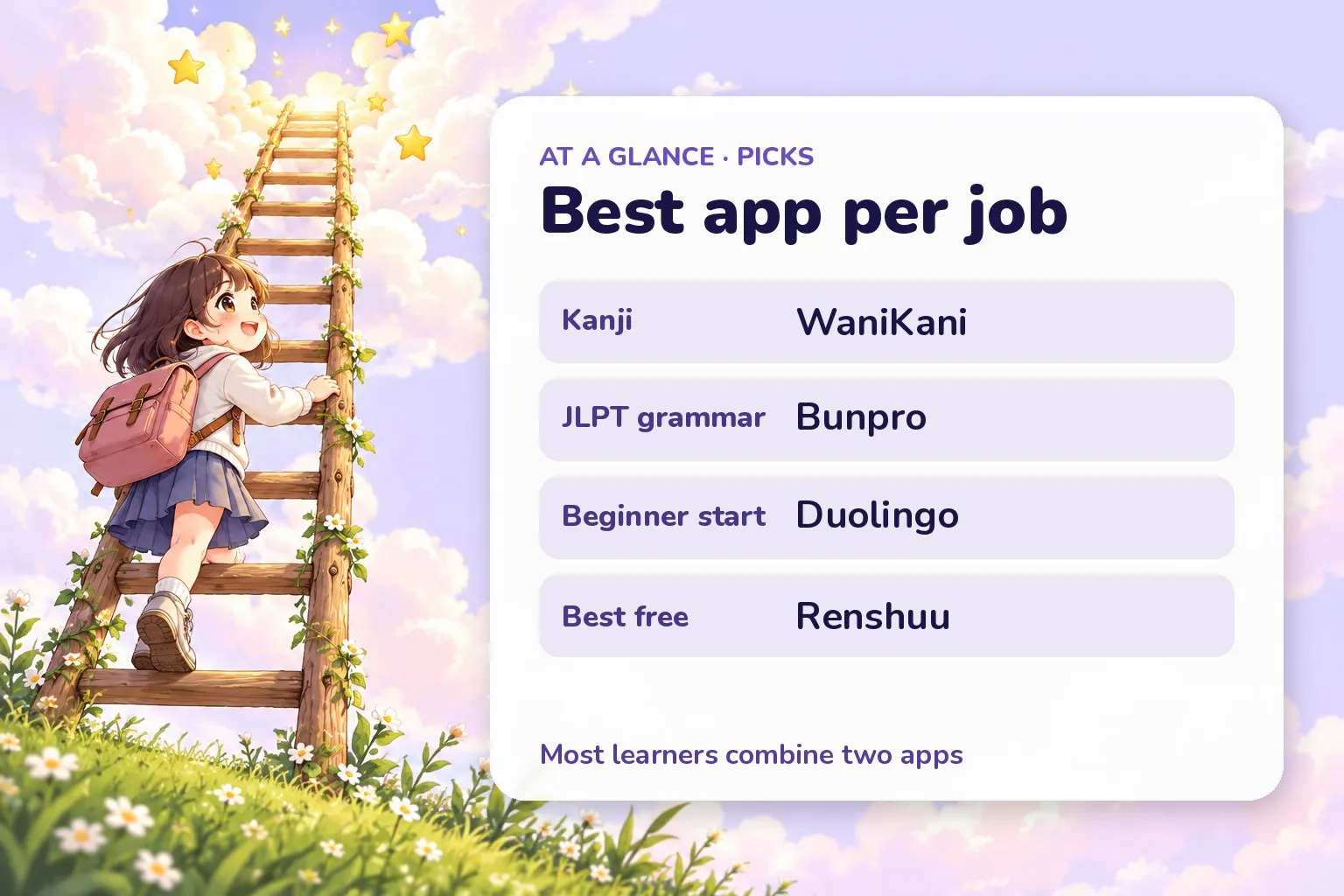
Quick recap before the quiz.
What they cost
Prices change by country and store, so verify on the vendor’s page. One figure we could confirm: Bunpro’s own FAQ lists a 30-day free trial, then Monthly 5.00 USD, Yearly 50.00 USD and Lifetime 150.00 USD (read 2 Nov 2026). Anki is free except its paid iOS app; Renshuu and Duolingo have free tiers; WaniKani, LingoDeer and Busuu publish their own current subscription prices.
Who should not pick the winner alone
No winner here is a complete course by itself. WaniKani teaches kanji but not grammar or conversation; Bunpro teaches grammar but not kanji or speaking; Anki gives you nothing until you add a deck. If you want structure handed to you, start with a course app (Duolingo, LingoDeer or Busuu) and bolt on WaniKani or Bunpro once you can read kana. Build the grammar foundation for free on our Japanese grammar track.
Frequently asked questions
What is the single best app for Japanese? There isn’t one — Japanese splits into kana, kanji and grammar. WaniKani wins kanji, Bunpro wins grammar, and a course app like Duolingo or LingoDeer wins the beginner start.
Can I learn Japanese completely free? Largely yes: Duolingo, Renshuu and Anki (desktop/Android/web) are free, and Busuu has a free tier. Paid tools like WaniKani and Bunpro are optional accelerators.
Do I need kanji from day one? No. Learn hiragana and katakana first, then begin kanji once you can read kana — otherwise the kanji apps are much harder.
Which app is best for the JLPT? Bunpro, because you can study grammar by JLPT level (N5–N1) and it tests production, not just recognition. Pair it with WaniKani for the kanji those levels require.
Which app fits you?
Which Japanese app fits you?
6 questions · pick an answer and you'll see straight away if it's right.
-
Show answer
Duolingo or LingoDeer — Start with a course app for kana and basics before kanji or grammar tools.
-
Show answer
WaniKani — WaniKani is built around ~2,000 kanji with mnemonics and SRS.
-
Show answer
Bunpro — Bunpro lets you study grammar by JLPT level and tests production with manual-input SRS.
-
Show answer
Renshuu — Renshuu's generous free tier covers kanji, vocabulary and grammar together.
-
Show answer
Anki — Anki is a free, open-source flashcard engine you fill with your own or shared decks.
-
Show answer
Grammar and conversation — WaniKani focuses on kanji and vocabulary reading; add a grammar and speaking tool separately.