Duolingo vs Babbel vs Busuu Compared
Duolingo wins for a free, habit-building start and the widest choice of languages; Babbel is the runner-up and best for fast conversational basics; Busuu is best if you want human feedback and a certificate.
On this page10 sections · tap to jump
These three apps dominate “which app should I use” searches, but they are built for different jobs. This page compares them on what each one actually publishes about its languages, free tier, teaching method and pricing — no affiliate ranking, no made-up test scores.
Quick verdict
Overall pick: Duolingo if you want to start today for free and keep a daily habit — its full course content is free for everyone, and it offers the widest range of languages. Runner-up: Babbel, the stronger choice if you want to hold a simple real-life conversation quickly and don’t mind paying. Busuu is the specialist pick when you want your writing and speaking corrected by real people and a certificate at the end.
Languages each app covers
Duolingo lists the largest catalogue — dozens of languages for English speakers, including less commonly taught ones, each shown with a live learner count on its free courses page. Babbel concentrates on a smaller set of widely spoken languages (and splits variants, such as Mexican versus European Spanish, by your display language). Busuu publishes a fixed line-up: its own plans page states you get “all lessons, at all available levels, in 14 different languages.”
So if you want a less common language, Duolingo is often the only one of the three that offers it. For the major European and East Asian languages, all three compete — and the decision comes down to method and budget, not the list.
Duolingo: free, gamified, widest choice
Duolingo’s defining feature is that the whole course is free. Its own help page is explicit: “We offer the same lesson content to all users.” The paid tier, Super Duolingo, does not unlock extra lessons — it only removes ads, gives “Unlimited Hearts” so mistakes don’t stop you, adds personalized practice for your errors, and gives unlimited attempts at Legendary challenges.
The trade-off is depth. Duolingo is excellent at building a daily habit and drilling vocabulary and sentence patterns, but its grammar explanations are light, which is why many learners pair it with a dedicated grammar resource. If you are learning Japanese, see our best apps to learn Japanese comparison for tools that go deeper on kanji and grammar.
Babbel: short lessons built around conversation
Babbel is subscription-first and designed around speaking. Its lessons “only take 15 minutes” and teach “real-life conversations with helpful tips in your native language”, with speech recognition, grammar tips and review sessions synced across devices. Babbel also cites a CUNY study that “15 hours of Babbel are equal to 1 university semester of language courses.”
Because the explanations are in your own language and the dialogues are practical, Babbel tends to get beginners to useful phrases faster than Duolingo’s gamified drills. The cost is that there is no free course to finish — you are on a subscription from the start.
Busuu: lessons plus human feedback
Busuu’s structured courses sit between the two, but its standout feature is the Busuu Community: even on the free tier you can “share language knowledge with other learners and get tips from fluent speakers”, who correct your written and spoken exercises. Its free plan includes the essential course, that community feedback and basic progress tracking.
Paid plans add more. Premium brings grammar and vocabulary review tools, Offline Mode, ad-free learning and Busuu Certificates when you pass a level. Premium Plus adds AI Conversations, pronunciation feedback and exclusive courses. If a shareable certificate or real-human correction matters to you, Busuu is the clear pick of the three.
Which app wins for what
- Complete beginner on a budget — winner Duolingo. The full course is free and the gamified streak keeps you coming back. Runner-up: Busuu, whose free tier still includes lessons plus community feedback.
- Fast conversational basics for a trip — winner Babbel. Fifteen-minute, dialogue-first lessons with native-language tips. Runner-up: Busuu Premium Plus for its AI Conversations and speaking feedback.
- Want corrections from real people — winner Busuu. Its community of fluent speakers reviews your writing and speaking. Runner-up: Babbel, which has speech recognition but no human community.
- A certificate to show progress — winner Busuu (Busuu Certificates on paid plans). Neither Duolingo nor Babbel offers an equivalent built-in certificate.
- A rare or less-common language — winner Duolingo, which lists far more languages than the other two.
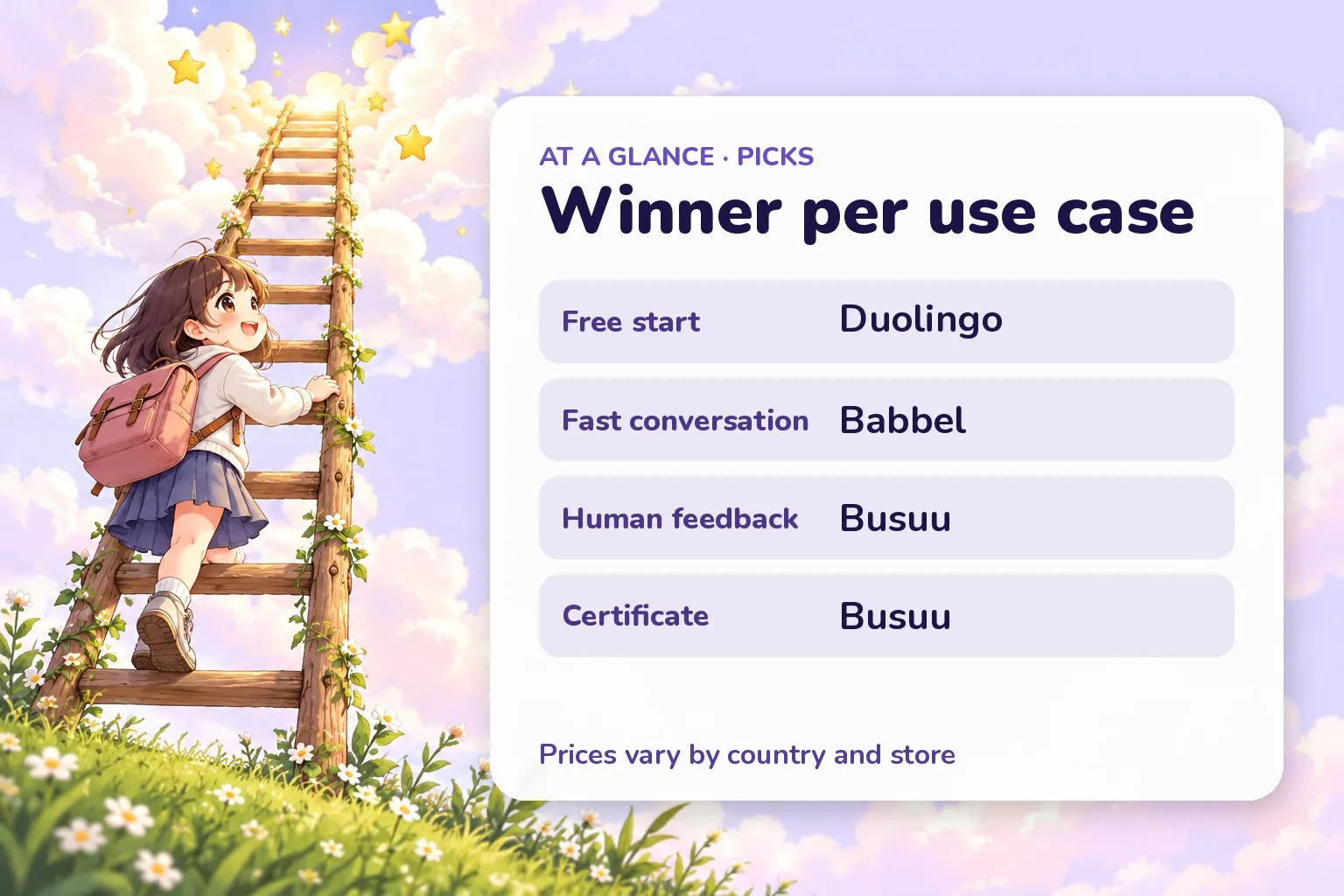
Quick recap before the quiz.
What they cost
All three change prices by country, platform and current promotion, so a single figure here would mislead. Check the live number before you commit:
- Duolingo — the course is free; Super Duolingo is the optional paid add-on (see the Super Duolingo page).
- Babbel — subscription only; see Babbel’s own plans and languages.
- Busuu — Free, Premium and Premium Plus tiers; Busuu states “pricing may vary depending on the platform used, active offers, and your local currency” on its Premium plans page.
Who should not pick Duolingo
Duolingo is the overall pick, but skip it as your main tool if you need deep grammar explanations, want human feedback on your speaking, or need a certificate — those are exactly the gaps Busuu fills, and Babbel’s native-language grammar tips often explain the “why” more clearly. Serious exam candidates usually outgrow all three and move to dedicated, exam-focused resources. Browse the structured lessons on our Japanese, Korean and French tracks when you want that depth for free.
Frequently asked questions
Can I use more than one of these together? Yes, and many learners do: Duolingo for daily habit and vocabulary, plus Babbel or Busuu for conversation and grammar. There is no reason to pick only one.
Is Duolingo enough to become fluent? On its own, usually not. It is strong for building vocabulary and a habit, but thin on grammar and real conversation, so pair it with grammar study and speaking practice.
Which gives the best speaking practice? Busuu (community feedback, and AI Conversations on Premium Plus) and Babbel (speech recognition and conversation-first lessons) are both stronger for speaking than Duolingo.
Do any of them give an official qualification? Busuu issues its own Busuu Certificates on paid plans, but none of the three replaces a recognised external exam such as a CEFR-aligned test.
Which app fits you?
Which app fits you?
6 questions · pick an answer and you'll see straight away if it's right.
-
Show answer
Duolingo — Duolingo's full course is free for everyone; Super only removes ads and adds conveniences.
-
Show answer
Babbel — Babbel's 15-minute, dialogue-first lessons target practical conversation.
-
Show answer
Busuu — Only Busuu has a built-in community of fluent speakers who give feedback.
-
Show answer
Busuu — Busuu issues Busuu Certificates on its paid plans when you pass a level.
-
Show answer
Duolingo — Duolingo lists far more languages, including rarer ones, than the other two.
-
Show answer
No ads and unlimited hearts — Course content is the same for all; Super removes ads and adds unlimited hearts and personalised practice.