How to Practise Arabic Writing
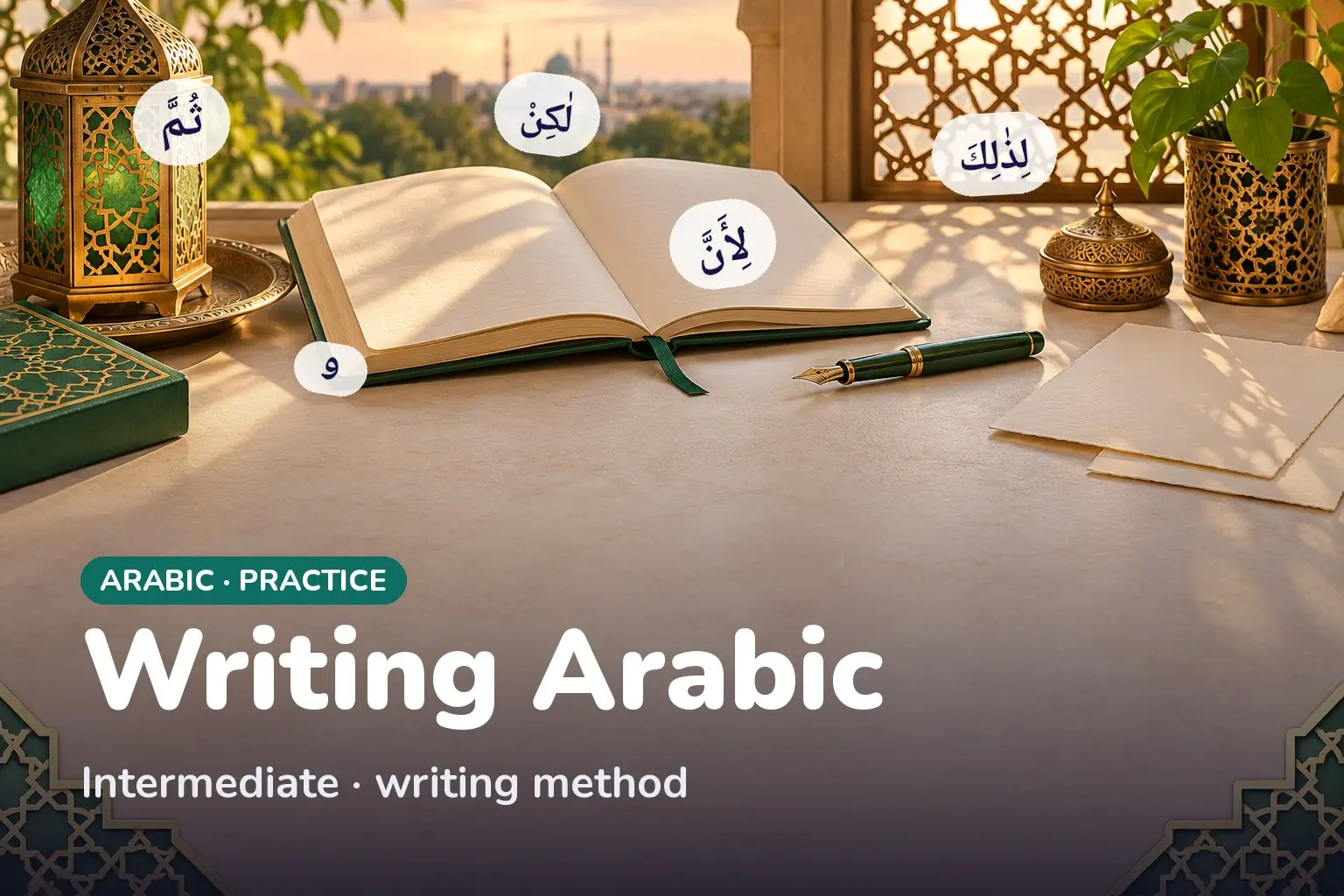
Practise Arabic writing by starting with short sentences you can already say, joining them into paragraphs with connectors like و (wa, and) and ثُمَّ (thumma, then), then checking each piece against a model answer and rewriting it.
Level: intermediate. Writing is the skill most learners skip, because it is slow and nobody is watching. That is exactly why it is worth doing: putting Arabic on the page forces you to commit to word order, gender agreement and connectors in a way that speaking lets you blur. This page gives you a repeatable method rather than a pile of prompts.
By the end of this page you can…
…run a short Arabic writing session on your own: build from single sentences to a paragraph, join ideas with the right connectors, and check your work against a model instead of guessing.
Start with sentences you can already say
Do not open a blank page and try to write a paragraph. Start with one sentence built from words and patterns you already control. If you can say it, you can usually write it — the new effort is spelling the connected letters correctly and getting the agreement right.
Write three or four separate sentences on one small topic: your morning, your room, your city. Keep each short and true. Only then do you join them.
Join sentences with connectors
The jump from “sentences” to “writing” is made with connectors (adawāt ar-rabṭ). You only need a small set to sound coherent:
- و (wa) — and
- ثُمَّ (thumma) — then / after that
- لٰكِنْ (lākin) — but
- لِأَنَّ (li-anna) — because
- لِذٰلِكَ (li-dhālika) — so / therefore
With these five you can sequence events, give a reason and show a contrast — the backbone of any short paragraph. Build the model paragraph below one line at a time, reading each aloud.
Example sentences
- أَسْتَيْقِظُ فِي السَّابِعَةِ صَبَاحًا.astayqiẓu fī s-sābiʿati ṣabāḥan.I wake up at seven in the morning.
- ثُمَّ أَشْرَبُ القَهْوَةَ.thumma ashrabu l-qahwata.Then I drink coffee.thumma sequences the next action
- أُحِبُّ الصَّبَاحَ لِأَنَّهُ هَادِئٌ.uḥibbu ṣ-ṣabāḥa li-annahu hādiʾun.I like the morning because it is quiet.li-anna gives a reason
- أُرِيدُ أَنْ أَكْتُبَ، لٰكِنْ لَا وَقْتَ لَدَيَّ.urīdu an aktuba, lākin lā waqta ladayya.I want to write, but I have no time.lākin shows contrast
- أَتَمَرَّنُ كُلَّ يَوْمٍ، لِذٰلِكَ تَحَسَّنَتْ كِتَابَتِي.atamarranu kulla yawmin, li-dhālika taḥassanat kitābatī.I practise every day, so my writing has improved.li-dhālika shows a result
- أَكْتُبُ جُمْلَةً وَاحِدَةً، ثُمَّ أَقْرَأُهَا بِصَوْتٍ عَالٍ.aktubu jumlatan wāḥidatan, thumma aqraʾuhā bi-ṣawtin ʿālin.I write one sentence, then read it aloud.
- كِتَابَتِي بَطِيئَةٌ، لٰكِنَّهَا صَحِيحَةٌ.kitābatī baṭīʾatun, lākinnahā ṣaḥīḥatun.My writing is slow, but it is correct.
- أُرَاجِعُ النَّصَّ غَدًا مَرَّةً أُخْرَى.urājiʿu n-naṣṣa ghadan marratan ukhrā.I will review the text again tomorrow.
Build a feedback loop
Writing you never check just rehearses your mistakes. After each short piece, run a quick loop:
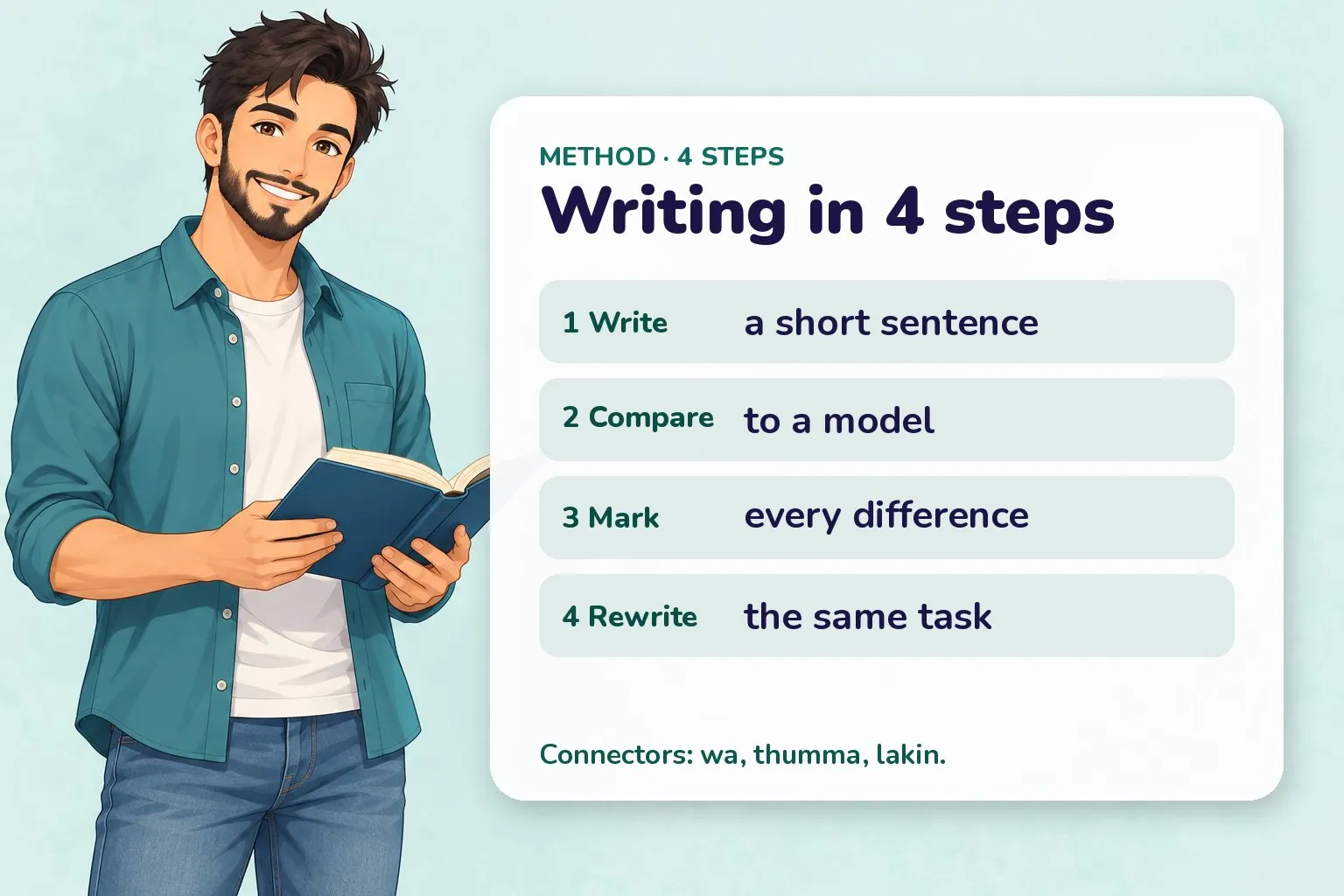
- Write the sentence or paragraph from the task.
- Compare it to a model — a lesson example, a graded reader, or a corrected version.
- Mark every difference: a wrong ending, a missing connector, a dropped ة (tā marbūṭa).
- Rewrite the same task, fixing what you marked. The second attempt is where learning happens.
Write to model answers
A model answer is a short, correct text that does the task you are attempting. Read it first, cover it, write your own version, then uncover it and compare. Our reading practice passages and the sentences in each grammar lesson make good models because they are short and verified. For the sound side of the same words, pair writing with shadowing so you can say what you write.
Pull the words you reuse from a frequency list so your practice centres on high-value vocabulary rather than rare words you will rarely need.
Quick recap before you practise.
Practice
Arabic writing method practice
Try each one, then press Check. No sign-up, nothing is sent anywhere — it all runs in your browser.
Hint: it links one step to the next
Show answer
thumma — ثُمَّ (thumma) means 'then / after that'.
4 Put the feedback loop in order.
Show answer
write the sentence compare to a model mark the differences rewrite the task — Write, compare, mark, rewrite — the second attempt is where you learn.
5 Match each connector to its job.
- و (wa)
- لٰكِنْ (lākin)
- لِذٰلِكَ (li-dhālika)
- لِأَنَّ (li-anna)
Show answer
- و (wa) → and
- لٰكِنْ (lākin) → but
- لِذٰلِكَ (li-dhālika) → so / therefore
- لِأَنَّ (li-anna) → because
wa = and, lākin = but, li-dhālika = so, li-anna = because.
Quiz
Arabic writing practice quiz
8 questions · pick an answer and you'll see straight away if it's right.
-
Show answer
it forces you to commit to word order and agreement — Writing makes you pin down choices that speaking lets you blur.
-
Show answer
connectors — Connectors sequence, contrast and give reasons, turning sentences into writing.
-
Show answer
لٰكِنْ (lākin) — لٰكِنْ (lākin) means 'but'.
-
Show answer
comparing to a model and rewriting the task — Comparing to a model and rewriting is where the improvement comes from.
-
Show answer
one, the one you make most — Fix one recurring error at a time, then move to the next.
-
Show answer
a short, correct text that does the same task — Short, correct, on-task models are easiest to learn from.
-
Show answer
a frequency list of common words — High-frequency words give the most useful practice.
-
Show answer
when the word's vowelling is what you are practising — Keep them optional, but add them when the vowelling is the point of the exercise.
Next
- Read short model texts in Arabic reading practice
- Say what you write with shadowing practice
- New here? Start with Start Learning Arabic Here
All Arabic practice topics
Vocabulary, pronunciation, phrases, practice and exam help, ordered by level. Pick a topic and go straight to it. New lessons go live every day, so topics marked Coming soon fill in over the next weeks.
Practice
Beginner 1 topics · 1 ready
Elementary 3 topics · 2 ready
- 02 How to Practise Arabic Listening
- 03 Arabic Reading Practice: Elementary
- 04 Idafa (Possessive Construction) Practice Coming soon
Intermediate 3 topics · 3 ready
- 05 Shadowing to Improve Arabic Speaking
- 06 Arabic Reading Practice: Intermediate
- 07 How to Practise Arabic Writing You are here