Indonesian Spelling (EYD) and Stress Explained
Indonesian spelling under the official EYD rules is almost perfectly phonetic — you write words the way you say them. Stress is light and usually falls on the second-to-last syllable, and it never changes a word's meaning, so getting it slightly wrong is rarely a problem.
Level: Elementary. Here is the best news a new learner of Indonesian can hear: the spelling is almost completely regular. Learn the value of each letter once and you can read any word aloud. This page covers the official spelling system, where to put stress, and how foreign words are respelled.
By the end of this page you can…
…read Indonesian words aloud with confidence, place the light word stress correctly, tell the two sounds of the letter e apart, and recognise how loanwords are adapted to Indonesian spelling.
What EYD means
EYD stands for Ejaan Bahasa Indonesia yang Disempurnakan — “the Perfected Spelling of the Indonesian Language”. It is the official spelling standard, set by the national language agency (Badan Bahasa). The current version is EYD Edition V (Edisi Kelima), issued in 2022, which restored the name EYD after a period when the same rules were called PUEBI.
For a learner, the practical point is simple: Indonesian is written in the ordinary Latin alphabet and is near-phonetic. Each letter has one main sound, so once you know the alphabet you can pronounce words you have never seen.
The one letter to watch: e
The single spelling point that trips up beginners is the letter e, which stands for two different sounds that are written the same way:
- A plain “eh” (like the e in bed): sore (“evening”), meja (“table”), enak (“tasty”).
- A soft, unstressed schwa “uh” (like the a in sofa): besar (“big”), empat (“four”), kenal (“to know”).
The spelling gives no clue which is which — you learn it with each word. (Dictionaries sometimes mark the plain sound as é, but everyday writing does not.)
Where the stress goes
Indonesian stress is light and even. Where a word does have a slightly stronger syllable, it is normally the penultimate — the second-to-last — syllable: MA-kan (“to eat”), be-SAR (“big”), se-LA-mat (“safe / congratulations”).
Two things make this easy to live with:
- Stress never changes meaning. No two Indonesian words are told apart by stress alone, so a wrong guess is not a real error.
- The schwa pulls stress away. If the penultimate syllable has the soft e (schwa), the stress tends to slide to the last syllable: be-SAR, ke-NAL.
So the honest advice is: keep the syllables roughly equal, lean gently on the second-to-last one, and don’t worry about it the way you would in English or Russian.
How loanwords are spelled
EYD adapts foreign words to Indonesian sounds and spelling rather than keeping the original look. A few reliable patterns:
- English -ty / -ity becomes -tas: activity → aktivitas, quality → kualitas, university → universitas.
- c (as “k”) and qu become k / ku: quality → kualitas, system → sistem.
- -tion becomes -si: information → informasi, action → aksi.
- The letters f, v, z are kept in modern spelling: aktif, vitamin, zona (older spelling once wrote them as p, f or j).
| English | Indonesian | Pattern |
|---|---|---|
| activity | aktivitas | -ity to -tas |
| quality | kualitas | qu to ku, -ity to -tas |
| system | sistem | c/y respelled |
| information | informasi | -tion to -si |
| television | televisi | -sion to -si |
| active | aktif | -ive to -if |
How to say it
- e (plain) — “eh” as in bed: meja (“table”) ≈ “MEH-ja”.
- e (schwa) — soft “uh” as in sofa: besar (“big”) ≈ “buh-SAR”.
- c — always “ch” as in church: cinta (“love”) ≈ “CHIN-ta”.
- stress — a light push on the second-to-last syllable; every syllable stays clear.
Example words
- makanto eatplain a; even syllables
- besarbigschwa e: 'buh-SAR'
- empatfourschwa e at the start
- mejatableplain e: 'MEH-ja'
- soreeveningplain e
- enaktastyplain e; final k is a soft stop
- kenalto know (a person)schwa e
- selamatsafe / congratulationsstress on second-to-last
- cintalovec = 'ch'
- aktivitasactivityloanword: -ity to -tas
- kualitasqualityloanword: qu to ku
- sistemsystemloanword respelled
- informasiinformation-tion to -si
- televisitelevision-sion to -si; v kept
- aktifactive-ive to -if; f kept
- zonazonez kept in modern spelling
A worked example: reading a new word
Take perpustakaan (“library”), a word you may never have met. Break it into syllables — per-pus-ta-ka-an — give each its plain letter value, use the schwa for the first e, and lean lightly on the second-to-last syllable: “per-pus-ta-KA-an”. No silent letters, no surprises. That is the whole system at work.
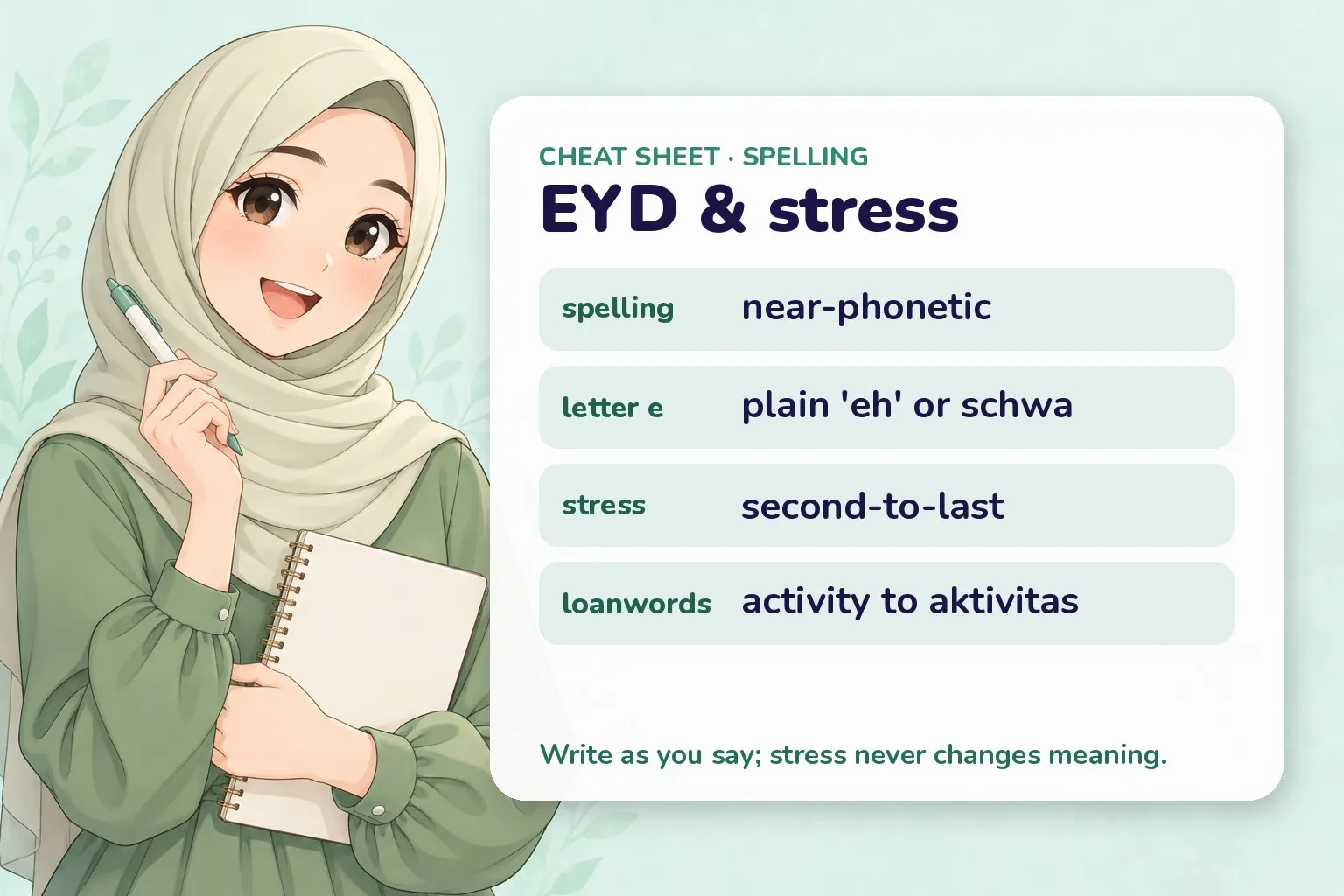
Quick recap before the quiz.
Practice
Indonesian spelling and stress practice
Try each one, then press Check. No sign-up, nothing is sent anywhere — it all runs in your browser.
Hint: the penultimate
Show answer
second — Stress is light and normally on the penultimate (second-to-last) syllable.
4 Match each English word to its Indonesian spelling.
- activity
- quality
- system
- information
Show answer
- activity → aktivitas
- quality → kualitas
- system → sistem
- information → informasi
EYD adapts loanwords: -ity to -tas, qu to ku, -tion to -si.
Hint: cinta
Show answer
in — c = 'ch', so cinta sounds like 'CHIN-ta'.
Quiz
Indonesian EYD spelling and stress
10 questions · pick an answer and you'll see straight away if it's right.
-
Show answer
near-phonetic — Indonesian is written in Latin letters and is near-phonetic.
-
Show answer
two sounds (plain 'eh' and schwa 'uh') — e can be a plain 'eh' (meja) or a schwa 'uh' (besar), unmarked in spelling.
-
Show answer
the second-to-last syllable — Light stress normally sits on the penultimate syllable.
-
Show answer
rarely matters, as stress is not meaning-distinguishing — Stress does not tell words apart in Indonesian.
-
Show answer
move to the last syllable — A penultimate schwa pulls the stress to the final syllable (besar).
-
Show answer
aktivitas — The -ity ending becomes -tas: aktivitas.
-
Show answer
informasi — The -tion ending becomes -si: informasi.
-
Show answer
It keeps the letters f, v and z — EYD V keeps f, v and z, which older spelling once replaced.
-
Show answer
like English 'ch' — c is always 'ch' as in church: cinta = 'CHIN-ta'.
-
Show answer
Badan Bahasa (the national language agency) — Badan Bahasa issues the EYD standard; EYD V dates from 2022.
Next
- Learn the letters first: the Indonesian alphabet
- The vowel sounds in detail: Indonesian vowels
- The tricky consonants c, ng, ny: Indonesian consonants and digraphs
- See the whole sound system: Indonesian pronunciation overview
All Indonesian pronunciation & writing topics
Vocabulary, pronunciation, phrases, practice and exam help, ordered by level. Pick a topic and go straight to it. New lessons go live every day, so topics marked Coming soon fill in over the next weeks.
Pronunciation & writing
Beginner 4 topics · 4 ready
Elementary 1 topics · 1 ready
- 05 Indonesian Spelling (EYD) & Stress You are here