Indonesian Consonants and Digraphs (c, ng, ny)
Most Indonesian consonants sound like English, with three traps: c is always the ch in church, g is always hard, and the digraphs ng, ny, sy and kh each spell a single sound. A final k is often swallowed into a glottal stop.
Level: Beginner. Indonesian uses the same 26 Latin letters as English, and most consonants sound almost exactly as you expect. The whole job of this page is the handful that differ: the letter c, the hard g, and four digraphs — two letters that spell one sound — ng, ny, sy and kh. Learn these and Indonesian becomes remarkably easy to read aloud.
By the end of this page you can…
…pronounce c, g and the digraphs ng, ny, sy and kh, recognise a digraph as a single sound, and hear the glottal stop that often ends a word spelled with final k.
The consonants that trip up English speakers
A digraph is a pair of letters that together stand for one sound — like English “sh” or “ch”. Indonesian has four, plus two single letters worth a special note.
| Letter | Sound (like) | Example |
|---|---|---|
| c | “ch” in church | cinta (love) |
| g | always hard “g” in go | gula (sugar) |
| j | “j” in jam | jalan (road) |
| ng | “ng” in sing | bangun (to wake) |
| ny | “ny” in canyon / Spanish ñ | nyamuk (mosquito) |
| sy | “sh” in ship | syarat (condition) |
| kh | the rasping “ch” in loch | khusus (special) |
The key mental switch: c is never “k” or “s”. The city Cirebon is “chee-re-bon”, and cuci (to wash) is “choo-chee”.
ng at the start of a word
English only uses “ng” in the middle or at the end of a word (singer, long). Indonesian happily puts it at the start: ngarai (canyon), nganga (to gape). To make it, start to say “sing” but stop before the “s” — you want only the final nasal, then open into the vowel.
The glottal stop: final k
At the end of a word, k is usually not released as a full “k”. Instead the throat closes briefly — a glottal stop, the catch in the middle of English “uh-oh”. So bapak (father) ends in a soft catch, roughly “BA-pa’”, and tidak (no) sounds like “TEE-da’”. The spelling keeps the k; the sound is the stop.
How to say it
- c — “ch” in church, every time: cuci ≈ “CHOO-chee”.
- g — hard “g” in go, never soft: gigi (tooth) ≈ “GEE-gee”.
- ng — one nasal glide, as in sing; can open a word: bunga ≈ “BOO-nga”.
- ny — the ny in canyon, a single soft sound: nyonya (madam) ≈ “NYON-ya”.
- kh — a rasp at the back of the mouth, like loch: akhir (end) ≈ “A-khir”.
- final k — a throat catch, not a full k: anak (child) ≈ “A-na’”.
Example words
- cintalovec = ch: 'CHEEN-ta'
- cucito washboth c's are ch
- kucingcatc = ch, and ng glides
- gulasugarhard g
- jalanroad / to walkj as in jam
- bangunto wake / buildng as in sing
- bungaflowerlet the ng glide, not boon-ga
- uangmoneyng closes the word
- nyamukmosquitony as in canyon
- nyonyamadam / Mrstwo ny sounds
- banyakmany / a lotny in the middle
- syaratcondition / requirementsy = sh
- khususspecialkh rasp at the start
- akhirendkh in the middle
- bapakfather / sirfinal k = glottal stop
- tidakno / notfinal k barely released
- anakchildends in a throat catch
- ngeriscaryword-initial ng
Why this makes reading easy
Indonesian is written almost exactly as it is said: one letter (or digraph) to one sound, with no silent letters and no surprise vowels. Once you have fixed c, the hard g, and the four digraphs, you can look at a brand-new word — a street sign, a menu, a name — and say it correctly on the first try.
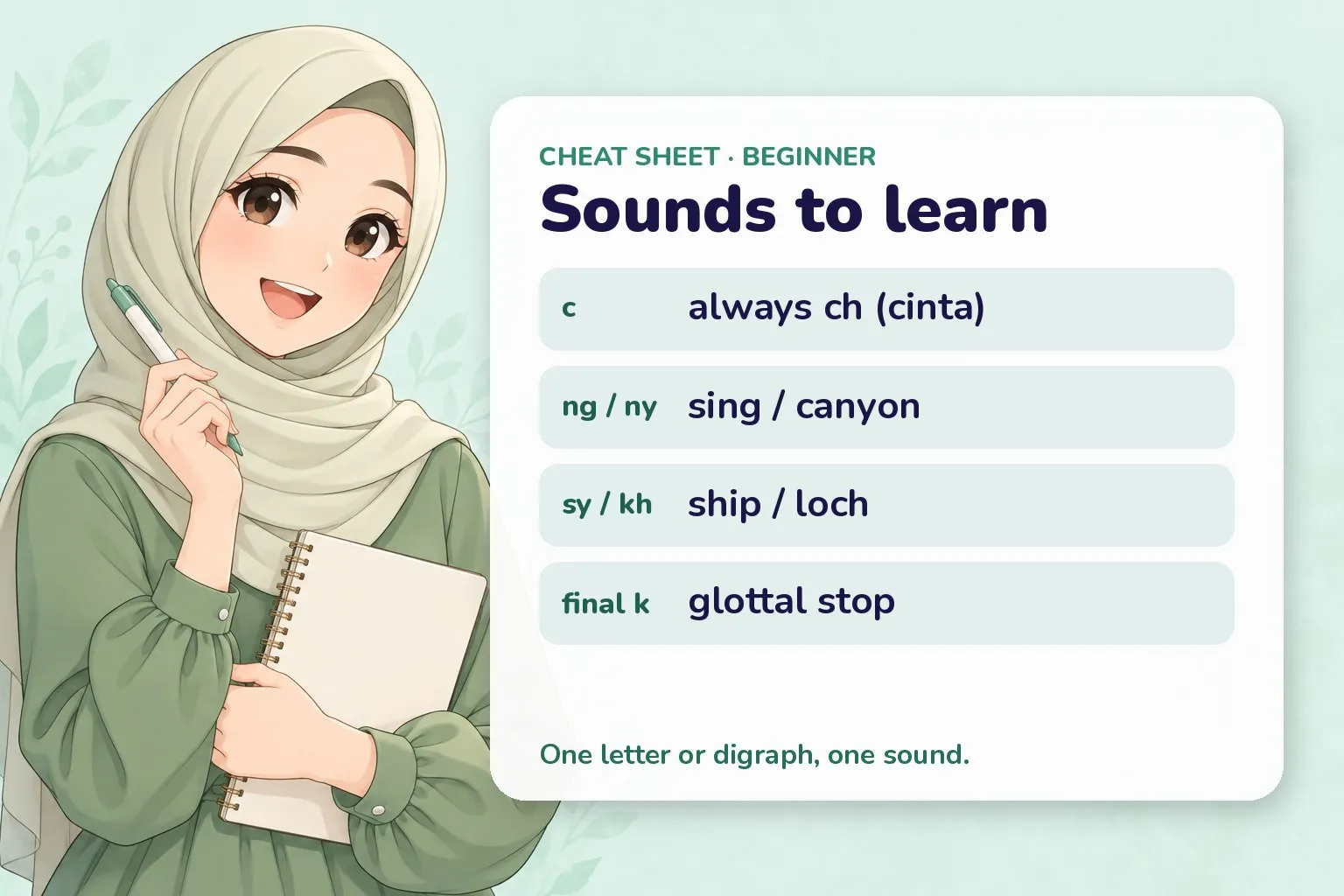
Quick recap before the quiz.
Practice
Indonesian consonants practice
Try each one, then press Check. No sign-up, nothing is sent anywhere — it all runs in your browser.
Hint: nyamuk
Show answer
ny — ny spells the soft sound in canyon / Spanish ñ.
3 Match each digraph to its sound.
- ng
- ny
- sy
- kh
Show answer
- ng → sing
- ny → canyon
- sy → ship
- kh → loch
ng = sing, ny = canyon, sy = sh, kh = the loch rasp.
Quiz
Indonesian consonants and digraphs
10 questions · pick an answer and you'll see straight away if it's right.
-
Show answer
like ch in church — c = 'ch' in every word: cinta, cuci, Cirebon.
-
Show answer
hard, like go — g is always the hard g in go.
-
Show answer
Four — Four: ng, ny, sy and kh.
-
Show answer
the ng in sing — ng is one nasal glide, as in sing.
-
Show answer
the ny in canyon — ny is the single soft sound in canyon / Spanish ñ.
-
Show answer
sh in ship — sy = 'sh', as in syarat.
-
Show answer
a glottal stop — Final k becomes a glottal stop — the catch in uh-oh.
-
Show answer
It can start a word — Unlike English, ng can begin a word, as in ngarai.
-
Show answer
Arabic — kh (khusus) and sy (syarat) come mainly from Arabic loanwords.
-
Show answer
'CHOO-chee' — Both c's are 'ch': 'CHOO-chee'.
Next
- Spell it out first: the Indonesian alphabet
- The vowels behind the consonants: Indonesian vowels
- See the whole sound system: Indonesian pronunciation overview
- New here? Start Learning Indonesian Here
All Indonesian pronunciation & writing topics
Vocabulary, pronunciation, phrases, practice and exam help, ordered by level. Pick a topic and go straight to it. New lessons go live every day, so topics marked Coming soon fill in over the next weeks.
Pronunciation & writing
Beginner 4 topics · 4 ready
- 01 Indonesian Pronunciation Overview
- 02 The Indonesian Alphabet
- 03 Indonesian Vowels & Diphthongs
- 04 Indonesian Consonants & Digraphs You are here